Revenue cycle management dental (dental RCM) is the process of managing every financial step of a patient visit, from the call that books the appointment to the last dollar collected from the insurer and the patient. It covers scheduling, insurance verification, coding, claim submission, payment posting, denial follow-up, and patient billing. When these steps run well, your practice gets paid faster and loses less to errors.
Dentistry makes this harder than most specialties. Almost every visit produces two payers, a dental plan and the patient, and each plan has its own limits, waiting periods, and rules. A mistake at the front desk on Monday often shows up as an unpaid claim six weeks later.
This article explains why dental RCM matters, walks through the nine steps of the cycle, shows which numbers tell you whether it is healthy, and helps you decide whether to run it in-house or outsource it. InfiniteRCM provides revenue cycle services to healthcare providers, so the outsourcing section comes from the billing side of the desk.
Why dental revenue cycle management matters for cash flow
Dental revenue cycle management matters because revenue is earned in the chair but only becomes cash after a long chain of handoffs. Each handoff is a place where money gets delayed or lost, and small leaks add up across hundreds of claims a month.
Where dental practices lose money
Most losses trace back to a handful of causes:

- Eligibility surprises: a patient has hit their annual maximum, is inside a waiting period, or has a frequency limit on the procedure.
- Coding and documentation gaps: wrong or outdated codes, or missing X-rays, narratives, or perio charting.
- Denials nobody works: a denied claim that is never corrected or appealed is written off by default.
- Patient balances: the patient portion is not collected at the visit, and each later statement costs more to chase.
Most dental revenue is not lost to bad dentistry. It is lost to claims that nobody checked, corrected, or followed up.
What a healthy cycle gives you
A tight revenue cycle gives you predictable cash flow and fewer surprises when a patient asks what they owe. It also frees your front desk from spending afternoons on hold with payers. Your team can spend that time on scheduling and patient conversations, which fill the chair. The practice does not do more dentistry to earn more. It collects more of what it already produced.
The nine steps of dental RCM from scheduling to collections
The dental revenue cycle has nine steps, and they run in three stages: before the visit, from treatment to claim, and after the claim goes out. Skipping any one of them shows up later as a denial or an aging balance.
Steps 1 to 3: before the patient sits down
- Scheduling and registration: capture accurate demographics, subscriber details, and plan information.
- Eligibility and benefits verification: confirm active coverage, remaining annual maximum, deductible, waiting periods, and frequency limits.
- Treatment planning and cost estimates: present the patient’s share before treatment. For major work, request a predetermination from the plan.

Verification is the cheapest fix in the whole cycle. Checking benefits takes minutes, and a denial can take weeks to resolve.
Steps 4 and 5: from chair to claim
- Charge capture and coding: assign the correct procedure codes. Dental practices use the ADA’s Current Dental Terminology (CDT) codes, not the CPT and ICD codes some general RCM guides emphasize.
- Claim submission: send a clean claim electronically with the required attachments, ideally within a day or two of the visit.
Steps 6 to 9: after the claim goes out
- Payment posting: match each insurer payment and patient payment to the right account and adjust for write-offs.
- Denial management and AR follow-up: correct, resubmit, or appeal rejected and underpaid claims, and chase anything that has aged.
- Patient billing and collections: send clear statements, offer payment options, and follow up on balances.
- Reporting and analysis: review your key numbers monthly and trace problems to their source step.
Fix the front end first. Steps 1 to 3 prevent more lost revenue than steps 7 and 8 ever recover.
Dental RCM metrics that show if your cycle is healthy
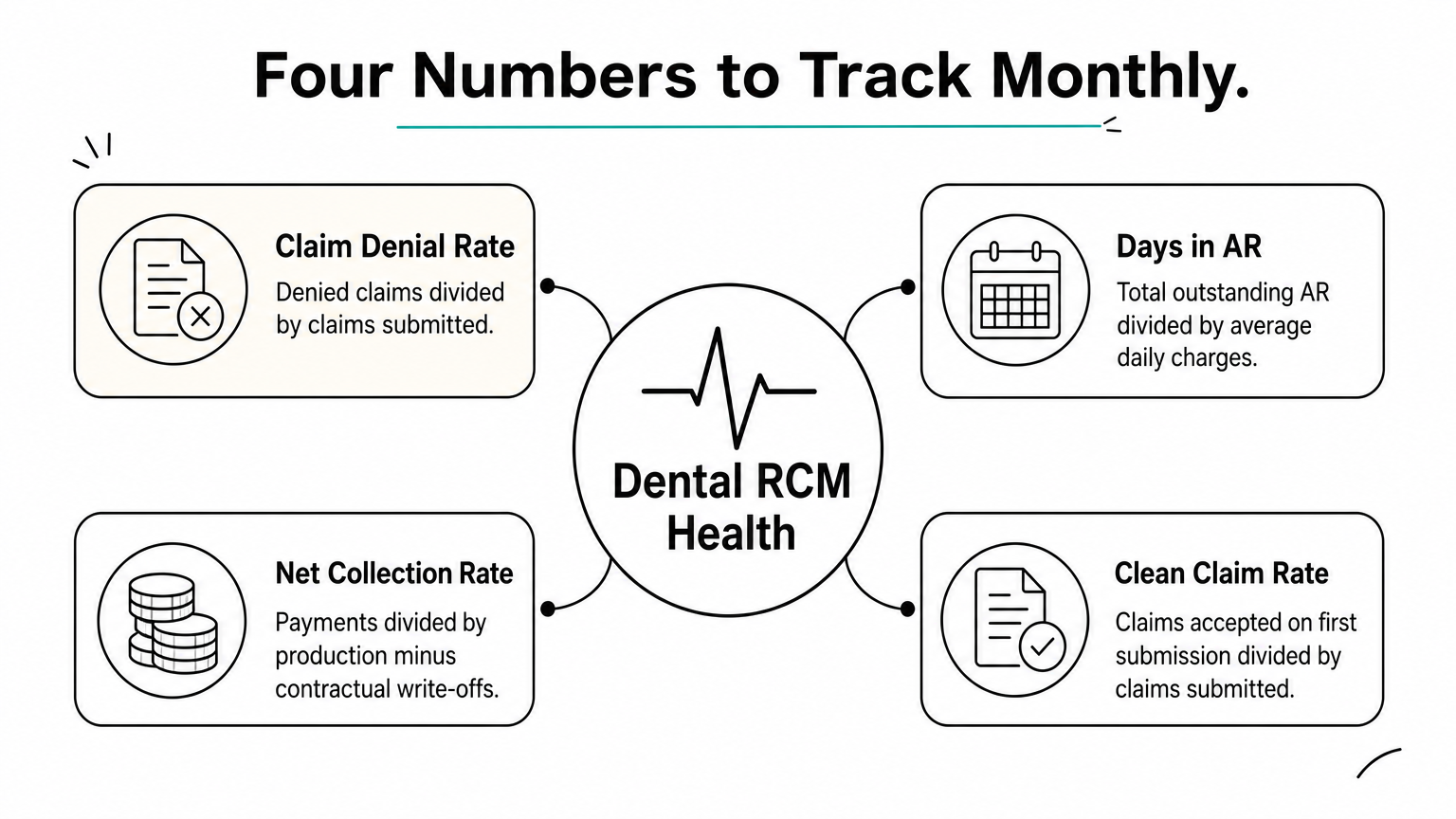
Four numbers tell you most of what you need to know about your revenue cycle, and you can calculate all of them from your practice management system’s reports. Review them monthly and by payer, because averages hide the one plan that is causing problems.
Four numbers to track
| Metric | How to calculate it | What it tells you |
|---|---|---|
| Claim denial rate | Denied claims ÷ claims submitted | How clean your claims are. Many practices aim for under 5%. |
| Days in AR | Total outstanding AR ÷ average daily charges | How fast money comes in. Lower is better. |
| Net collection rate | Payments ÷ (production minus contractual write-offs) | How much collectible revenue you actually collect. Many practices aim for 98% or higher. |
| Clean claim rate | Claims accepted on first submission ÷ claims submitted | How well your front end and coding work. |
A worked example
Say your practice produces $100,000 in a month and contractual write-offs total $20,000, so $80,000 is collectible. You collect $77,600. Your net collection rate is 77,600 ÷ 80,000, or 97%. That sounds fine, but it means $2,400 left that month, and the same gap repeats every month.
Now say you submitted 400 claims and 28 were denied. Your denial rate is 7%. If your AR balance is $60,000 and you charge $2,000 a day on average, your days in AR is 30. Those three figures together tell you where to look: denials first.
Mistakes that quietly drain revenue
- Verifying benefits only for new patients, when plans and maximums change for existing ones too.
- Submitting claims in weekly batches, which delays payment and hides errors.
- Letting denials sit past the payer’s appeal or resubmission deadline.
- Skipping attachments such as X-rays and narratives on crowns, scaling and root planing, or other procedures that need them.
- Ignoring underpayments, where the plan pays less than your contracted fee.
If you cannot name your denial rate and days in AR today, you are managing your revenue cycle by guesswork.
Should you outsource dental RCM or keep it in-house?
Outsource when billing work is outgrowing your team’s time or expertise. Keep it in-house when you have a skilled biller, low denial rates, and enough volume to justify the salary. Many practices land somewhere in between, handing off the hardest parts while the front desk keeps patient-facing work.
How the two options compare
| Factor | In-house | Outsourced dental RCM services |
|---|---|---|
| Cost structure | Fixed salary and benefits | Typically scales with collections or workload |
| Expertise | Depends on one or two people | A team that handles many claim types |
| Coverage | Gaps during vacation or turnover | Work continues when staff change |
| Control | Direct, in the office | Through reports and an account manager |
| Technology | You buy and maintain tools | Provider’s tools and clearinghouse connections |
When outsourcing makes sense, and what to ask
Outsourcing tends to pay off when denials keep climbing, when AR is aging past 45 days, or when your biller leaves and you cannot replace them quickly. Before you sign with any provider, ask these questions:
- Do you handle dental claims, CDT coding, and attachments?
- How soon after charge entry do you submit claims?
- Do you work inside my existing practice management system, or do I need new software?
- What reports will I see, and how often?
- What is the contract term, and how do I cancel?
InfiniteRCM’s revenue cycle service covers eligibility verification, clean claim submission, payment posting, denial management, and financial reporting. It is fully remote and works in your existing systems with no software purchase. Most claims go out within 24 to 48 hours after charge entry, and dedicated account managers are available for communication and support. Confirm your dental-specific needs, such as CDT coding and attachments, before you start.
Outsourcing works when it replaces a weak step in your cycle, not when it hides a problem you never measured.
Putting dental RCM to work
Dental revenue cycle management is the discipline of getting every step right between booking and final payment: verify benefits, code accurately, submit clean claims fast, work every denial, and collect the patient portion. Track your denial rate, days in AR, and net collection rate each month, and fix the earliest step that is failing.
If your team has outgrown the work or the numbers are slipping, an outside partner can take on the heavy parts of the cycle. To see whether InfiniteRCM fits your practice, contact InfiniteRCM and ask about your claim volume, systems, and goals.