The right podiatry medical billing company depends on what your practice bills most. InfiniteRCM suits practices that want billing, AR recovery, credentialing and prior authorization handled by one team. AnnexMed and Transcure fit practices whose denials come from routine foot care and modifier rules. Coronis Health suits practices that want their providers coached on documentation. Precision Practice Management fits podiatrists who bill facility claims through an ambulatory surgery center.
Podiatry punishes small mistakes. Routine foot care needs a qualifying systemic diagnosis and the right Q modifier, laterality has to be correct, and Local Coverage Determinations differ by Medicare contractor. A generalist biller misses these details, and you find out months later in your A/R aging report.
This article compares five companies on what they offer, who they fit and how they charge. It then gives you a checklist to test any vendor. We are InfiniteRCM, so we list ourselves first and say where we are not the strongest fit. Details on the other companies come from how they describe themselves, so confirm every figure on a call before you sign.
1. InfiniteRCM
InfiniteRCM is the pick for practices that want one remote team to run the whole revenue cycle, not only claim submission. It covers billing, AR recovery, prior authorization, credentialing and virtual staffing under one roof.
What it offers
InfiniteRCM is a fully remote, cloud-based company. Each practice gets a dedicated team of certified billers who learn its workflows and payer mix, plus a dedicated account manager. Most claims go out within 24 to 48 hours after charge entry through secure clearinghouses. The company guarantees a clean claim rate of 99% or more. It reports 500+ providers served, 10+ years in business and $50M+ recovered for clients.
- Eligibility verification, clean claim submission, payment posting and denial management
- AR recovery, including underpayment identification and insurance appeals
- Prior authorization: requirement checks, clinical document collection and payer follow-up
- Credentialing and enrollment, CAQH profile management and NPI registration support
- Medical virtual assistants, part-time or as a dedicated full-time hire
Coding follows ICD-10, CPT and HCPCS. The team works inside your existing EHR or practice management system, so you buy no software. You receive weekly performance reports, plus financial and denial reports.
One team across authorizations, claims and AR leaves fewer handoffs where podiatry claims can stall.
Who it suits and what it costs
It suits solo podiatrists, small clinics and multi-provider groups that need more than claims. Typical needs are credentialing for a new associate, prior authorization for surgical or DME cases, or cleanup of old AR. InfiniteRCM is a multi-specialty company, not a podiatry-only one, so run the checklist near the end of this article on Q modifiers, laterality and routine foot care before you commit.
Pricing can be percentage-based, flat-rate or customized, with no hidden fees and no long-term contracts. A monthly contract cancels with 30 days written notice, and a money-back satisfaction guarantee applies. Onboarding takes a few days to a few weeks, including data migration from your current billing company. A free consultation starts with a call about your volume and billing needs.
2. AnnexMed
AnnexMed is the pick for practices that want a vendor built around podiatry coding rules, with detailed reporting and security credentials.
What stands out
AnnexMed reports nearly 20 years of healthcare RCM experience and AAPC-certified coders trained in podiatric procedures, modifier logic and LCD requirements. Its workflow stresses modifier validation, laterality accuracy and payer-specific claim edits. Practices receive a dedicated account manager and real-time dashboards covering collections, denial trends, aging A/R and payer performance. It also reports SOC 2 Type 1 and Type 2 certification and more than 2,000 billing and coding professionals.
- Eligibility verification, charge entry and coding review
- Claim submission and payment posting
- Denial management and A/R recovery
Modifier and laterality checks before submission prevent more podiatry denials than appeals ever recover.
Who it suits and what it costs
AnnexMed suits podiatry practices, orthopedic groups and multi-specialty organizations that want end-to-end RCM with specialty coding and clear reporting. Pricing is custom and no rates are published. Ask for a quote built on your claim volume and payer mix, and ask which dashboards are included.
3. Transcure
Transcure is the pick when routine foot care, wound care and surgery all move through one billing workflow and coverage qualification is your main risk.

What stands out
Transcure builds its podiatry service around coverage qualification. Its work covers Q modifier and systemic diagnosis pairing, prior authorization for surgical and DME claims, and monitoring of LCD and NCCI edits. That focus targets the routine foot care denials that drain many podiatry practices.
On scale, it reports more than 1,100 AAPC-certified coders, a 98%+ first-pass clean claim rate and 24/7 operations. It also reports integrations with 40+ EHR and practice management platforms, including eClinicalWorks, ModMed and NextGen. That breadth of integrations matters if you are leaving an in-house biller or another vendor and do not want to change software.
Routine foot care pays only when the diagnosis, the modifier and the documentation all agree.
Who it suits and what it costs
It suits practices with a mixed podiatric service line and practices switching billing vendors without switching EHRs. Its pricing is listed at 3% to 6% of collections. A practice collecting $60,000 a month would pay between $1,800 and $3,600 monthly. Where you land in that range depends on volume, payer mix and scope, so get the rate and the scope in writing.
4. Coronis Health
Coronis Health is the pick when your denials trace back to provider documentation and you want coaching, not just claim processing.
What stands out
Coronis reports 35+ years of overall RCM experience and 20+ years of podiatry billing. It is based in Sykesville, Maryland, and serves 400+ providers. It is system-agnostic, so it works across virtually every practice management and EHR platform and you keep your current setup.
Its distinguishing feature is education. Podiatry clients reportedly receive monthly group education sessions and one-on-one coaching on specific denied claims. It also assigns US-based dedicated account managers. That turns denial data into better documentation at the source, which lowers future denials instead of only fixing past ones.
Billing fixes yesterday’s claims, while provider education prevents tomorrow’s denials.
Who it suits and what it costs
It suits practices with recurring documentation denials, new providers still learning payer rules, and groups that want to keep their EHR. Pricing is custom. Ask whether the education sessions are included in the base rate and how often you get claim-level feedback.
5. Precision Practice Management
Precision Practice Management is the pick for podiatrists who work in surgery centers or need professional and facility billing from one vendor.

What stands out
Precision Practice Management is an AAPC-certified company that handles both professional and facility billing for podiatry. That matters in an ambulatory surgery center, where claim requirements differ from office visits. Its platform connects scheduling, documentation and billing in one workflow. Monthly financial performance meetings with analytics help practices spot underpayments, coding inefficiencies and payer trends.
- Professional and facility claims
- Multi-provider and multi-location support
- Surgical claims management
- Revenue analytics and reporting
If you bill facility claims, confirm your vendor does it daily, not occasionally.
Who it suits and what it costs
It fits ASC-based podiatrists, multi-provider groups and practices with high procedure volume. An office-only practice may pay for capability it never uses. Pricing is custom, so request a quote that separates professional billing from facility billing.
How to choose a podiatry medical billing company
Choose by testing podiatry knowledge first, then compare pricing, reporting and contract terms. The same checks apply whether you review podiatric medical billing services from a large vendor or a small one.
Questions that test podiatry knowledge
Ask these in the sales call and expect specific answers, not general assurances.
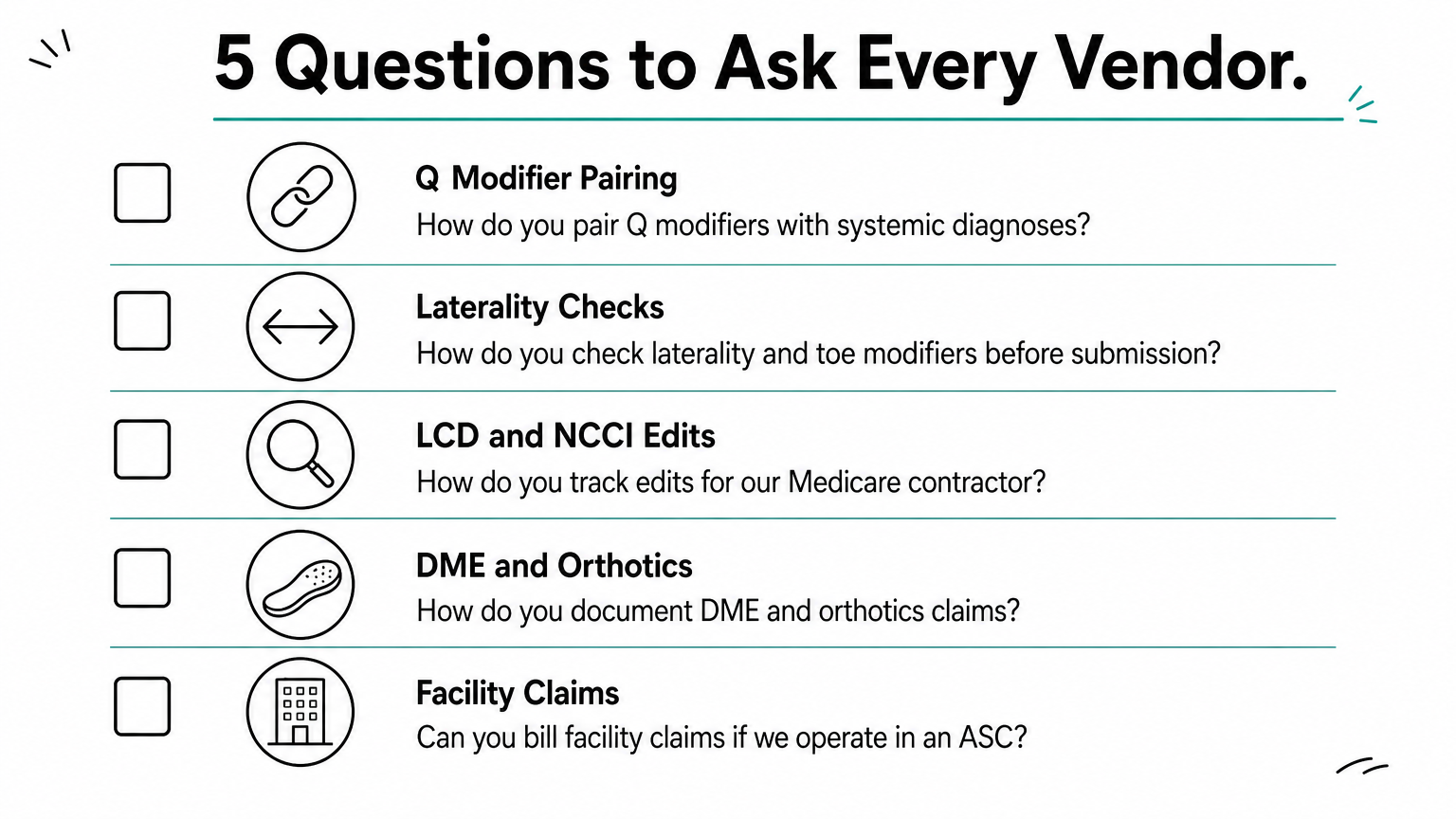
- How do you pair Q modifiers with systemic diagnoses for routine foot care?
- How do you check laterality and toe modifiers before a claim goes out?
- How do you track LCD and NCCI edits for our Medicare contractor? You can verify policies yourself in the CMS Medicare Coverage Database.
- How do you document DME and orthotics claims?
- Can you bill facility claims if we operate in an ASC?
Also ask for clean claim and denial figures from podiatry clients only, not company-wide averages.
A vendor that cannot answer podiatry questions in detail will learn on your claims.
Side-by-side comparison
| Company | Best fit | Pricing signal | Standout |
|---|---|---|---|
| InfiniteRCM | Full RCM, credentialing, prior auth, virtual staff | Percentage, flat-rate or custom; no long-term contracts | 99% clean claim guarantee |
| AnnexMed | Podiatry, orthopedic and multi-specialty groups | Custom quote | Podiatry-trained coders, SOC 2 |
| Transcure | Mixed routine, wound and surgical billing | 3% to 6% of collections | 40+ EHR integrations |
| Coronis Health | Documentation-driven denials | Custom quote | Monthly provider education |
| Precision Practice Management | ASC and surgical groups | Custom quote | Professional and facility billing |
Reporting and contract terms
Before you sign, get these answers in writing:
- How often you receive reports, and which ones (collections, denials, aging A/R)
- The notice period to cancel and whether a long-term contract applies
- Whether the vendor migrates data from your current biller
- That the vendor signs a HIPAA business associate agreement
- Who your account manager is, when they are available, and where your billing team is located
Choosing your podiatry billing partner
Podiatry billing rewards specialty knowledge. Q modifiers, laterality, LCDs and facility claims decide whether you get paid, so judge each company on how well it handles those details. Each of the five fits a different practice. InfiniteRCM suits practices that want a full revenue cycle team, AnnexMed and Transcure suit coverage and modifier problems, Coronis Health suits documentation problems, and Precision Practice Management suits surgery-center billing.
Shortlist two or three vendors, run the five questions above, and compare quotes on the same scope. If you want a straight answer on how InfiniteRCM would handle your podiatry claims, request a free consultation. Bring your current denial reports and we will walk through them with you.