
A management services organization agreement is a written contract in which a separate company, the MSO, provides non-clinical services to a medical practice for a fee. Those services typically include billing, staffing, IT, marketing and facilities. The physicians keep full control of patient care. People also call it an MSA, and in an MSO agreement in healthcare it serves one core purpose: it keeps the business side and the clinical side legally apart. That separation matters because in many states only licensed professionals can own a medical practice.
This article covers why the agreement exists, how to structure one, and which clauses it needs. It also explains the state and federal compliance issues attached to it (corporate practice of medicine, fee-splitting, the Anti-Kickback Statute and Stark Law) and the mistakes that cause trouble later. You will also find a worked fee example and a sample clause.
At InfiniteRCM, we handle billing, accounts receivable recovery and credentialing for practices, which are the same functions an MSO agreement often hands to the MSO. This guide is educational and not legal advice. State rules differ, so a healthcare attorney should review any real agreement.
Why a management services organization agreement matters
A management services organization agreement matters because it lets a business run your non-clinical operations without breaking the rules on who may own and control a medical practice. Without a written agreement, the arrangement is informal, and a regulator can read it as unlicensed ownership or control of medical care.
The corporate practice of medicine problem
Many states follow the corporate practice of medicine (CPOM) doctrine. It holds that a physician’s medical judgment should stay free from the influence of corporations, investors and other unlicensed owners. In those states, a non-physician entrepreneur, an investor group or a nurse practitioner often cannot own a medical practice outright. Some states also limit which types of licensed providers may co-own a practice. Even two licensed professionals can therefore need this structure.

The MSO model works by splitting the business in two. A professional entity, usually a PC or PLLC and often called the "friendly PC," is owned by licensed providers and delivers all care. The MSO, usually an LLC, handles everything else. The agreement is the bridge between the two, and it is the first thing a regulator, lender or buyer reads to understand the arrangement.
The agreement turns two related companies into a defensible structure, because it records who controls the medicine and who controls the business.
What each side gets from the agreement
The practice gets relief from administrative work and access to systems and staff it could not easily build alone. The MSO gets a defined scope, a defined fee and a legal basis for the relationship. The table shows the usual split of responsibilities.
| Professional entity (PC or PLLC) | MSO |
|---|---|
| Delivers all medical services | Billing, collections and bookkeeping |
| Hires, supervises and disciplines clinicians | Hires and manages non-clinical staff |
| Sets clinical protocols and the fee schedule | Scheduling, front desk and call center |
| Receives patient payments | IT, EHR support and cybersecurity |
| Holds patient records as custodian | Marketing, leases, supplies and vendor contracts |
The agreement also protects each side from the other. The physicians are shielded from business pressure on clinical decisions. The MSO is shielded from vague expectations, because the services and the fee are written down.
How to structure an MSO agreement in healthcare
To structure an MSO agreement, form two separate entities with separate ownership. Then define the services, set a compliant fee, reserve all clinical authority to the practice, and plan for termination before you sign. Order matters, because the agreement can only be as clean as the entities beneath it.
Form two entities with separate ownership
The professional entity must be owned by providers who are licensed to own it in your state. The MSO can usually be owned by anyone, including non-physicians and investors. Keep ownership and control clearly separate, because overlap invites the question of who is really directing care. If a licensed provider owns part of the MSO, have counsel confirm how your state treats that overlap before you form anything.
Draft the agreement in six steps
Work through the agreement in this order. Each step feeds the next.
- Identify the parties and their roles. Name both entities, their owners’ roles and the purpose of the relationship.
- List every service the MSO will provide. Attach a schedule, and say which services are excluded.
- Reserve clinical authority to the practice. State that the physicians control all medical decisions, staffing of clinicians and patient care.
- Set the fee and the payment mechanics. Use a fixed methodology and document how the amount was determined.
- Set the term, renewal and termination rights. Include notice periods, cure periods and a transition plan.
- Add compliance, privacy and dispute provisions. Cover change-in-law, HIPAA, indemnification and dispute resolution.
Draft the agreement around one rule: the MSO manages the business, never the medicine.
Sample clause for clinical authority
This short clause shows the kind of language used to reserve clinical control. Treat it as an illustration to discuss with counsel, not as finished legal text.
Nothing in this Agreement authorizes Manager to practice medicine or to
control, direct, or interfere with the professional judgment of any
licensed provider. Practice retains sole authority over all clinical
decisions, including diagnosis, treatment, patient acceptance, clinical
protocols, and the hiring, supervision, and discipline of licensed
clinical staff. Where an operational policy of Manager conflicts with a
provider's clinical judgment, the provider's judgment controls.
Key terms every MSO agreement should cover
Every management services organization agreement should cover eight areas: scope of services, clinical authority, compensation, term, termination, records and privacy, restrictive covenants, and risk allocation. The table shows what each clause should do and where drafts most often go wrong.
The clauses at a glance
| Clause | What it should say | Common weakness |
|---|---|---|
| Scope of services | Lists each service and what is excluded | Vague phrases like "all administrative support" |
| Clinical authority | Reserves all medical decisions to the practice | Operational policies that steer clinical choices |
| Compensation | Fixed or cost-plus fee set by a documented method | Percentage of revenue with no valuation |
| Term | At least one year, with renewal terms | Silent auto-renewals |
| Termination | Notice, cure period, for-cause and without-cause rights | No wind-down plan |
| Records and privacy | Practice owns records; business associate terms for PHI | MSO controls EHR access with no exit terms |
| Restrictive covenants | Reasonable scope and duration under state law | Covenants that conflict with employment agreements |
| Indemnification and insurance | Each side covers its own acts, with defined coverage | One-sided indemnity |
How fees and payment flow work in practice
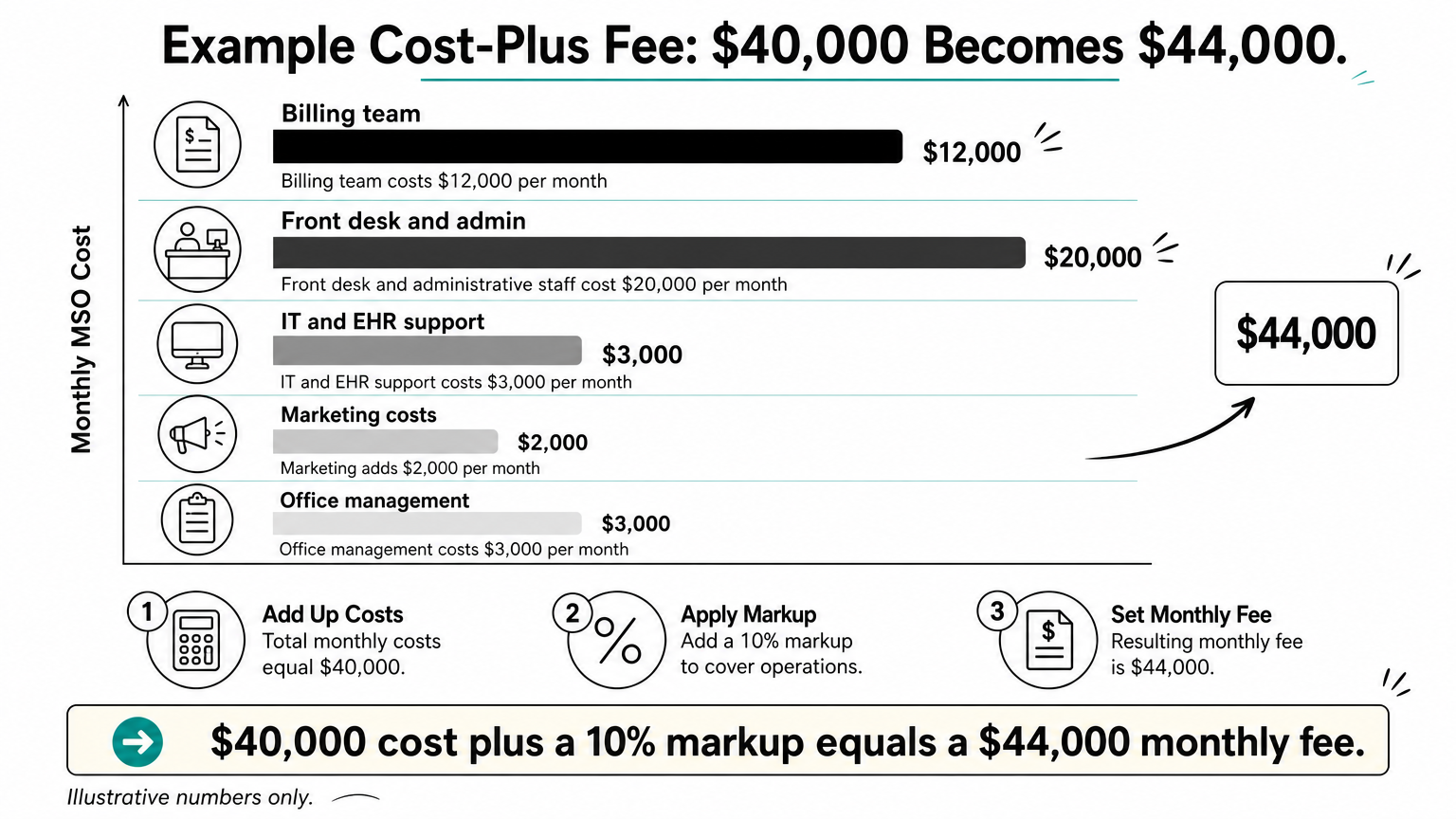
Fees are the clause that draws the most scrutiny, so the mechanics need to be specific. Here is a hypothetical example with illustrative numbers. Suppose the MSO’s monthly cost to serve one practice is $12,000 for the billing team, $20,000 for front desk and administrative staff, $3,000 for IT and EHR support, $2,000 for marketing and $3,000 for office management. That totals $40,000 per month. A cost-plus fee with a 10% markup would be $44,000 per month. If the practice collects $200,000 in a month, that fee equals 22% of collections, yet it is still a fixed dollar amount tied to services, not a share of patient revenue. The 10% markup is only for illustration. A real fee should rest on a documented valuation.
The agreement should also state the order of payments from practice revenue. A common order is the physician owner’s compensation first, then practice operating expenses such as clinical salaries, rent and supplies, then the management fee. Add a right for the MSO to review the practice’s books at set intervals, so it can confirm that the practice can cover its obligations.
Termination and transition
A good termination clause names who can terminate, when and why. Typical provisions include a notice period, a cure period for breaches, and separate rights for termination with and without cause. The clause should also say what happens next: how patient records and EHR access transfer, how billing hands over, which vendor contracts move, how payer relationships continue and how staff transition. A practice that skips the transition plan often discovers it cannot reach its own data or revenue stream during a dispute.
Compliance issues: CPOM, fee-splitting, AKS and Stark
The main compliance issues in an MSO agreement are state CPOM and fee-splitting rules, the federal Anti-Kickback Statute, Stark Law, and the fair market value standard that ties them together. Each one asks the same question: does money or control improperly influence medical decisions or referrals?
State law: CPOM and fee-splitting
CPOM and fee-splitting laws vary widely by state. Some states enforce them strictly, while others allow broader ownership and management models. Fee-splitting rules generally prohibit sharing patient-care revenue with an unlicensed party in a way that could influence medical decisions. In stricter states, a management fee set as a percentage of the practice’s revenue can be treated as fee-splitting. These states usually expect a flat or cost-plus fee instead, and patient payments go to the practice, not directly to the MSO. An arrangement that works in one state can need major changes in another, so check the rules where the practice operates and where its patients live.
Federal law: Anti-Kickback and Stark
The federal Anti-Kickback Statute prohibits offering, paying, soliciting or receiving anything of value to induce referrals of services paid by federal healthcare programs such as Medicare and Medicaid. A safe harbor for personal services and management contracts protects arrangements that meet its conditions. In summary, the arrangement must:
- Be in writing and signed by both parties.
- Cover and specify all the services the MSO provides.
- Last at least one year.
- Set the compensation methodology in advance, at fair market value.
- Not set payment based on the volume or value of referrals or other federal program business.
- Not involve promoting unlawful activity.
Stark Law is a separate analysis. It restricts physician referrals of certain Medicare designated health services, such as clinical laboratory, physical therapy and radiology, to entities with which the physician has a financial relationship. It matters most when the MSO or its investors own labs, imaging centers or therapy groups. The personal services exception has its own conditions, including a written agreement, a term of at least one year and fair market value compensation. Meeting one test does not satisfy the other, so counsel should run both.
Fair market value as the common thread
Fair market value means the fee reflects what the services are actually worth, independent of referrals or patient volume. A fee that is far above or below that value invites scrutiny under all three bodies of law. Document how you reached the number, and review it when the services or the practice change. Some state laws also bar kickbacks on private and cash-pay business, so the federal safe harbor is a floor and not the whole picture.
Fair market value, set in advance and documented, is the single habit that protects an MSO fee under state and federal law.
Common mistakes, templates and when to get a lawyer
Most MSO agreement problems come from using a generic template, vague service descriptions, fees tied to revenue, and an MSO that drifts into clinical decisions. A template is a fine starting reference, but a healthcare attorney should finalize the agreement for your state, provider type and ownership structure.
Templates and samples are starting points
Searches for an MSO agreement template, sample or PDF are common, and a sample is useful for seeing the shape of the document. It cannot account for your state’s CPOM and fee-splitting rules, your payer mix or your ownership structure. Use a sample to learn the vocabulary and prepare questions. Do not sign anything built from it without legal review. The same goes for drafts produced by AI tools.
Red flags in a draft
Watch for these warning signs when you review an agreement:

- A management fee that is a percentage of practice collections with no valuation.
- Service descriptions that say "all administrative functions" without a schedule.
- The MSO setting clinical protocols, evaluating clinicians or choosing which tests or referrals patients receive.
- Staff incentives tied to revenue targets or patient volume.
- Silent auto-renewals, or no plan for records and billing after termination.
- Ownership that overlaps between the MSO and the practice without a legal review.
Where billing and revenue cycle work fit
Billing is often the largest operational piece an MSO takes on, and it is where revenue leaks if the clause is thin. If the MSO handles claims, make sure the agreement covers who verifies eligibility, who submits claims, how denials get worked, who reports performance and who owns the data. If billing is the main reason you are considering an MSO, a narrower services agreement with a dedicated billing partner may fit better. InfiniteRCM, for example, provides billing, AR recovery, credentialing and virtual assistant support for practices. Whichever route you take, have the agreement reviewed before signing.
Next steps for your agreement
A management services organization agreement is the contract that separates business operations from clinical care, and the strongest ones are specific. They name every service, reserve all medical decisions to the practice, set a documented fair market value fee and plan for termination from the start. State law shapes the details, and federal rules apply when federal programs pay. For those reasons, a healthcare attorney should draft or review the final document.
If you are weighing which functions to hand to an MSO, start with billing and revenue cycle work, since it affects cash flow the most. You can talk to InfiniteRCM about your billing and revenue cycle needs to see what an outsourced billing arrangement would look like before you commit to a larger structure.