The best medical spa website design makes three things obvious within seconds: what you treat, proof that it works, and how to book. Treatment-based navigation suits spas with long menus. Before-and-after galleries suit injectable and laser practices. Reviews and provider credentials help newer brands earn trust fast. One-tap booking and published pricing suit spas chasing first-time clients. A distinct brand look holds the rest together.
The problem is that many med spa sites look polished and still book few appointments. A beautiful hero image does not tell a nervous first-timer what Botox costs, who will inject it, or how to reserve a slot. This guide gives you six design elements, each with real med spa sites that use it well and a short build checklist. A final section covers platforms, cost, and how to pick a designer.
InfiniteRCM works with healthcare practices on billing and revenue cycle operations, and it also offers web development for healthcare organizations. That is why this guide judges a website by one measure: whether it turns visitors into booked, paying clients. Use the six elements as an audit of your current site or as a brief for a new one.
1. Treatment-based navigation
Why it converts
Visitors arrive with one concern, such as fine lines or unwanted hair, and they leave if the menu hides that treatment. Strong medical spa website design mirrors how clients think about their skin, not how your equipment list reads.
Group services by area or concern, then keep pricing, contact, and booking in the top bar. A sticky header keeps those links in reach on long treatment pages.
A visitor who cannot find their treatment within a couple of clicks will find another spa.
A real example
VIO Med Spa operates in more than 20 states and sorts its hundreds of treatments into four groups: Face, Skin, Body, and Wellness. Four clear categories make a huge menu browsable. The Biostation takes another route with symptom-based navigation, which suits wellness clinics where clients know the problem before they know the treatment name.
What to copy:
- Limit top-level categories to four to six.
- Name categories in client language, not product names.
- Add a second path by concern, such as acne or aging.
How to build it
Start by writing down every treatment you sell. Then run a quick sort with people outside your team, and let them group the treatments themselves. Their groupings become your menu.
- Ask three non-staff friends to group your treatments on index cards.
- Use their groups as your top-level menu labels.
- Mirror the groups in your URLs, such as /injectables/botox.
- Test the menu on a phone and ask someone to find your most popular treatment.
2. Before-and-after galleries
Why it converts
Prospective clients want proof before they commit money and their face. A results gallery is often the most persuasive page on a med spa site because it shows outcomes instead of describing them.
Handle consent and rules carefully. Get written patient consent before publishing any photo, and check your state’s advertising rules before you attach claims to results.
Real results convince faster than any paragraph of marketing copy.
A real example
Skin Solutions Collective, with locations in Tribeca, Greenwich, the Hamptons, and Miami, pairs a soft pink-and-white brand with galleries that present real results with tasteful discretion. LYEV Beverly Hills goes further and places before-and-after results prominently inside a luxury design, so proof sits beside the brand story.
What to copy:
- Filter galleries by treatment so clients see relevant cases.
- Use consistent lighting, angles, and backgrounds.
- Label each case with sessions and timeline.
How to build it
Photography is the hard part, so standardize the shoot before you design the page. Without consistent images, even a good gallery looks unreliable.
- Photograph every case with the same lighting, angle, and background.
- Organize cases by treatment, not by date.
- Compress images so the gallery loads quickly on mobile.
- Add a caption with treatment, number of sessions, and downtime.
- End each gallery with a button such as "Book a consultation for fillers".
3. Reviews and provider credentials
Why it converts
Clients hand over their face and their skin, so trust decides bookings more than design does. Review volume answers "do other people like this place," and provider profiles answer "who will treat me."
Both belong high on the page, not buried in a footer. Medical spa website design that puts a star rating under the hero and a team link in the main menu removes two objections before the visitor scrolls.
Visitors book the injector they trust, so show them who that is.
A real example
Revive Med Spa, with nine California locations, displays more than 13,000 five-star reviews across its site. Laser Clinique in La Jolla and San Diego shows a 4.9-star rating from over 5,000 reviews, which suits a focused laser practice well. Purely Natural Medical Spa in Brooklyn takes the personal route with detailed team profiles that put credentials beside faces.
What to copy:
- Show the rating and review count near the top of the homepage.
- Give each provider a page with photo, license type, and training.
- Link provider names from the treatments they perform.
How to build it
Pull reviews from your Google Business Profile so the numbers are real and current. Never inflate or invent counts, because clients check them against Google.
- Place a rating line under the hero image.
- Create one profile per injector, nurse, or physician.
- List license, certifications, and years of experience.
- If intake forms collect health history, use a form tool built for HIPAA and ask your compliance advisor to confirm the setup.
4. One-tap booking and clear calls to action
Why it converts
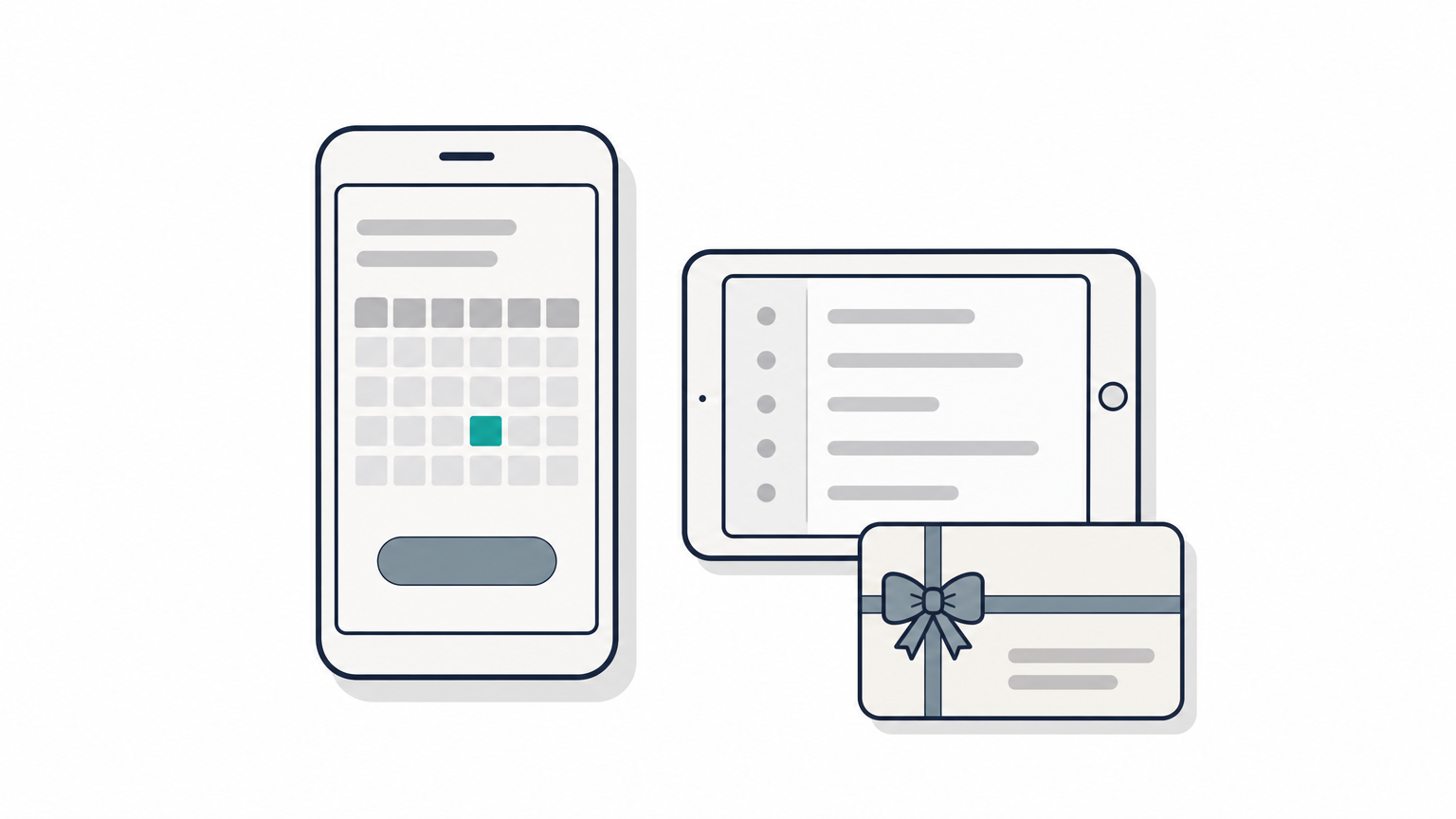
Every page should end with one obvious next step. Specific button labels such as "Book a consultation" outperform vague ones such as "Submit," because they tell the visitor what happens next.
Most med spa browsing happens on phones. A booking path that needs pinching, zooming, or a phone call loses the client who was ready to book at lunch.
If booking takes more than a few taps, you lose the client who was ready to say yes.
A real example
Upkeep Med Spa, with five locations across NYC and Dallas, integrates Boulevard booking directly into the site. Alea Med Spa in Midtown Manhattan keeps booking functionality prominent, so nobody hunts for how to schedule. Viva Day Spa + Med Spa also features gift certificates up front, which turns the site into a revenue tool as well as a booking tool.
What to copy:
- Put a booking button in the header on every page.
- Link each treatment page to its own consultation request.
- Feature gift certificates if you sell them.
How to build it
Choose booking software that integrates with your site and your scheduling system before you choose a design. A beautiful form that does not sync to your calendar creates double work.
- Add a sticky "Book now" button on mobile.
- Make the phone number tap-to-call.
- Ask for as few form fields as possible.
- Send an instant confirmation by text or email.
- Track which pages generate the most bookings.
5. Published pricing
Why it converts
Cost uncertainty keeps many first-timers from booking, and most spas still hide prices behind a consultation. Showing even a starting price filters out poor matches and reassures good ones.
You do not need a full price list. Show starting prices for your five or six most popular treatments, and explain what changes the final number, such as units, areas, or sessions.
Clients book the spa that tells them the cost before they ask.
A real example
Peachy Studio, with more than 15 studios across NYC, Chicago, DC, Atlanta, and Austin, displays flat-rate Botox pricing prominently. Its Shopify-based site treats treatments like clearly priced products with easy booking. For first-timers, that removes the anxiety of unknown costs, which a consultation-first menu cannot do.
What to copy:
- Lead with "starting at" prices for popular treatments.
- Explain what is included in each price.
- Show memberships or packages beside single-session prices.
How to build it
Decide what you are comfortable publishing, then be consistent. A price that changes between pages damages trust faster than no price at all.
- Pick five or six popular treatments to price publicly.
- Add a line on what affects the final cost.
- State consultation fees or deposits clearly.
- Link financing options if you offer them.
- Review prices every quarter so the site matches the front desk.
6. A brand-led look that works on mobile
Why it converts
A med spa sells a feeling as much as a result, so the design must signal your standard of care. A distinct visual identity helps clients tell you apart from the five other spas they opened in new tabs.
The look must survive a small screen. Mobile-first layouts and readable type matter more than animation, because that is where most visitors will first see you.
Your website should look like the room clients walk into.
A real example
Minimale Skin in Soho takes an editorial, ultra-minimalist approach, with a grid that gives each treatment equal visual weight. The Perfect Secret in Phoenix uses a dark neutral palette and a peacock-gold logo for quiet luxury. Alea Med Spa’s muted grey-green palette steps away from the usual gold-and-white luxury look.
What to copy:
- Choose one distinctive color story and stick to it.
- Pair two typefaces, one for headings and one for body text.
- Use generous whitespace so treatments feel curated.
How to build it
Use photography of your real space and team. Stock photos are the quickest way to look like every other spa. Then test the result on real devices.
- Pick one accent color, two typefaces, and a consistent photo style.
- Check that body text has enough contrast against its background, especially on dark designs. WCAG recommends at least 4.5:1.
- View every page at phone width before approving the design.
- Run the site through Google’s PageSpeed Insights and fix the heaviest images first.
How to choose a med spa website designer
Choose a designer who can show live med spa sites, explains how the site will be found and booked, and quotes the full scope in writing. Medical spa website design has its own demands around photos, consent, intake forms, and trust, so general portfolio work is not enough.
Builder, template, or custom
Templates and builders suit a single location with a standard menu. Custom builds suit large groups with complex needs. The sites above use a mix of platforms:
| Platform | Seen on | Best fit |
|---|---|---|
| Squarespace | Upkeep Med Spa, Minimale Skin, Alea Med Spa | Boutique spas wanting elegant templates and booking integrations |
| Shopify | Peachy Studio, BeautyFix MedSpa | Spas selling products alongside treatments |
| Wix | RJ Med Spa, Lumiere Medical Spa | Drag-and-drop builds with animated layouts |
| WordPress | Cienega Med Spa, Tribeca MedSpa, Skinney MedSpa | Flexible sites with page builders such as Elementor or Divi |
| Custom (Next.js) | Revive Med Spa, VIO Med Spa | Multi-location groups needing scale and speed |
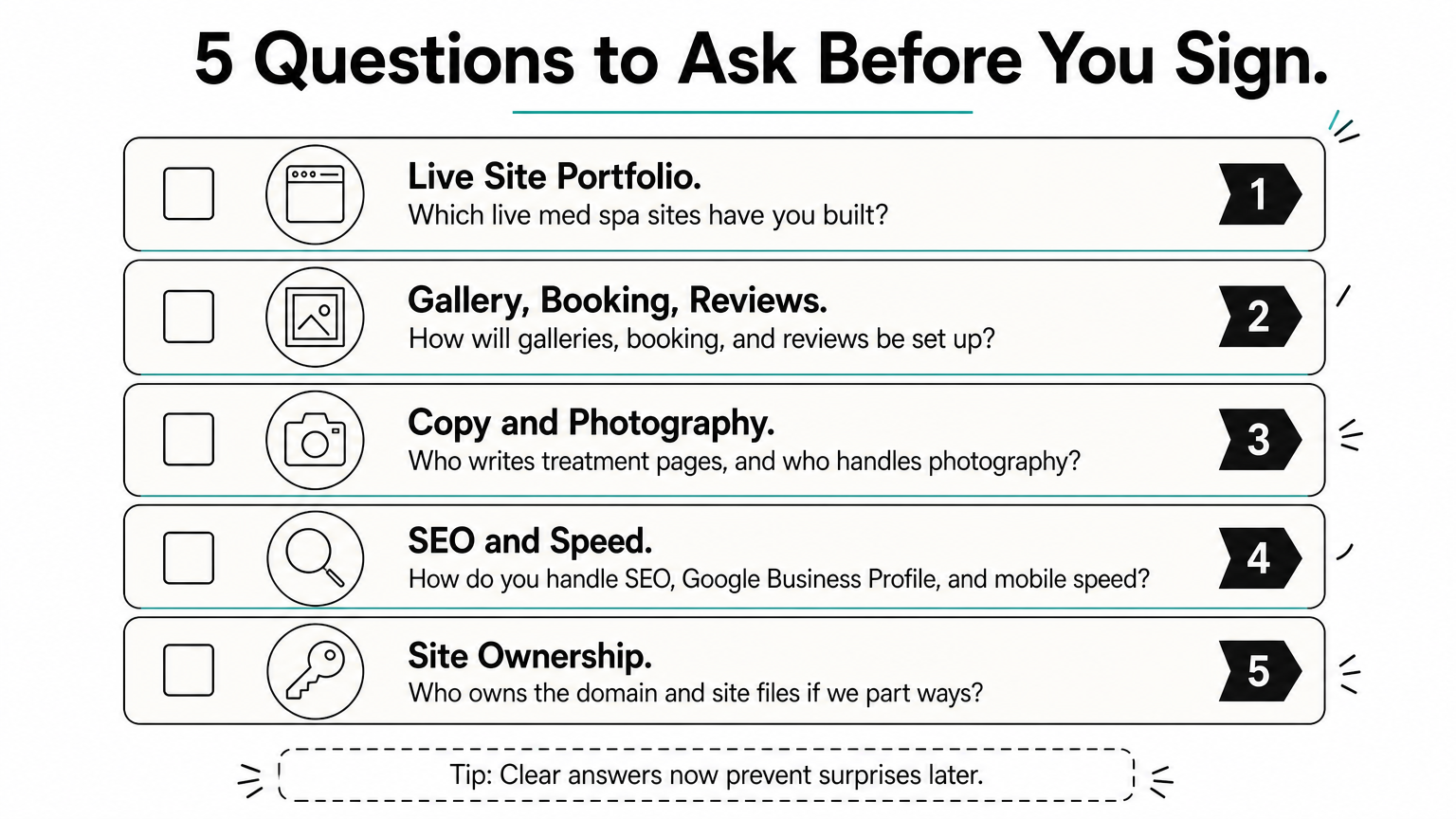
Questions to ask before you sign
- Which live med spa or aesthetics sites have you built?
- How will before-and-after galleries, booking, and reviews be set up?
- Who writes the treatment pages, and who handles photography?
- How do you handle SEO, Google Business Profile, and mobile speed?
- Who owns the domain and site files if we part ways?
What a med spa website costs
Cost varies too widely for one honest figure. It depends on platform, page count, custom design, photography, copywriting, booking integration, and ongoing support. Ask for a written, itemized quote that separates design, development, content, SEO setup, and hosting and maintenance. That lets you compare bids fairly and see what you are paying for.
InfiniteRCM’s Web Development Services cover healthcare website development, SEO, social media management, Google Business optimization, and healthcare content marketing, built for healthcare businesses. If you shortlist us, ask for a written scope and relevant examples, as you would with any designer.
The right designer shows you live med spa sites and prices the full scope in writing.
Build the site that books clients
A high-converting med spa website does six jobs: it organizes treatments by how clients think, shows real results, proves trust with reviews and provider profiles, makes booking effortless, publishes starting prices, and looks distinct on every screen. You do not need all six on day one. Audit your current site against the list and fix the weakest element first.
If you want a partner to build or refresh your site, contact InfiniteRCM to discuss your goals and the scope of work.