Your front desk is drowning in claim follow-ups, your biller quit last month, and denials keep piling up while patients wait on hold. That’s usually the moment practice managers start searching for a virtual assistant medical billing solution instead of posting another job ad and hoping for the best. It’s a fair question: what does this role actually cover, and does it make financial sense for your practice?
A medical billing virtual assistant handles the tasks that eat up your staff’s day: verifying insurance eligibility, submitting clean claims, posting payments, and chasing down denials, all remotely and usually at a fraction of an in-house salary. Costs typically range depending on whether you hire a dedicated medical biller virtual assistant directly, contract through a staffing agency, or partner with a full-service RCM company that bundles VA support with billing oversight.
This article breaks down exactly what these virtual assistants do day to day, what you should expect to pay in 2026, and how to tell whether hiring one, or partnering with a team like InfiniteRCM, fits your practice’s size and billing headaches.
Why practices rely on medical billing virtual assistants
Most practices don’t wake up one day and decide to outsource billing for fun. They get there because claim denials are climbing, a biller quit without notice, or the front desk is spending more time on hold with payers than helping patients check in. A medical billing virtual assistant solves a staffing problem before it becomes a revenue problem. Instead of posting a job, waiting six weeks for applicants, and training someone new on your EHR, you plug in a remote specialist who already knows the workflows and can start within days.
The tasks eating up your staff’s day
Before practices bring in remote billing support, the same tasks usually pile up on one or two overworked employees: eligibility checks before every visit, claim scrubbing, payment posting, and denial appeals. None of these tasks require a physical presence in your office. They require accuracy, consistency, and someone who won’t burn out after six months of chasing the same insurance company. A medical biller virtual assistant typically handles:
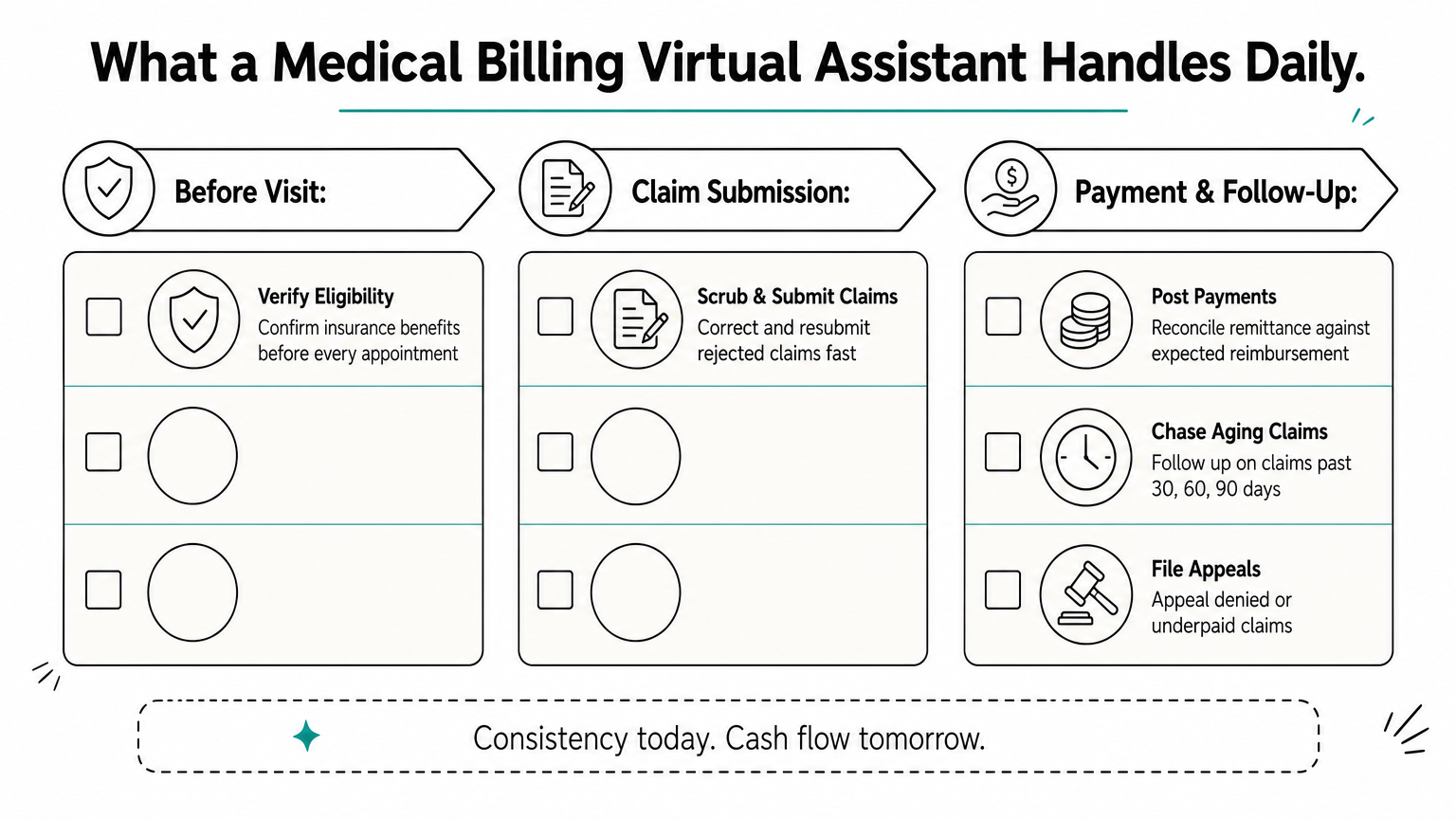
- Verifying patient insurance eligibility and benefits before appointments
- Submitting clean claims and correcting rejected ones before resubmission
- Posting payments and reconciling remittance advice against expected reimbursement
- Following up on aging claims past 30, 60, and 90 days
- Filing appeals on denied or underpaid claims
- Answering patient billing questions and setting up payment plans
Why remote staffing beats another in-house hire
Given the tight labor market for experienced billers, remote hiring has become the practical answer rather than a trend. Qualified in-house billers are hard to find, expensive to retain, and prone to burnout when denial volume spikes. A virtual assistant working through a staffing partner or an RCM company like InfiniteRCM often costs 40-60% less than a full-time in-house hire once you factor in benefits, office space, and turnover. That’s not a small difference for a practice running on thin margins.
A medical billing virtual assistant doesn’t replace your front desk, it removes the backlog that’s been slowing your front desk down for months.
Here’s how the two staffing paths typically compare for a single-provider practice:
| Factor | In-house biller | Medical billing virtual assistant |
|---|---|---|
| Average annual cost | $45,000-$55,000 + benefits | $18,000-$30,000 |
| Hiring timeline | 4-8 weeks | 1-2 weeks |
| Coverage during PTO/sick days | Gaps in claims processing | Backup staff usually included |
| Denial follow-up consistency | Depends on workload | Dedicated daily task |
| Scalability during growth | Requires new hire | Add hours or staff quickly |
Insurance follow-up sits at the center of this decision for most practices. Underpaid and denied claims don’t resolve themselves, and every week a claim sits untouched pushes it closer to the payer’s filing deadline for appeals. Justifying a full-time in-house employee dedicated solely to AR follow-up is hard for a practice billing under $2 million annually, but a virtual assistant handling that task alongside eligibility checks and payment posting makes the math work.
Keeping compliance tight matters just as much as speed. A trained medical billing virtual assistant follows HIPAA-compliant workflows, uses secure access to your practice management system, and documents every claim touch point, which protects you during audits and payer reviews. That combination of lower cost, faster hiring, and built-in compliance is why the role has moved from a nice-to-have to a standard fixture in practices of every size.
How to hire a medical billing virtual assistant
Finding a competent medical biller virtual assistant takes more than posting a job on a freelance site and hoping for the best. Practices that get burned usually skipped the vetting step and hired based on a resume alone, without checking whether the candidate had actually worked inside a practice management system or handled real denials. Treat this hire the way you’d treat any employee who touches patient data and revenue, because that’s exactly what they are.

Choose your hiring path
Three paths dominate this market, and each fits a different practice size. Direct hiring through a freelance platform gives you the most control over training and workflow but leaves you responsible for management, backup coverage, and quality checks. Staffing agencies place a pre-vetted VA with your practice but often charge a placement fee and offer limited billing oversight. Partnering with a full-service RCM company gives you a trained medical billing virtual assistant backed by a compliance team, denial specialists, and reporting dashboards, which matters most for practices that don’t have an office manager who can supervise billing full time.
The cheapest hire on paper usually costs the most once you count the claims that fall through the cracks.
Vet for these skills before signing anything
Don’t skip a working interview. Ask candidates to walk you through how they’d handle a denied claim, correct a rejected submission, or verify eligibility for a new patient. Look for:
- Hands-on experience with your specific EHR or practice management system (Kareo, AdvancedMD, athenahealth, etc.)
- Working knowledge of CPT, ICD-10, and payer-specific billing rules
- A documented HIPAA training certificate
- References from at least two prior healthcare clients
- Comfort with your state’s top payers, since Medicaid and regional carrier rules vary widely
Gaps in any of these usually surface within the first 30 days, and by then you’ve already lost claims to the timely filing window.
Set expectations in writing
However you hire, put turnaround times, escalation procedures, and reporting cadence in a written agreement before day one. If a candidate resists a working interview or can’t explain how they handle a stubborn payer, that’s your answer. For practices that would rather skip the vetting altogether, InfiniteRCM’s virtual assistant services come pre-trained on billing workflows and HIPAA compliance, with a supervisor already in place.
How much a medical billing virtual assistant costs
Pricing for a medical billing virtual assistant swings widely depending on experience level, hours needed, and whether you’re hiring direct or through a managed service. A part-time VA handling eligibility checks and payment posting for a small practice costs far less than a dedicated medical biller virtual assistant managing full AR recovery and appeals for a multi-provider group. Location matters too. Offshore talent in the Philippines or Latin America typically runs cheaper than domestic remote hires, though quality varies more without a vetting layer in place.

Typical pricing by hiring model
Budget expectations shift once you compare the three common paths side by side:
| Hiring model | Typical hourly rate | Typical monthly cost (full-time) | Included oversight |
|---|---|---|---|
| Freelance platform (direct hire) | $8-$18/hr | $1,400-$3,000 | None, you manage |
| Staffing agency placement | $15-$25/hr | $2,600-$4,300 | Light, agency handles HR only |
| Full-service RCM company | Bundled into service fee | Often 3-8% of collections | Compliance, QA, reporting included |
Rates climb when the role includes denial appeals, prior authorization, or credentialing support, since those tasks demand payer-specific knowledge that a generalist VA doesn’t have.
What actually drives the number up or down
Experience explains most of the price gap you’ll see between candidates quoting the same job title. A VA with two years of eligibility-verification work costs less than one who’s spent five years resolving underpaid surgical claims for an orthopedic group. Specialty also matters: billing for behavioral health or physical therapy, with their bundled visit limits and prior auth requirements, commands a premium over general family medicine billing.
Paying less per hour rarely means paying less overall once denied claims start slipping past their appeal deadlines.
Hidden costs trip up practices that only compare hourly rates. Training time, software licenses, and management overhead add up fast when you hire direct. Bundled RCM pricing, like the InfiniteRCM pricing structure, avoids that math entirely by tying cost to collections performance instead of headcount, so the VA’s success and your revenue move in the same direction.
Qualifications, training, and career path
Qualifications for this role rarely start with a four-year degree. Most medical billing virtual assistants come up through certificate programs, on-the-job training at a billing company, or a background in medical coding that expanded into full-cycle billing. What matters more than a diploma is documented, hands-on experience with claim submission, denial resolution, and payer portals, since that’s what determines whether a claim gets paid on the first pass or bounces back three times.
Certifications worth checking
A handful of credentials signal that a candidate has actually studied the rules instead of picking them up by trial and error:
- Certified Professional Biller (CPB) through AAPC
- Certified Billing and Coding Specialist (CBCS)
- HIPAA compliance training certificate
- CPC or coding credential for practices needing crossover billing-coding support
None of these certifications guarantee competence on their own, but their absence should raise questions during the interview.
How training actually happens
Growing into this role usually happens in stages rather than all at once. New hires typically start with eligibility verification and payment posting, low-risk tasks that build familiarity with a practice’s specific payer mix. From there, they move into claim scrubbing and denial follow-up, and eventually into appeals and underpayment recovery once they’ve proven they can read an explanation of benefits correctly. Reputable staffing partners and RCM companies run this progression deliberately, pairing new VAs with a senior biller for the first 60 to 90 days rather than handing them a full caseload on day one.
A certificate gets a resume noticed, but claim accuracy over the first 90 days is what actually proves someone can do this job.
Where the career goes from here
Experienced billers often move from generalist VA work into specialty billing, denial management, or credentialing, roles that pay more because they require deeper payer knowledge. Some transition into supervisory positions overseeing a team of VAs, especially within larger RCM companies that need quality control across dozens of client accounts. For practices evaluating candidates, this career trajectory matters: a VA with three years of eligibility-checking experience isn’t the same hire as one who has already handled appeals for denied surgical claims, and the pay difference should reflect that gap.
Finding the right billing support for your practice
Hiring a medical billing virtual assistant isn’t about chasing the cheapest hourly rate you can find. It’s about matching the role to the size of your denial problem, your AR backlog, and how much oversight you can realistically provide. A single-provider practice might do fine with a part-time VA handling eligibility checks. A multi-provider group losing money to underpaid claims needs someone backed by denial specialists and compliance review, not a freelancer working alone.
Whatever path you choose, treat this hire like the revenue-critical role it is. Vet the experience, put expectations in writing, and track claim outcomes from month one. If the vetting process feels like more work than the billing problem it’s supposed to fix, that’s a sign to bring in a team that’s already built the workflow. InfiniteRCM pairs trained virtual assistants with full RCM oversight, so your claims get worked, not just watched.