The right revenue cycle management vendor depends on three things: your size, whether you want software or a team that does the billing for you, and how much of your current EHR you plan to keep. InfiniteRCM suits independent and mid-sized practices that want outsourced billing with fast claim turnaround. R1 RCM and Optum suit hospitals and health systems that need scale. athenahealth suits practices that want EHR, practice management and billing in one platform. GeBBS suits groups that want high-volume coding and billing support with offshore delivery to manage cost.
A revenue cycle management vendor is a company that handles, or supplies software for, the steps between patient check-in and final payment. Those steps are eligibility checks, coding, claim submission, payment posting, denial follow-up and collections. Choosing one is hard because every vendor promises fewer denials and faster payment. Online lists also mix hospital-scale enterprises with billing firms built for a five-provider clinic. This article sorts the options by who they actually serve.
We are InfiniteRCM, so we list ourselves first and we hold ourselves to the same criteria as everyone else. Each pick below uses the same three subheadings so you can compare them side by side. The last section gives you a service-model table, the proof to ask for, and a worked fee example. Competitor descriptions come from public information, so confirm current terms with each vendor before you sign.
1. InfiniteRCM
InfiniteRCM is an outsourced medical billing and revenue cycle company that runs your billing remotely, inside the systems you already use. It is the best fit on this list for practices that want a hands-on billing partner without buying new software.

What it does
InfiniteRCM covers eligibility verification, clean claim submission, payment posting, denial management and financial performance reporting. Claims go out electronically through secure clearinghouses, and most are submitted within 24 to 48 hours after charge entry. Around that core sit AR recovery, prior authorization, credentialing and enrollment (including CAQH profiles and NPI registration support), and medical virtual assistants for scheduling and administrative work.
The company reports a 99% clean claim rate, 40% faster collections and 60% fewer denials. It also cites more than 10 years of experience, 500+ providers served and over $50M recovered for clients. Treat these as vendor-reported figures and ask for results in your own specialty.
A vendor that can run billing inside your existing systems removes the biggest cost of switching: replacing software.
Who it suits
It works for solo providers, small clinics and larger multi-provider organizations, including urgent care centers, laboratories and specialty practices. It is strongest for practices with high denial rates, long AR days or billing staff stretched thin.
Because the service is fully remote and cloud-based, it accesses your EHR or practice management system without a software purchase.
Pricing and contract terms
InfiniteRCM states that its pricing is transparent with no hidden fees. You can get in touch through its contact page. Onboarding typically takes a few days to a few weeks, depending on setup complexity.
You get a dedicated account manager, and support responds within 24 business hours. A monthly contract can be canceled with 30 days written notice, which keeps the exit simple.
2. R1 RCM
R1 RCM is one of the best-known enterprise revenue cycle companies, built for organizations with large claim volumes. It fits hospitals, physician groups and health systems that want to hand over most of the revenue cycle.
What it does
R1 provides end-to-end revenue cycle services, including operations, analytics and workforce support. That means the vendor takes over functions such as coding, billing and collections rather than only supplying a tool. Its broad service portfolio and scalability are the main reasons large organizations choose it.
R1 RCM is a full-scale outsourcing partner for large systems, not a lightweight billing tool.
Who it suits
Pick R1 if you run a hospital, a large physician group or a multi-site system and need one partner across many departments. The scale that helps a system can work against a small practice. Before you shortlist R1 as a small group, ask whether a team of your size gets dedicated attention.
Pricing and what to ask
R1 does not publish standard rates, so expect a custom proposal based on volume and scope. Ask how fees are structured, which functions are included, and who the named contacts are on your account.
Ask for reference clients of your size and payer mix. Find out how long implementation takes and what happens to your staff’s workflows during the transition.
3. Optum
Optum combines technology, payer insights and operational expertise for hospitals and health systems. It is a strong choice when you want national-scale infrastructure behind your revenue cycle.
What it does
Optum’s revenue cycle solutions span coding, billing, analytics and workflow management. The draw is the breadth of resources: a large organization with data, tools and operations support under one roof. You can often combine pieces, such as analytics for your internal team, instead of outsourcing the whole function.
Optum’s value is breadth and reach, which matters most when your revenue cycle spans many sites and payers.
Who it suits
Optum fits hospitals and health systems that want extensive resources and a vendor with national reach. A small independent practice will likely find the scope more than it needs. The more departments, facilities and payer contracts you manage, the more the investment makes sense.
Pricing and what to ask
Pricing is quoted per engagement, not published. Ask exactly which modules your quote includes, because the product range is wide and scope drives cost. Also ask how your data will be reported back to your finance team, and how often.
4. athenahealth
athenahealth offers a combined practice management, EHR and revenue cycle platform supported by centralized billing operations. It suits practices that want clinical and financial workflows in one cloud-based system.

What it does
Its revenue cycle services integrate with its own cloud-based software, so charges, claims and clinical documentation live in the same environment. This reduces handoffs between systems. The tradeoff is that you adopt the platform, not only a billing service.
If you want one vendor for the chart and the claim, athenahealth is built for that. If you want to keep your current EHR, look elsewhere.
Who it suits
It is a practical choice for ambulatory practices and groups replacing separate EHR, practice management and billing tools at once. If you are happy with your EHR, switching just to change billing vendors is a high price to pay. A bundled platform makes the most sense when you were already planning a system change.
Pricing and what to ask
Pricing is not published, and it depends on the modules and services you buy. Ask what is bundled and what costs extra. Ask what happens to your data and billing if you later leave the platform, since the billing service is tied to the software.
5. GeBBS
GeBBS is a global revenue cycle outsourcing firm. It suits groups that want to supplement or replace an internal billing team and keep a close eye on cost.
What it does
GeBBS offers coding, billing, follow-up and quality assurance. Its offshore delivery model lets providers scale capacity without hiring locally. Coder certification and accuracy are what to verify, since coding quality decides how many claims get denied.
An offshore model can lower cost, but only if coding accuracy and communication hold up.
Who it suits
It fits small to mid-sized practices and larger groups that need extra capacity or want to outsource coding and billing for a lower per-claim cost. Time-zone gaps and communication style matter more here than with a U.S.-based team. Ask how escalations are handled during your business hours.
Pricing and what to ask
Rates are quoted on request. Ask whether you will be billed per claim, per hour or as a percentage of collections. Ask who audits coding quality, how often, and how you will be told about errors.
How to choose a revenue cycle management vendor
Choose a vendor by matching its service model to your size, demanding proof for its claims, and comparing fees against what you actually keep. These three checks eliminate most poor fits before you take a demo.
Match the service model to your size
Vendors fall into software, service and hybrid models. Software tools suit practices that keep billing in-house. Service vendors take over the work. Hybrids bundle both. This table sets the five picks side by side.
| Vendor | Model | Typical client | Keeps your current EHR? |
|---|---|---|---|
| InfiniteRCM | Outsourced billing service | Solo to multi-provider practices | Yes, works in your existing systems |
| R1 RCM | End-to-end outsourcing | Hospitals, physician groups, health systems | Confirm during scoping |
| Optum | Technology plus services | Hospitals and health systems | Confirm during scoping |
| athenahealth | Integrated EHR, PM and RCM | Ambulatory practices and groups | No, tied to its platform |
| GeBBS | Offshore outsourcing | Practices and groups needing capacity | Confirm during scoping |
Ask for proof, not promises
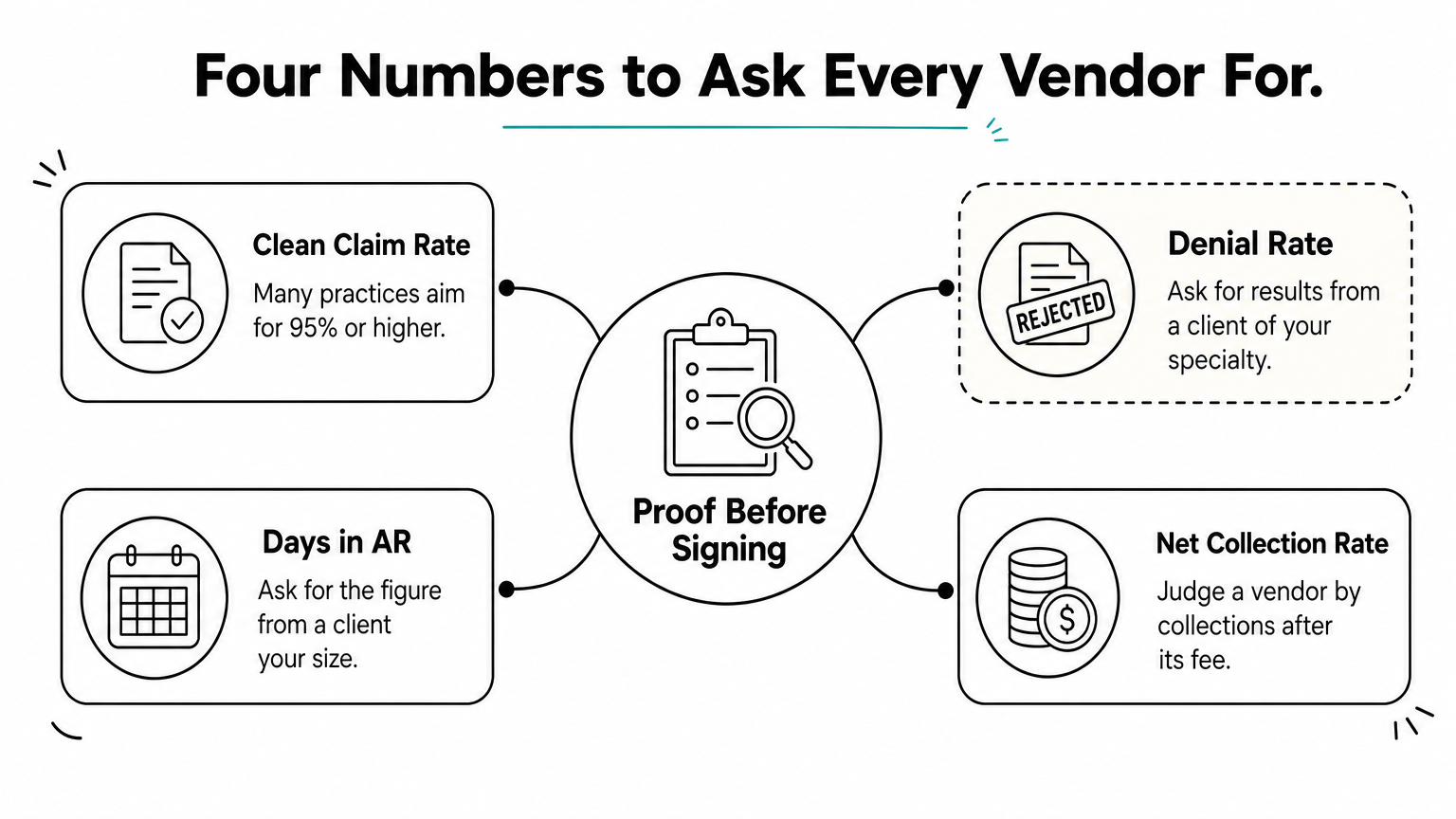
Ask each vendor for four numbers, clean claim rate, denial rate, days in AR and net collection rate, with results for a client of your specialty and size. Many practices aim for a clean claim rate of 95% or higher, so a vendor that cannot show its own figure is a risk.
Also ask about HIPAA compliance and security practices, how the vendor connects to your EHR, who your day-to-day contact will be, and how quickly it responds.
Compare fees on net collections
Judge a vendor by collections after its fee, not by the fee alone. Here is a hypothetical example. Your practice collects $200,000 a month. A vendor charges 6% of collections and lifts them 8% to $216,000. The fee is $12,960, so you keep $203,040. That is $3,040 more than before, and your own billing staff costs are on top of that.
Run the same math with each quote, and read the contract for minimum terms, notice periods and late-payment charges. A vendor with a short cancellation window, such as 30 days written notice, gives you leverage if results slip.
The right fee is the one that leaves you with more cash after the vendor is paid.
Picking your RCM partner
The best revenue cycle management vendor is the one that matches your size, your systems and your tolerance for change. Large systems lean toward R1 RCM or Optum. Practices that want one platform for everything look at athenahealth. Groups that need low-cost capacity consider GeBBS. Practices that want to keep their EHR and have a remote team run billing have a strong option in InfiniteRCM.
Whichever you shortlist, ask for proof in your specialty, run the net collections math, and read the exit terms before you sign. If you want a quote or a conversation about your denials and AR, contact InfiniteRCM.