
The right us medical billing company depends on your size and on how much of the revenue cycle you want to hand over. If you run a solo, small, or mid-size practice and want a remote team working inside your current EHR, InfiniteRCM, CareCloud, Transcure, and MZ Medical Billing are the best fits on this list. If you want your EHR and billing in one system, look at athenahealth and AdvancedMD. If you run a hospital or health system, R1 RCM and GeBBS are built for that volume. A good pick publishes numbers you can verify, works with your EHR, and puts its fees in writing.
Every vendor in this market claims a high clean claim rate and calls itself a top medical billing company. Meanwhile you are dealing with denials, aging receivables, and staff stuck on hold with payers. The claims are hard to compare because each company measures them differently. This article puts ten US medical billing services side by side so you can judge them on the same terms.
We list InfiniteRCM first because it is our company, and we hold it to the same checklist as the rest. The other nine run roughly from enterprise scale down to small independents. Each entry covers what the company does, who it fits, and what to watch for. Two closing sections cover what outsourcing costs and how to choose. Treat every performance figure as the vendor’s own claim until you have seen numbers from a practice like yours.
How these US medical billing services compare at a glance
All ten companies below handle some or all of the revenue cycle for US practices. They differ most in scale, in whether they sell software, and in how much of their performance data you can check. Use the table to shortlist, then read the entries for the two or three that match your situation.
The ten companies side by side
The table shows who each company suits and one proof point. Every proof point is self-reported by the vendor unless noted, so use it to start a conversation rather than end one.
| # | Company | Best for | Proof point |
|---|---|---|---|
| 1 | InfiniteRCM | Solo to multi-provider practices outsourcing billing inside their current EHR | 99% clean claim rate, 500+ providers served |
| 2 | R1 RCM | Large hospitals and health systems | 95 of the top 100 US health systems |
| 3 | GeBBS Healthcare Solutions | Hospitals and large practices wanting a global billing partner | KLAS-rated, HITRUST CSF, SOC 2 Type 2 |
| 4 | athenahealth | Multi-specialty groups wanting EHR and billing in one system | 170,000+ clinicians on its network |
| 5 | CareCloud | Mid-size practices that want billing without switching software | Roughly 94% to 98% first-pass rate, depending on the source |
| 6 | AdvancedMD | Independent and multi-provider practices, especially behavioral health | Written 95%+ first-pass clean claim guarantee |
| 7 | Tebra | Solo and small practices | $99 to $399 per provider per month |
| 8 | Transcure | Specialty-heavy practices wanting an overlay biller | 1,100+ certified billers and coders |
| 9 | OmniMD | Multi-specialty practices wanting AI across notes and billing | 97% first-pass rate in cardiology and urgent care programs |
| 10 | MZ Medical Billing | Independent practices and small specialty groups | 95.8% claim acceptance rate |
Notice that only some of these are billing companies in the strict sense. Others are software platforms that also offer billing help. That difference changes who is accountable for your collections, and the "how to choose" section returns to it.
Shortlist by scale and software fit first, then compare numbers, because a perfect clean claim rate means little if the vendor cannot work in your EHR.
How we judged each company
We scored each company on six points: verifiable performance numbers, whether it works inside your existing EHR, the scope of services, specialty depth, security credentials, and fee and contract transparency. A company did not need to win on all six. A hospital system and a three-provider clinic need different things.
We took facts about InfiniteRCM from its own materials and facts about the other nine from their published claims and independent coverage. Where numbers varied by source, as with CareCloud’s first-pass rate, we show the range instead of the best figure. For any vendor, ask for results from a comparable practice in your specialty, size, and payer mix.
1. InfiniteRCM
InfiniteRCM is a fully remote, cloud-based medical billing and revenue cycle company that works inside the EHR and practice management system you already use. It is built for practices that want an outsourced billing team without buying or migrating software.

What it does
InfiniteRCM runs the full cycle: patient eligibility verification, clean claim submission, payment posting, denial management, and financial performance reporting. Most claims go out within 24 to 48 hours after charge entry, submitted electronically through secure clearinghouses. The company reports a 99% clean claim rate, 40% faster collections, 60% fewer denials, and more than $50M recovered for clients across 500+ providers.
InfiniteRCM covers the whole cycle, from eligibility checks to appeals, without asking you to buy new software.
You can also buy pieces of the work separately:
- AR recovery: unpaid claims, underpayments, denied claims, and insurance appeals.
- Prior authorization: requirement verification, clinical document collection, submission, payer follow-up, and status tracking.
- Credentialing and enrollment: group and individual payer enrollment, CAQH profile management, and NPI registration support.
- Medical virtual assistants: part-time or full-time support for billing, scheduling, and insurance verification.
Who it fits
InfiniteRCM serves solo providers, small clinics, and larger organizations, including physician groups, urgent care centers, laboratories, and specialty practices such as family medicine, cardiology, and orthopedics. It suits you best if your denial rate is climbing, AR days are stretching, or your front-desk staff spend their days on billing calls.
It is a weaker match if you want one vendor for both your EHR and your billing. InfiniteRCM works in your existing systems instead of replacing them, so a platform vendor such as athenahealth fits that goal better.
Cost and trade-offs
InfiniteRCM advertises transparent pricing with no hidden fees, and you request a quote through its contact page. Onboarding typically takes a few days to a few weeks depending on setup complexity. Monthly contracts cancel with 30 days written notice, and dedicated account managers are available for communication and support.
- The performance figures are company-reported, so ask for results from a practice similar to yours.
- The service is fully remote, so it will not suit you if you want a biller in your office.
- Support replies within 24 business hours, which is prompt for billing questions but not instant.
2. R1 RCM
R1 RCM is the biggest enterprise name in outsourced revenue cycle work, and the usual answer to "which is the largest medical billing company." It is built for hospitals and health systems, not for small practices.
What it does
R1 started in 2003 as Accretive Health and is now based in Murray, Utah. It works with more than 1,000 provider organizations, including 95 of the top 100 US health systems, and processes over 270 million payer transactions a year. It went private in late 2024 in a deal worth $8.9 billion.
R1 launched its Phare Operating System in October 2025, a set of AI agents that split work between AI models and human experts. R1 says that in some deployments more than 40% of denials now resolve automatically. You can also start with one function, such as denials, and expand later.
Who it fits
R1 makes sense for a health system with hundreds of millions in revenue and the staff to manage a large vendor relationship. R1 has reported 5% to 7% revenue gains for big system clients, though results depend heavily on your starting point.
A five-provider group will find the onboarding and pricing out of proportion. The company’s structure and process assume hospital-scale operations, and small practices are not its target.
Cost and trade-offs
Expect a custom enterprise proposal rather than a published rate. R1 earned Best in KLAS for 2026 in three categories: Extended Business Office (small, under 200 beds), Government Reimbursement Services, and Underpayment Recovery Services.
- Not built for or accessible to small or independent practices.
- The full-service model leaves less room to keep some tasks in-house.
- Heavy investment in AI means you should ask which parts of your work are automated and who reviews the output.
3. GeBBS Healthcare Solutions
GeBBS Healthcare Solutions is a large revenue cycle and risk adjustment company aimed at hospitals and big practices that want a global billing partner with formal accreditation.
What it does
GeBBS was founded in 2005 and reports more than 14,000 employees across the US, India, the Dominican Republic, and the Philippines. Its services span coding, billing, health information management, clinical documentation improvement, eligibility verification, denial management, and risk adjustment. It is backed by the private equity firm EQT.
Its credentials are easier to check than most. GeBBS is KLAS-rated, holds HITRUST CSF certification and SOC 2 Type 2 compliance, and was named a Leader in Everest Group’s RCM Operations PEAK Matrix assessment.
GeBBS gives you checkable credentials, which matters more than any marketing figure when you hand over patient data.
Who it fits
GeBBS suits hospitals, health systems, and large multi-specialty practices that want coding and billing under one roof. The scale that makes it credible also makes it more than a small group needs.
If your priority is risk adjustment or coding backlog relief alongside billing, its service mix is broader than most dedicated billers. If you want a vendor that knows your office staff by name, a smaller company will feel closer.
Cost and trade-offs
GeBBS does not publish pricing, so you need a custom quote to compare it against vendors with transparent rates.
- Much of the workforce operates offshore. Some practices are comfortable with that and others want to avoid it, so ask directly where your account work happens.
- Built for larger organizations, so small practices may pay for capacity they do not use.
- Private equity ownership can change over time, so ask about the current ownership and any recent changes.
4. athenahealth
athenahealth is the pick if you want EHR, practice management, and billing in one cloud system. It is a software platform with billing services attached, not a standalone billing company.
What it does
Its athenaOne platform bundles the EHR, practice management, and billing. Every practice on the platform shares de-identified data that improves billing rules for the rest. As of late 2025, the network included more than 170,000 clinicians and submitted over 315 million claims a year.
athenahealth reports a 1.6% front-end claims rejection rate, meaning 98.4% of claims clear registration and eligibility checks before reaching a payer. It also says practices that switch have seen collections rise by as much as 6%. Both figures come from the company’s own data.
Who it fits
athenaOne fits multi-specialty groups and clinics that want one connected system for charting, billing, and patient engagement instead of stitching vendors together. Specialty templates reduce the friction of a generic system.
It fits poorly if you like your current EHR. Moving your clinical records and billing at once is a larger project than switching a biller, and the platform expects you to run your EHR on it.
Cost and trade-offs
Pricing climbs for high-volume practices, so this is not the budget option. Get a written quote that lists every module you will use.
- You commit to the full athenaOne system instead of a billing-only add-on.
- Implementation of a combined EHR and billing system takes longer than adding an outside biller.
- Plan for a 60 to 90 day window for a full platform switch before results settle.
5. CareCloud
CareCloud is a mid-size option that lets you use its billing service without adopting its practice management software. Most competitors bundle the two tightly, which makes this unusual.
What it does
CareCloud runs claim scrubbing through its CollectiveIQ engine and adds automation through its cirrusAI tools. It reports sending more than 50,000 claims a day to payers and managing over $4 billion in client accounts receivable each year. It works across all 50 states and more than 50 specialties.
The company is legally CareCloud, Inc., publicly traded on Nasdaq as CCLD. It was formerly MTBC, which acquired the CareCloud brand in January 2020 and renamed itself in 2021. That means public financials you can read before you sign.
Who it fits
CareCloud fits mid-size practices that want to keep their existing EHR and outsource billing in part or in full. You can start with part of the cycle and expand as the practice grows.
Be skeptical of any single first-pass number. Its own materials and some reviewers say roughly 94%. One detailed review found 98.2%, and a third-party analysis said 95%+. Ask CareCloud what your specialty and payer mix should expect.
Cost and trade-offs
Startup costs can run high. One review cited $5,000 per provider for the first three providers, plus $2,750 for each additional one, for EDI setup alone. Contracts usually run three years, the longest on this list.
- The mobile tool is iOS only, with no Android app.
- Some users describe the interface as complex.
- Because the company grew through acquisition, older reviews may reflect a rougher transition period.
6. AdvancedMD
AdvancedMD suits independent and multi-provider practices that want a combined EHR and practice management system with a written first-pass guarantee. It is strongest in behavioral health.
What it does
Its Claim Inspector checks claims for CCI, HIPAA, and LCD errors before submission. AdvancedMD guarantees a first-pass clean claim acceptance rate of at least 95%, backed by more than 20 years of running the same core technology. A single EHR and practice management system also cuts the double entry that causes coding mistakes.
Patient tools push self-pay collections at the point of care instead of chasing balances afterward. A fully managed billing option has AdvancedMD’s own staff handle appeals and follow-up.
Who it fits
AdvancedMD works well for independent practices and multi-provider groups, particularly behavioral health practices that bill codes such as 90837, 90834, and 90791. If you want hands-off billing without changing platforms, the managed option is worth pricing.
If your specialty is uncommon, ask about setup time. Less common specialties may need more configuration than a fully turnkey competitor.
Cost and trade-offs
Request a written quote that separates software fees from managed billing fees, so you can see what each costs.
- Third-party billing companies often layer on top of AdvancedMD. Confirm who owns denial resolution before you sign.
- It has less network-scale data than athenahealth because it does not run on the same open-network model.
- Read the guarantee carefully: ask how a missed 95% target is measured and what remedy applies.
7. Tebra
Tebra is a software-first option for solo and small practices, with the most transparent published pricing on this list. It was formed in 2021 from the merger of Kareo and PatientPop.
What it does
Tebra’s EHR+ system bundles charting, scheduling, billing, and patient engagement. AI Note Assist handles part of the documentation, and tools for online reputation help bring in patients. You can run billing in-house with its built-in tools, or Tebra matches you with a partner billing company for outsourced revenue cycle work.
Pricing is roughly $99 to $399 per provider per month depending on the tier, plus a typical onboarding fee of about $500 per provider. You pay per prescribing provider, so front desk and billing staff use it at no extra cost.
Who it fits
Tebra suits solo providers, newly independent doctors, and small practices that value a quick setup. Capterra reviewers are overwhelmingly small businesses, with 97% describing themselves that way.
It is a poorer match once you grow. Practices often find it limiting past 10 to 15 providers, and larger groups usually want a dedicated billing vendor.
Cost and trade-offs
The published tiers make budgeting easy, but your final quote still depends on the modules and volume you choose.
- Claim processing reliability is the complaint that appears most often in reviews.
- Tebra does not publish a first-pass or denial-rate figure the way AdvancedMD or CareCloud does, so you cannot compare it on that basis.
- Because outsourced billing runs through partners, ask who is accountable when a claim stalls.
8. Transcure
Transcure is a dedicated billing company, not a software platform, and it works as an overlay on the EHR you already have. It is a good fit for practices with demanding specialties.
What it does
Transcure reports more than 1,100 certified billers and coders, based in Dallas, Texas and Woodbridge, New Jersey, across more than 40 specialties including cardiology, OB/GYN, orthopedics, and surgery centers. It has built AI agents named ELIXA, for real-time eligibility verification, and DEXA, for denial detection and resolution.
Because dedicated billing companies are paid on collections, their incentives differ from a software vendor trying to keep you on a platform. Transcure works on top of Epic, athenahealth, and Kareo. An overlay setup can take as little as 7 to 14 days.
Who it fits
Transcure fits specialty-heavy practices and surgical groups that want certified coders with depth in less common specialties. It also suits you if you cannot or do not want to replace your EHR.
It is less suitable if you want one vendor accountable for both clinical software and billing. With two vendors, you need clear ownership of problems that fall between them.
Cost and trade-offs
Get the fee model and reporting terms in writing before onboarding.
- Its 98%+ first-pass figure comes from Transcure’s own materials, not an independent audit.
- Reviews on Capterra and Trustpilot are genuinely mixed, including at least one describing a poor onboarding experience. Ask for recent references.
- Test coordination between your EHR vendor and Transcure’s team early in onboarding.
9. OmniMD
OmniMD pairs EHR, practice management, billing, and AI tools in one system, and it can also supply billing alone. It suits multi-specialty practices that want AI to carry through from visit notes to claims.
What it does
OmniMD has operated since 2002 from Hawthorne, New York, and grew without outside funding. It reports serving more than 12,000 healthcare professionals across 600+ facilities and 20+ specialties. Its AI scribe writes a structured note from the visit, and that note feeds the billing side, where AI tools suggest CPT and ICD-10 codes and flag denial patterns.
Its specialty billing programs report a 97% first-pass clean claim rate in cardiology and urgent care. It holds HITRUST and SOC 2 Type II certifications. Billing, coding, and prior authorization can run as standalone modules in your existing EHR.
Who it fits
OmniMD fits multi-specialty practices that want documentation and billing linked, or practices that want to add RCM on top of the EHR they already use. Founder ownership means fewer ownership changes than you see at acquisition-built vendors.
It has a smaller network than athenahealth, so there is less network-wide benchmarking data. It is also less widely reviewed outside healthcare IT, so there are fewer independent sources to check its claims against.
Cost and trade-offs
Ask for a written proposal that lists included tasks, reporting, and fees, then compare it with the fee models later in this article.
- Its published case studies name individual clinics, which helps, but they are still the vendor’s own account of results.
- The AI-native workflow works best if you adopt the documentation tools too.
- Confirm which of its 97% figures apply to your specialty, since the number comes from specific programs.
10. MZ Medical Billing
MZ Medical Billing is a small independent biller for practices that want a team that knows their account by name. It is the newest company on this list and the smallest.
What it does
MZ started in 2022 and is based in St. Petersburg, Florida. It runs the full cycle: eligibility checks, coding review, claim submission, payment posting, denial follow-up, and patient statements. It covers more than 70 specialties, from chiropractic and ophthalmology to anesthesia, oncology, dental, and mental health, in all 50 states.
It cites a 95.8% claim acceptance rate across its published client reviews and a 4.6 out of 5 score on Trustpilot. Reviewers mention cleaner claims and fewer denial headaches after switching from another biller.
Who it fits
MZ suits solo doctors, small groups, and mid-size specialty practices that want direct communication and a quick start measured in weeks. It is a good test of whether a smaller biller meets your needs before you consider larger vendors.
It is not built for a hospital system moving hundreds of millions in claims a year. That volume needs the infrastructure of a company like R1.
Cost and trade-offs
Pricing is by proposal based on your specialty and claim volume, so ask for the included tasks and reporting in writing.
- A short track record, since the company started in 2022, so ask for references from practices that have stayed with it.
- Its numbers come from its own published reviews, not an audit.
- A small team means you should ask who covers your account during absences and busy periods.
What medical billing outsourcing costs
Outsourced medical billing usually costs between 3% and 10% of net collections. Sources differ on the range, with some citing 3% to 8% and others 4% to 10%. Software platforms charge by subscription instead, and some vendors add setup fees.
Common fee models
Most quotes fit one of a few models, and each shifts risk differently. A percentage of collections ties the vendor’s pay to your results. A flat or subscription fee is predictable but pays the vendor regardless of how your collections go.
| Model | Typical cost | Works best when | Watch for |
|---|---|---|---|
| Percentage of collections | Roughly 3% to 10% of net collections | You want the vendor paid on results | Whether the base is collected or billed amounts |
| Per provider, per month | Tebra publishes $99 to $399, plus about $500 onboarding per provider | You bill in-house with software | Module add-ons and onboarding fees |
| Per claim | Set by the vendor | Your volume is low and steady | Minimums and extra charges for appeals |
| Dedicated staff (VA/FTE) | Set by hours or full-time equivalent | You want staff inside your own workflow | Scope of tasks and supervision |
A worked example
Say your practice nets $100,000 a month in collections. At 4%, you pay $4,000 a month. At 6%, you pay $6,000. At 8%, you pay $8,000. Vendors commonly cite a 2% to 7% lift in net revenue, which on your figures would be $2,000 to $7,000 a month, though results depend on your specialty and where you start.
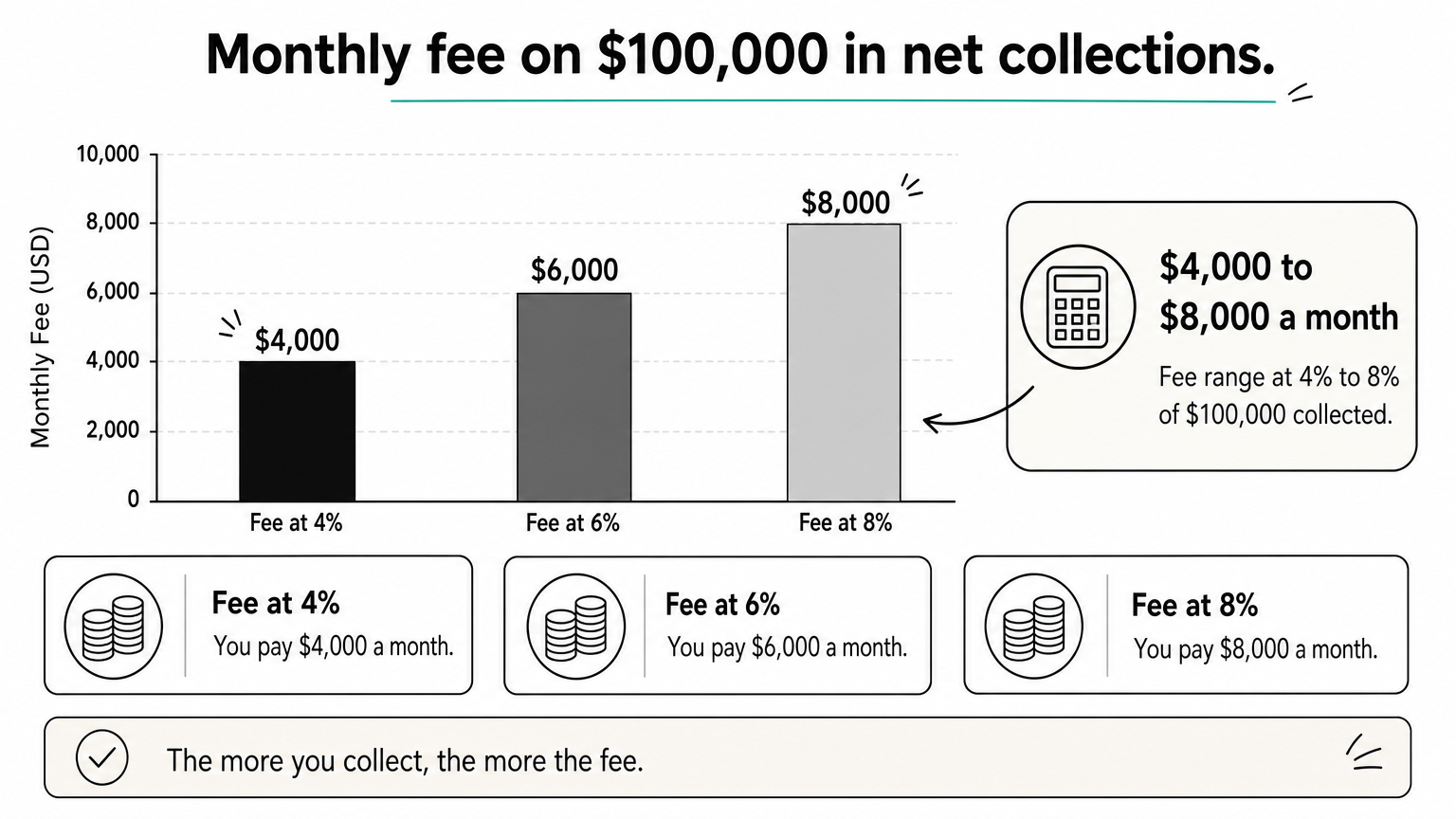
The fair comparison is that fee against what your in-house billing costs today. That means salaries, benefits, software, clearinghouse fees, and training. Vendors often cite savings of 30% to 40% over an equivalent in-house team, but that varies with how efficient your staff already are.
Fees beyond the percentage
Read the contract for the costs that do not show up in the headline rate. Setup charges can be significant, as CareCloud’s reported EDI fees show. Contract length matters too, since three-year terms lock you in even if results disappoint. Look at cancellation notice, which is 30 days written notice for InfiniteRCM’s monthly contracts.
Compare vendors on total cost over the contract term, not on the percentage in the first quote.
How to choose the right medical billing company for your practice
Choose by matching a company’s scale and software model to your practice, then confirm its numbers independently. A vendor that suits a 200-bed hospital can frustrate a four-provider clinic, and the reverse is also true.
Match the company to your practice
Start with your size and software. Use this as a first filter:
- Solo or 1 to 5 providers: InfiniteRCM, Tebra, MZ Medical Billing, or OmniMD.
- Mid-size groups that want to keep their EHR: InfiniteRCM, CareCloud, Transcure, or OmniMD.
- Groups wanting one platform for EHR and billing: athenahealth or AdvancedMD.
- Hospitals and health systems: R1 RCM, GeBBS, or athenahealth.
Specialty matters as much as size. Behavioral health, orthopedics, and cardiology each have distinct payer rules and denial patterns, so ask for experience with your exact claim types.
Questions to ask before you sign
Ask each shortlisted vendor the same questions:

- Which EHR versions have you integrated with, and who handles the interface?
- Will you put clean claim rate, AR days, and collection targets in writing, with a remedy if you miss them?
- Can I speak to a client who has stayed two or more years?
- What is the contract length, the notice to cancel, and every setup fee?
- Where is my billing work done, and who owns denial resolution?
- Will you sign a Business Associate Agreement and show current security certifications?
Then look for the vendor outside its own website. A KLAS rating, a Capterra or G2 profile with real reviews, or a client you can call all count. If the only proof is the vendor’s homepage, treat every number as a claim.
Benchmarks to hold vendors to
Use these ranges to judge the numbers you are given. They come from industry rules of thumb, so use them to frame questions instead of treating them as guarantees.
| Metric | Acceptable | Strong |
|---|---|---|
| First-pass clean claim rate | Industry average is roughly 85% to 87% | 95% to 98% |
| Denial rate | Under 5% to 10% | Under 5% |
| Days in AR | Under 40 | Low 30s or under 30 |
Allow 30 to 90 days for onboarding and 60 to 90 days before results show in denial rates and AR days, assuming your data migrates cleanly. If a vendor promises results in two weeks, ask what that is based on.
Ask every vendor for results from a practice like yours, because averages hide the specialty and payer mix that decide your outcome.
Picking a billing partner you can verify
Choosing among US medical billing companies comes down to three checks: does the company fit your size and software, can you verify its numbers, and are its fees clear over the full contract. Enterprise vendors such as R1 and GeBBS serve hospitals, platforms such as athenahealth and AdvancedMD bundle software with billing, and independents such as MZ Medical Billing and Transcure serve smaller or specialty-heavy practices.
If you want an outsourced team that works inside your current systems, start by asking the same questions of each shortlisted vendor and comparing the answers. To see how InfiniteRCM would handle your claims, denials, and enrollment, talk to the InfiniteRCM team about your practice’s numbers.