The best revenue cycle management companies pair proven claim-level results with a model that fits your size, your EHR, and your specialty mix. Of the six below, InfiniteRCM suits small and mid-sized practices that want outsourced billing with transparent pricing. athenahealth and CureMD suit groups that want billing tied to their software. R1 RCM, Conifer Health, and Optum suit hospitals and health systems.
Most buyers start this search for the same reason. Denials climb, accounts receivable ages, and billing staff spend the week on rework instead of collections. A long vendor directory does not fix that. You need a short list built on fit, plus a way to test every name against your own numbers.
This guide compares six healthcare revenue cycle management companies by what they do, who they suit, and how they charge. InfiniteRCM is our own company, so it sits first, and we state its limits as plainly as we state the others’. A comparison table and a checklist of questions at the end help you turn the list into a real shortlist.
1. InfiniteRCM
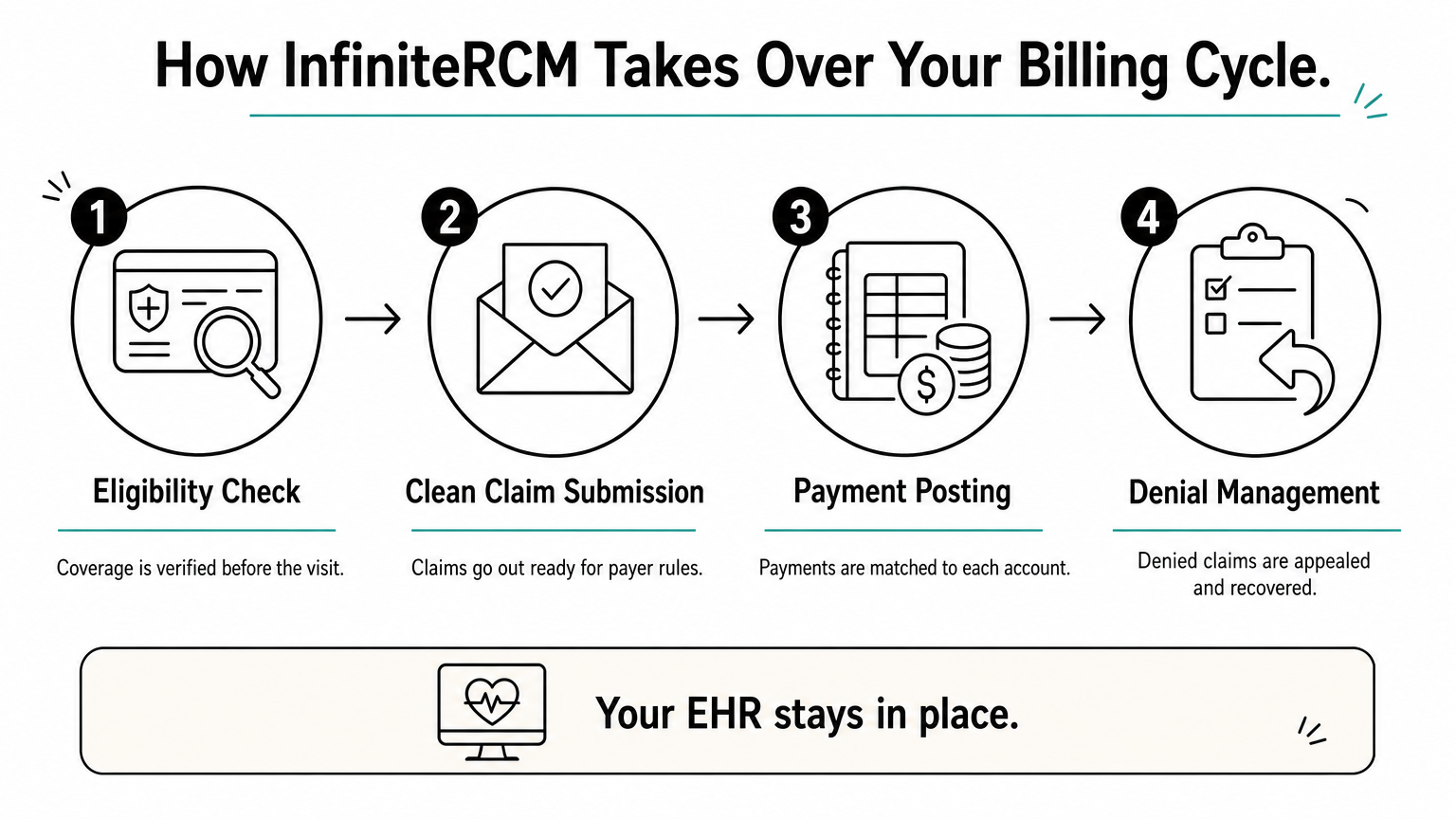
InfiniteRCM is the best fit for independent practices and multi-provider groups that want to hand off billing entirely. It works inside your current EHR or practice management system, so you keep your software and change only who does the work.
What it does
InfiniteRCM runs the full billing cycle, from eligibility verification and clean claim submission to payment posting and denial management. Reporting runs through real-time dashboards, and support is available around the clock.
- Eligibility checks, claim submission, payment posting, and financial reporting
- AR recovery, including underpayment identification and insurance appeals
- Credentialing, payer enrollment, and CAQH profile management
- Prior authorization support and medical virtual assistants for scheduling and verification
The company reports a 99% clean claim rate and 60% fewer denials, with more than $50M recovered across 500+ providers.
InfiniteRCM is the pick when you want the work done for you, not another platform to learn.
Who it suits
It suits practices in family medicine, cardiology, orthopedics, and general clinics. The typical buyer is a practice manager facing high denial rates, aging A/R, or billing staff who are stretched thin.
The limit is scale. InfiniteRCM is a service partner, not a hospital enterprise suite, so a large health system that needs a full patient access redesign will be better served by the last three names on this list.
Pricing and trade-offs
Pricing is transparent with no hidden fees, and you receive a quote scoped to your volume and the services you choose. A certified team with more than 10 years of experience runs the work.
Ask for the same detail you would demand from any of the revenue cycle management companies here. Get a written scope, the fee basis, and a clear picture of the monthly reporting you will receive.
2. athenahealth
athenahealth is the strongest choice for ambulatory groups that want billing, scheduling, and clinical records on one cloud platform. Its revenue cycle tools are built into the platform rather than sold as a separate outsourced service.

What it does
The system uses a rules engine that checks claims against payer requirements before submission, and it automates routine A/R follow-up. Because charge capture and clinical notes share one system, errors that start at the point of care are easier to catch.
- Pre-submission claim edits based on payer rules
- Automated follow-up on unpaid claims
- Billing, scheduling, and clinical records in one system
The value of athenahealth is a single system where clinical and billing data never have to be reconciled.
Who it suits
Medium and large ambulatory practices and multispecialty groups get the most from it. It works best when you are ready to replace your EHR along with your billing process.
It is a weaker fit if you just finished an EHR rollout elsewhere. In that case the switching cost can outweigh the gain, and a service that works inside your current system is the cleaner move.
Pricing and trade-offs
athenahealth has traditionally priced its services as a percentage of collections. That aligns its income with yours, but it can grow expensive as revenue rises. Compare it with the other revenue cycle management companies on total cost, not the headline rate.
The trade-off is dependence. Billing, records, and reporting all sit with one vendor, so moving later is a bigger project than changing a billing service.
3. CureMD
CureMD suits small and mid-sized practices that want an EHR, practice management, and billing from one vendor. It also offers medical billing services, so you can outsource the work instead of running it in-house.
What it does
CureMD sells a unified platform with electronic health records, practice management, a patient portal, and a mobile EHR app. Its billing services sit alongside that software, with denial management and reporting built in.
- Medical billing and revenue cycle services for outsourced work
- Denial management and financial reporting
- Specialty-specific EHR workflows
CureMD works best when one vendor should answer for both the chart and the claim.
Who it suits
Practices across many specialties benefit when they want a single accountable vendor for clinical and billing data. Multispecialty groups and growing clinics are the usual match.
Groups that prefer to keep software and billing with separate companies may find the bundle restrictive. Among healthcare revenue cycle management companies, this is the model where vendor lock-in deserves the closest read of the contract.
Pricing and trade-offs
CureMD pricing is quote-based, and its site routes you to a pricing form instead of a rate card. Ask whether software and billing services are priced separately.
Also request a line-by-line view of onboarding and data migration costs. Implementation fees are where bundled quotes most often diverge from the monthly price.
4. R1 RCM
R1 RCM is a large-scale outsourcing partner for hospitals and health systems that want to hand off most of the revenue cycle. It is built for volume, not for a five-physician clinic.
What it does
R1 provides end-to-end services that cover patient access, coding, billing, and collections. It pairs them with analytics reporting so executives can see performance across entities.
- Front-end patient access and registration support
- Coding, billing, and claim follow-up
- Collections and denial management at high volume
R1 RCM is a system-level operating partner, and its contracts and timelines reflect that.
Who it suits
Health systems and large hospital groups with complex payer mixes and thousands of daily claims are the target. These organizations need a vendor that can absorb entire departments of billing work.
A solo practice or small group would be an awkward match. Of all the revenue cycle management companies here, R1 asks for the biggest commitment, and smaller buyers risk getting less attention.
Pricing and trade-offs
Contracts are negotiated per engagement, and no public rate card exists. Expect a long evaluation and a multi-stage transition.
Insist on service-level targets written into the agreement, along with an exit plan that returns your data and work queues cleanly. Those two clauses protect you if results slip.
5. Conifer Health
Conifer Health Solutions is a revenue cycle outsourcer for hospitals, health systems, and physician groups. It is a subsidiary of Tenet Healthcare, so its processes were built around hospital operations.
What it does
Conifer provides revenue cycle management covering patient access, billing, A/R management, and denial management. It also supports value-based care, which matters to systems moving away from pure fee-for-service.
- Patient access and billing operations
- A/R management and denial management
- Value-based care and financial risk support
Conifer Health is built for hospital billing complexity, which is both its strength and its limit.
Who it suits
Hospitals and health systems that want a long-term operating partner with deep hospital billing experience are the core audience. It also fits organizations planning a shift toward value-based contracts.
Small physician practices will find the scale mismatched. A leaner service or a platform-based vendor usually serves them better and costs less to onboard.
Pricing and trade-offs
Pricing is custom and contract-based. As with every enterprise vendor among revenue cycle management companies, ask for reference clients of your own size and payer mix.
Request named performance metrics in the contract, such as net collection rate and days in A/R. Without them, you cannot judge the partnership after the first year.
6. Optum
Optum, part of UnitedHealth Group, offers revenue cycle technology and services for health systems and physician organizations that want analytics and automation next to outsourcing. It leans on data-driven denial prevention.

What it does
Optum combines software, services, and analytics aimed at claim accuracy, denial prevention, and a better patient financial experience. Buyers can use parts of the offering or take a broader managed arrangement.
- Denial prevention and claim accuracy tools
- Financial analytics for leadership decisions
- Services that range from point solutions to broader outsourcing
Optum is the data-heavy option for systems that want technology and outsourcing in the same contract.
Who it suits
Large health systems and big physician groups with in-house revenue cycle teams are the best match. They can use Optum’s tools to sharpen existing operations without handing over everything.
Small practices will find the scope larger than they need. Healthcare revenue cycle management companies at this tier assume you have dedicated finance staff to manage the relationship.
Pricing and trade-offs
Pricing is negotiated for each organization. Because Optum sits inside a company that also operates in the insurance market, some buyers ask for clear contract language on data use. It is a fair question to settle in writing.
How to choose between revenue cycle management companies
Choose by matching the vendor model to your size, then test claim results against your own numbers. Revenue cycle management companies fall into three models: service-first outsourcers, software platforms with billing built in, and enterprise operators for hospitals.
Side-by-side comparison
Use the table to cut the list down. Size and software situation eliminate most options before price does.
| Company | Model | Best fit | Pricing basis |
|---|---|---|---|
| InfiniteRCM | Outsourced billing service inside your EHR | Small to mid-sized practices, multi-provider groups | Transparent quote, no hidden fees |
| athenahealth | Cloud platform with built-in RCM | Mid-sized to large ambulatory groups | Historically a percentage of collections |
| CureMD | EHR, practice management, and billing services | Small to mid-sized, multispecialty practices | Quote-based |
| R1 RCM | Enterprise outsourcing | Hospitals and health systems | Negotiated contract |
| Conifer Health | Hospital-focused outsourcing | Hospitals, health systems, physician groups | Negotiated contract |
| Optum | Technology plus services | Large systems and physician organizations | Negotiated contract |
Whichever you pick, track three numbers for the first 90 days: clean claim rate, denial rate, and days in A/R. Record your baseline before launch so the comparison is honest.
Questions to ask before you sign
Put these questions to every finalist and compare the answers in writing.
- What are your first-pass acceptance and denial rates for my specialty, and how do you calculate them?
- How many days in A/R do comparable clients carry?
- Will you work inside my EHR, or must I move systems?
- Is my account handled by a named team or a shared queue?
- What is the total cost, including onboarding, credentialing, and patient statements?
- Will you sign a HIPAA business associate agreement, and how do you protect patient data?
- How do I exit, and how is my data returned?
Ask every vendor for first-pass rate and days in A/R by specialty, then compare the answers side by side.
Making your shortlist
The right partner depends on size and software. Small and mid-sized practices usually do best with an outsourced service that works inside their EHR. Groups willing to change systems can consider a platform with billing built in. Hospitals and health systems should focus on the enterprise operators, and they should hold each one to named metrics.
Whatever you choose, measure it against your own baseline for clean claims, denials, and days in A/R. Those numbers show whether a vendor performs better than your current process.
If you run an independent practice or a multi-provider group and want billing, denials, and A/R recovery handled by a team that works inside your current systems, talk to InfiniteRCM about your revenue cycle.