The best healthcare web design agency for your practice builds for patients first, signs a business associate agreement when your site touches patient data, and ties the design to search and booking results. Of the four options below, InfiniteRCM suits practices that want a website and billing from one vendor. Healthcare Web Agency suits small clinics that want a specialist. PatientGain suits owners who want fixed monthly pricing. Orbit Media suits larger organizations focused on growth.
The problem is that every agency calls itself healthcare-focused and HIPAA-ready. A polished site that hides the phone number, loads slowly on a phone, or sends form entries through an insecure tool costs you patients and creates risk. Most lists of healthcare web design companies also fail to say who fits a three-provider clinic and who fits a hospital group.
This article compares four medical website design agencies on the same terms: what they offer, who they suit, and what to ask before you sign. A short guide at the end covers the criteria that separate strong agencies from average ones, with a side-by-side table and a worked cost example.
1. InfiniteRCM
InfiniteRCM fits practices that want their website and their revenue cycle handled by one vendor. It is a billing company first, so treat its web work as a healthcare-specific service that sits next to billing, not as a design studio with a long portfolio.

What it offers
InfiniteRCM’s Web Development Services cover healthcare website development, search engine optimization, social media management, Google Business optimization, and content marketing. That bundle matters because a site alone rarely brings in patients. Local listings and steady content do much of the work around it.
- Website development designed for healthcare businesses
- SEO and Google Business optimization for local discovery
- Social media management and healthcare content marketing
A healthcare website earns its keep only when search, listings, and content work around it.
Who it suits and what to ask
It suits solo providers, small clinics, and multi-provider groups that already struggle with denials or long AR days and want one point of contact. The company says its team is HIPAA certified and that it has served 500+ healthcare providers on the billing side.
Before you sign, ask to see healthcare sites the team has built. Ask how forms handle patient data and whether it will sign a business associate agreement. Those questions apply to every agency here, but they matter most when web design is one part of a wider offer.
2. Healthcare Web Agency
Healthcare Web Agency is the specialist pick for doctors, dentists, and clinics that want a medical website design agency that works only in healthcare. Its pitch is professional websites that patients can trust.
What it offers
The agency describes itself as a healthcare-focused web design agency, and its listing pairs website design with SEO. For a small practice, that pairing is the core need: a credible site and a way for nearby patients to find it.
Because the agency serves several kinds of providers, ask how it tailors a dental site differently from a primary care site. Good answers mention service pages per specialty, insurance information, and clear appointment paths.
A specialist agency is only worth the premium if it can show how its sites differ by specialty.
Who it suits and what to ask
It suits single-location practices and small clinics that want a design partner and have no in-house marketer. You get the most value from a firm that has seen the same patient questions many times.
Ask whether SEO is included in the design price or billed separately. Ask who writes the page copy, and confirm in writing that you own the domain and site files if you ever leave.
3. PatientGain
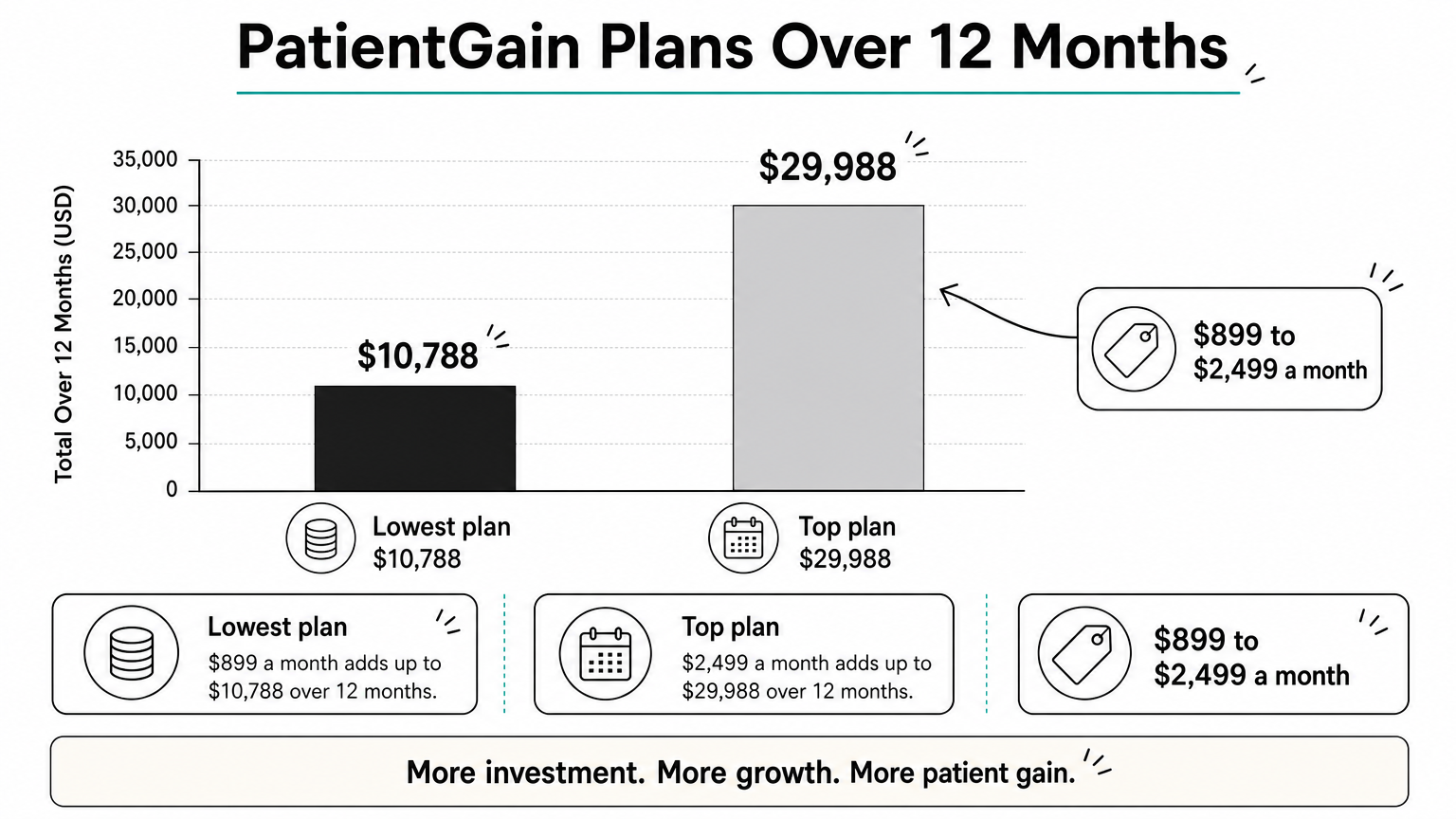
PatientGain is the pick when you want a published price and a subscription model instead of a large upfront project. Its listing shows monthly plans from $899 to $2,499, with HIPAA compliance and SEO included.
What it offers
The model bundles design, HIPAA compliance, and SEO into one monthly fee. That makes budgeting simple, because you know the yearly cost before you start. Over 12 months, the range works out to $10,788 to $29,988.
- Monthly pricing from $899 to $2,499
- HIPAA compliance included
- SEO included
A monthly plan is easy to budget, but only if you know what separates the cheapest tier from the top one.
Who it suits and what to ask
It suits practice owners who prefer predictable monthly costs and want compliance and search handled together. It is less attractive if you plan to run the same site for many years, because subscriptions add up.
Confirm current rates on its site, then ask what each tier includes and how long the contract runs. Ask what happens to your site and content if you cancel the plan.
4. Orbit Media
Orbit Media suits larger practices, multi-location groups, and health organizations with a marketing team that wants measurable growth. Its healthcare offer emphasizes SEO best practices, AI discoverability, and conversion rate optimization.
What it offers
The listing describes healthcare website design and development built for growth. In practice, that means the project is judged by outcomes such as calls, form submissions, and appointment requests, not only by how the site looks.
The emphasis on conversion work is the right one for organizations with several service lines to promote. Ask how it tracks a patient booking request from first click to completed form.
Judge a growth-focused agency by the patient actions it tracks, not by the screenshots it shows.
Who it suits and what to ask
It suits groups with enough volume and budget to justify ongoing optimization, and in-house staff who can supply clinical content and approvals. A solo provider will likely pay for more than they use.
Its public positioning leans toward growth rather than compliance, so ask directly how it handles patient data in forms and integrations. Ask for the business associate agreement terms before any design work starts.
How to compare healthcare web design companies
Compare the best medical website design companies on five things: compliance, patient experience, search results, ownership, and price. If an agency cannot answer all five plainly, keep looking. Treat "HIPAA compliant" as a claim to verify, not a badge. You can read the government’s own overview at HHS HIPAA guidance.
Criteria that separate good agencies
A simple brochure site holds no patient data, but online forms, scheduling, and portals do. That is when a signed agreement matters. A DIY builder may do for a one-provider brochure site, but once you add intake forms you need a vendor that will sign a business associate agreement.

- Compliance: the agency signs a business associate agreement and explains hosting, form handling, and analytics.
- Patient experience: the site works well on a phone, loads fast, meets accessibility standards, and puts the phone number and booking link in view.
- Search: it covers local SEO, your Google Business profile, and a page for each service.
- Ownership: you keep the domain, content, and site files.
- Proof: it shows live healthcare sites you can open on your own phone.
If an agency cannot name who owns the site and who signs the agreement, it is not ready to build yours.
Side-by-side comparison and cost
| Agency | Best for | Standout | Published pricing |
|---|---|---|---|
| InfiniteRCM | Practices wanting web plus billing | Website, SEO, Google Business, content in one service | Request a quote |
| Healthcare Web Agency | Doctors, dentists, small clinics | Healthcare-only focus | Request a quote |
| PatientGain | Owners wanting a fixed monthly cost | HIPAA compliance and SEO included | $899 to $2,499 per month |
| Orbit Media | Larger groups focused on growth | SEO, AI discoverability, conversion work | Request a quote |
Here is a worked example. A three-provider clinic on PatientGain’s lowest plan pays $899 a month, or $10,788 a year. Over three years that is $32,364. Compare that figure with a one-time build quote plus hosting and upkeep before you decide which model costs less.
Choosing your agency
A good healthcare web design agency makes the site easy for patients to use, signs the agreement that protects their data, and shows you how the work brings in appointments. Match the agency to your size: a specialist for a small clinic, a fixed-fee plan if you want predictable costs, a growth-focused firm for larger groups, or one vendor for both billing and web if you want fewer moving parts.
Whichever you shortlist, ask the same five questions on compliance, patient experience, search, ownership, and price, and compare the answers side by side. If you want your website, local search, and billing handled by one healthcare-focused team, contact InfiniteRCM to talk through what your practice needs.