Outsourcing revenue cycle management means hiring an outside company to run some or all of the steps that turn a patient visit into payment: eligibility checks, coding, claim submission, payment posting, denial follow-up, and collections. You keep delivering care. The partner does the billing work, reports on results, and answers for the numbers it agrees to hit.
This article covers why practices and hospitals make the move, how to do it without disrupting cash flow, what can go wrong, how to choose a partner, and what outsourced RCM costs. The same logic applies whether you are weighing outsourced RCM services for a solo practice or a multi-provider group.
InfiniteRCM provides billing, AR recovery, prior authorization, and credentialing for medical practices. The guidance below reflects how these handoffs work in practice, including the parts that are easy to get wrong.
Why outsourcing revenue cycle management matters
Outsourcing matters because small billing failures compound into real revenue loss, and most practices cannot staff a billing department deep enough to catch them. A denied claim that nobody appeals before the payer deadline is money you earned and never collected. An outside team whose only job is billing is built to catch it.
What an outsourcing partner takes over
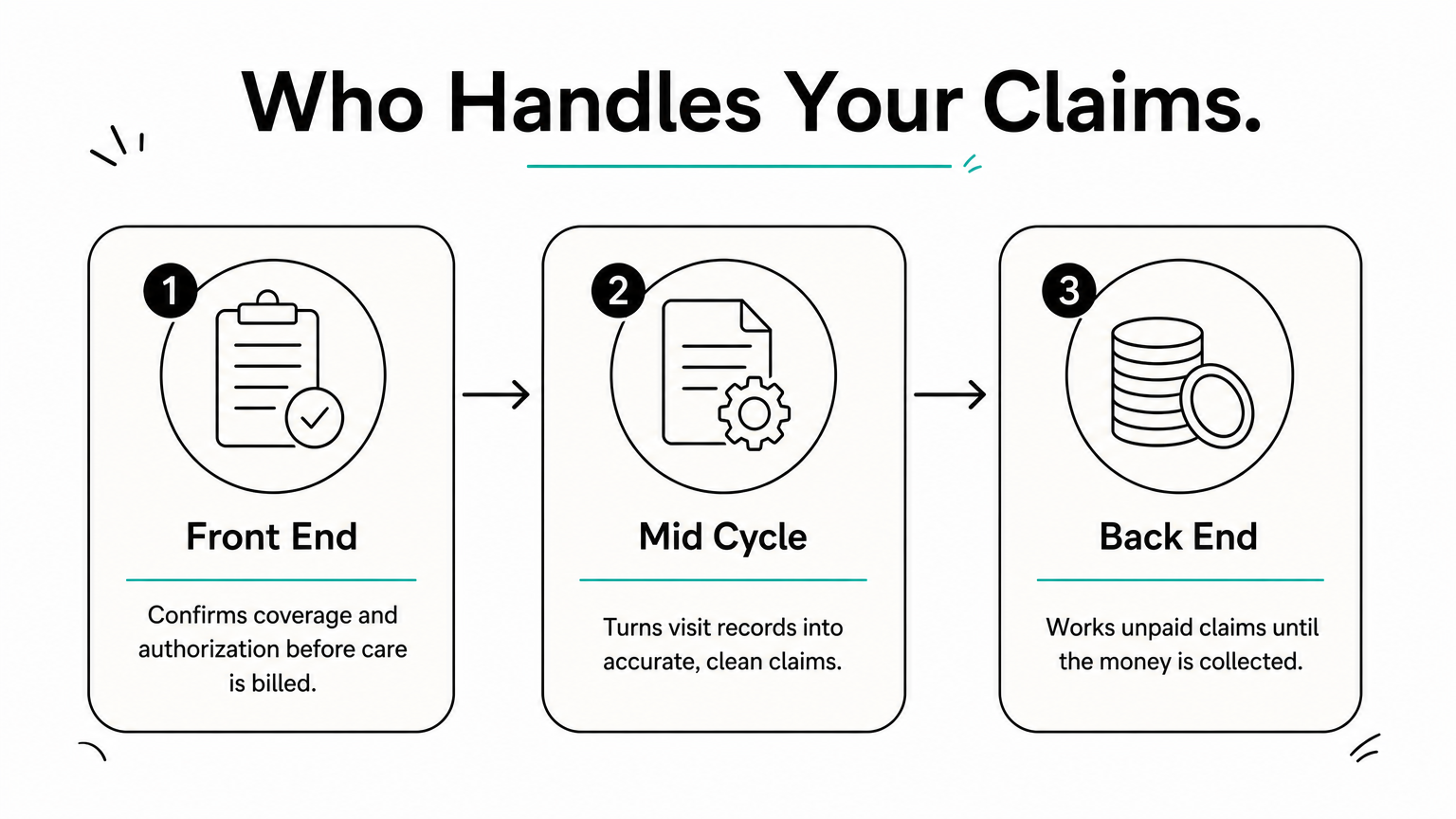
Outsourced RCM services split into three stages of the revenue cycle, and you can hand over one stage or all of them. Full-cycle outsourcing covers every row below. Partial outsourcing targets the stage where you lose the most money.
| Stage | Typical tasks | A common starting point if… |
|---|---|---|
| Front end | Eligibility verification, prior authorization, credentialing and payer enrollment | Claims are denied for coverage or authorization reasons |
| Mid cycle | Charge entry, coding review, clean claim submission | Coding errors or late claims drive rework |
| Back end | Payment posting, denial management, appeals, AR follow-up, patient balances, reporting | Unpaid claims keep aging |
InfiniteRCM sells several of these as separate services, including AR recovery, prior authorization, credentialing and enrollment, and medical virtual assistants. A practice can start with its weak spot instead of replacing its whole workflow.
The benefits you can expect
The biggest benefit is cleaner claims and fewer denials. A team that works claims all day learns payer-specific rules that a generalist front desk never sees. The second benefit is continuity. Your billing no longer stops when a biller quits, goes on leave, or takes weeks to replace and train.
The remaining benefits are easy to scan:
- Visibility: a good partner gives you denial rates, AR aging by payer, and collections trends on demand, not once a month.
- Compliance upkeep: the partner tracks payer rule changes and keeps staff trained on HIPAA.
- Scalability: adding a provider or a location does not mean hiring another biller.
- Focus: you and your staff spend less time on hold with payers.
Adoption is already common. In a November 2024 MGMA Stat poll with 352 applicable responses, 36% of practice leaders said they would outsource or automate part of their revenue cycle in 2025, most often collections, billing, and coding. Half said no, and many of those already outsource some of that work.
Signs it is time to outsource
You do not need all of these. Two or three is enough to justify a serious look:
- Your clean claim rate sits below 90%, which MGMA consultants describe as a generally accepted best practice.
- More than 10% of claims are denied on first pass.
- Days in AR keep rising while patient volume stays flat.
- A billing position has been open for 60 days or more.
- You cannot pull AR aging by payer without a day of spreadsheet work.
- A physician or practice manager spends several hours a week on billing disputes.
Outsource when billing problems cost you more than the fix would, not when the practice is already in crisis.
How to outsource revenue cycle management step by step
You outsource in three moves: measure your current numbers, decide what to hand over first, and run the transition in a fixed order so no claim falls into the gap. Done well, the handoff often takes a few weeks, not a quarter.

Measure your baseline before you talk to vendors
Pull the last 6 to 12 months of data and record six numbers. Without them you cannot judge a proposal or prove the partner is working.
- Clean claim rate: share of claims accepted without errors on the first submission.
- First-pass denial rate: share of claims denied on the first submission.
- Appeal overturn rate: share of appealed denials that get paid.
- Days in AR: average time to collect after service.
- Net collection rate: payments collected divided by what you were contractually owed.
- Cost to collect: total billing cost divided by total collections.
Decide what to hand over first
Match the scope to your biggest leak. If denials and aging claims hurt most, start with denial management and aged AR recovery. If staffing is the problem, a medical virtual assistant or a full billing handoff makes more sense. If you are adding providers, credentialing and enrollment delays cost the most, because a provider who is not enrolled cannot bill that payer.
Keep the number of vendors small. Each vendor calculates metrics its own way, so three vendors can hand you three reports that never reconcile. One partner that owns the whole chain gives you one set of numbers and one party to hold accountable.
Run the transition in a set order
A clean handoff follows a sequence. Skipping steps is how claims get lost.
- Sign a business associate agreement (BAA) before anyone sees patient data.
- Grant system access to your EHR or practice management system, clearinghouse, and payer portals.
- Agree who works the old AR, meaning claims submitted before the start date, and by when.
- Verify payer enrollment and credentialing so new claims are not rejected for setup errors.
- Set KPIs and a reporting rhythm, such as weekly dashboards and a monthly review call.
- Run claims in parallel for a short period so you can compare the partner’s output to your own.
- Review at 90 days against your baseline and fix gaps in writing.
At InfiniteRCM, onboarding typically takes a few days to a few weeks depending on setup complexity. The team works inside your existing systems remotely, so you buy no new software, and most claims go out within 24 to 48 hours of charge entry. Ask any vendor for the same specifics.
Measure first, hand over one stage at a time, and follow the same seven steps every time.
Risks of outsourced RCM and how to reduce them
Outsourcing carries real risks: less direct control, wider exposure of patient data, a dip during transition, and dependence on one partner. Each one can be managed with the right contract and oversight, but none disappears on its own.
The drawbacks worth taking seriously
The first risk is losing sight of your own revenue. If the partner sends only a monthly summary, you cannot see problems until they have cost you money. The second is misaligned incentives. A fee based on a percentage of collections can reward working easy claims and leaving hard appeals untouched.
Dependence is the third risk. After the 2024 Change Healthcare ransomware attack disrupted claims processing and eligibility checks, some practices told MGMA they moved back in-house. They had been forced into manual workarounds and wanted direct control. The lesson is not to avoid outsourcing. It is to ask every partner how it keeps claims moving when a clearinghouse or system goes down.
Safeguards to put in the contract
| Risk | Safeguard to require |
|---|---|
| Lost visibility | Read access to your own PM system and clearinghouse reports, plus weekly dashboards |
| Data security | Signed BAA, role-based access, HIPAA-trained named staff, breach notification timeline |
| Transition dip | Parallel run, written ownership of old AR, 90-day review |
| Misaligned incentives | Reporting on appeals and aged AR, not only total collections |
| Lock-in | Short initial term, clear notice period, data return on exit |
| Outages | A documented backup plan for the clearinghouse and billing systems |

On exit terms, InfiniteRCM’s monthly contracts cancel with 30 days written notice. Whatever vendor you choose, confirm the notice period before you sign, because it tells you how easy it is to leave if results fall short.
Every risk of outsourcing has a contract clause that contains it, so negotiate the clauses before you sign.
How to choose an RCM outsourcing partner
Choose the partner that can show you claim-level data, name the people who will touch your patient information, and commit in writing to measurable targets. Reputation and sales polish matter less than those three things.
Criteria that separate partners
| Criterion | What to ask | What a good answer sounds like |
|---|---|---|
| Specialty fit | How many practices like mine do you bill for? | Named specialty experience and payer mix knowledge |
| System integration | Do you work inside my EHR or PM system? | Yes, with no forced software change |
| Reporting | What can I see, and how often? | Real-time dashboards with claim-level detail |
| Compliance | Who handles my PHI, and how are they trained? | A BAA, HIPAA training records, audit history |
| Performance terms | Which targets are in the contract? | Clean claim rate, denial rate, and days in AR in writing |
| Account management | Who do I call? | A named manager with a stated response time |
Size matters less than fit. MGMA notes that some practices prefer smaller vendors for personal attention, while others choose larger revenue cycle management companies for resources and technology. For reference, InfiniteRCM assigns a dedicated account manager, uses a HIPAA certified team, and reports a 99% clean claim rate. Whatever number a vendor quotes, ask how it is calculated and whether it appears in the contract.
Questions to ask on the sales call
- Which clearinghouse do you use, and what is your backup if it goes down?
- How do you handle claims that were denied before we started?
- Who appeals denials, and how do you decide which ones to pursue?
- Can I see a sample report with real claim-level data?
- Who owns the data and the payer relationships if we leave?
- How are fees calculated, and what is billed separately?
Red flags to walk away from
Be wary of any vendor that promises a 100% clean claim rate, because no one achieves it. Walk away from vendors who will not name who works on your account, who limit you to a monthly summary, or who lock you into a long auto-renewing term. Third-party recognition such as KLAS rankings or HFMA MAP awards helps, but read how the ranking was built. Then call two references that match your specialty and size.
A partner who shows you claim-level data before you sign will show you the same data after.
What outsourced RCM costs and how pricing works
Outsourced RCM services are priced one of four ways: a percentage of collections, a flat monthly fee, a per-claim fee, or an hourly or full-time-equivalent rate for medical billing virtual assistants. The right model depends on your volume and on what behavior you want the partner to be paid for.
Common pricing models compared
| Model | How it works | Best for | Watch out for |
|---|---|---|---|
| Percentage of collections | Fee is a share of what is collected | Practices wanting aligned incentives | Rewards easy claims over hard appeals |
| Flat monthly fee | Fixed amount regardless of volume | Stable, predictable volume | Overpaying in slow months |
| Per claim | Fee for each claim submitted | Low or uneven volume | Costs rising with claim count |
| Hourly or FTE | Pay for a dedicated assistant’s time | Admin support, scheduling, verification | Needs you to direct the work |
Ask for a written list of what is included. Setup fees, appeals, credentialing, patient statements, and minimum monthly charges are common extras. InfiniteRCM advertises transparent pricing with no hidden fees, and you should get the same clarity from any vendor.
A worked example for a five-provider practice
These figures are assumptions for illustration, not quotes. A practice collects $1,200,000 a year. In-house, it employs two billers at $50,000 each, pays 25% on top for benefits and payroll taxes, and spends $15,000 on software and clearinghouse fees. Outsourced, it pays a partner 6% of collections, assumes the software cost is included in that fee, and keeps a part-time coordinator at $20,000.
| Line | In-house | Outsourced |
|---|---|---|
| Billing staff (2 × $50,000) | $100,000 | $0 |
| Benefits and payroll taxes (25%) | $25,000 | $0 |
| Software and clearinghouse | $15,000 | $0 |
| Part-time coordinator | $0 | $20,000 |
| Partner fee (6% of $1,200,000) | $0 | $72,000 |
| Total | $140,000 | $92,000 |
The direct saving is $48,000 a year, and cost to collect falls from about 11.7% to about 7.7%. If stronger denial work lifts collections by 3%, that adds $36,000, or $33,840 after the 6% fee on the extra revenue. The combined yearly advantage is $81,840. Your numbers will differ, so run the same table with your own baseline.
Compare total cost to collect, not the fee percentage, because the cheapest quote is rarely the cheapest result.
Deciding whether to outsource
Outsourcing revenue cycle management pays off when your billing results lag, your staff is stretched, and you cannot see what is happening to your claims. Measure your baseline, hand over the stage that leaks most, protect yourself with a BAA and written targets, and judge any partner by the data it shows you.
If you want to see how this would work for your practice, talk to the InfiniteRCM team. Bring your current clean claim rate, denial rate, and days in AR, and we can tell you plainly whether outsourcing makes sense and where to start.