Cardiology billing is not like billing for other specialties. Stress tests, echocardiograms, device checks, and cath lab procedures each carry strict coding rules and payer-specific edits. One missed modifier or a weak prior authorization can sink a claim. If you are losing money to denials and slow payments, the right cardiology medical billing company can fix that faster than hiring more in-house staff.
Here is the short answer. The best cardiology medical billing services combine cardiology-specific coding expertise with strong denial management, clean claim rates above 95%, and transparent pricing. Avoid any vendor that treats your practice like a generic clinic or hides fees in the contract.
Below, you will find six companies worth comparing in 2026. For each one, we cover what it does well, who it fits best, and where it may fall short. We also include InfiniteRCM, which reports a 99% clean claim rate and 60% fewer denials across 500+ providers. Use the list to build a shortlist, then ask each vendor the questions that matter.
1. InfiniteRCM
What it offers cardiology practices
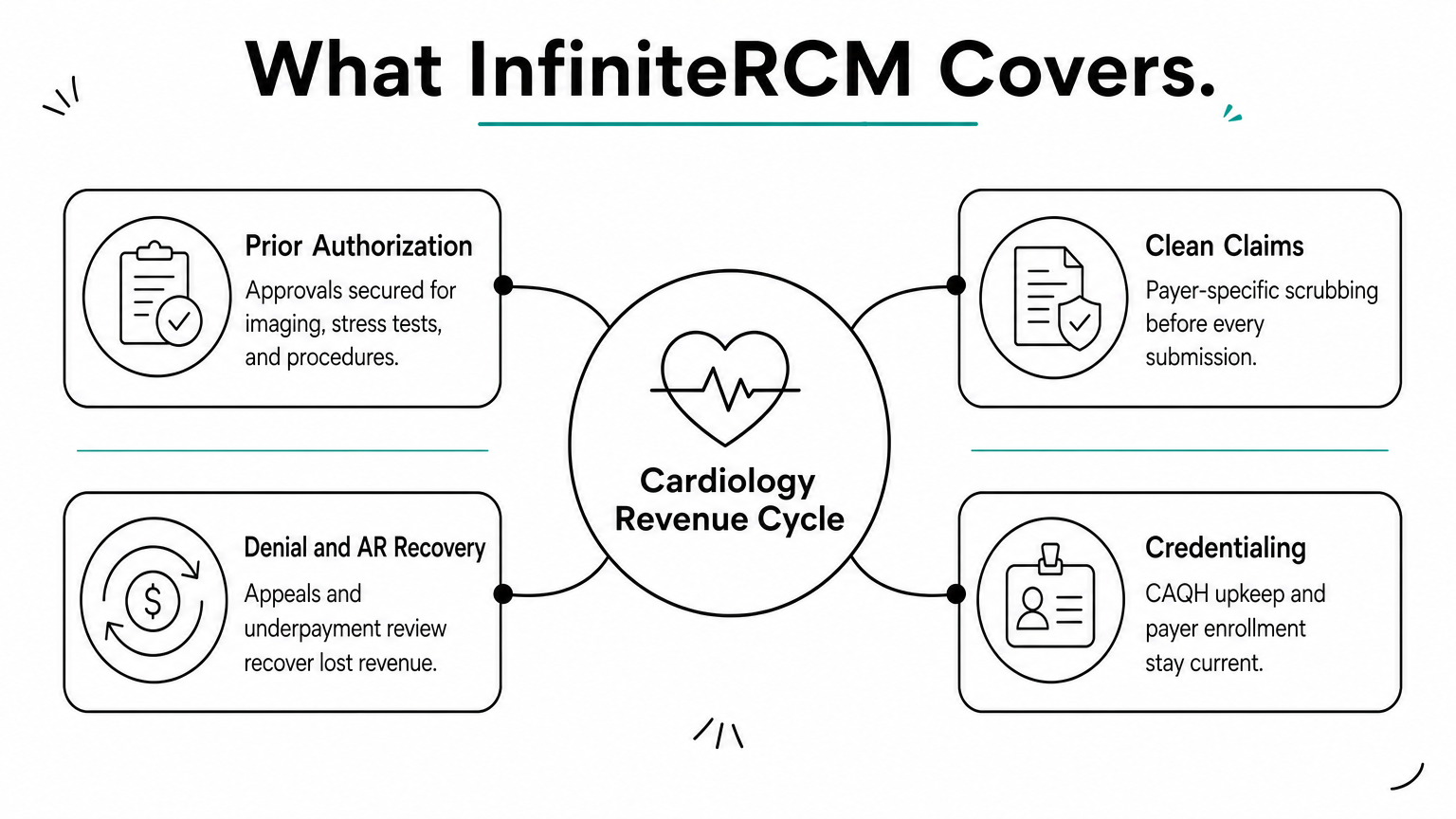
InfiniteRCM is a full-service cardiology medical billing company that manages the whole revenue cycle, not just claim submission. Its medical billing services cover the work that trips up cardiology claims most often:
- Eligibility verification and prior authorization for imaging, stress tests, and procedures
- Clean claim submission with payer-specific scrubbing
- Payment posting and denial management
- AR recovery, including underpayment review and insurance appeals
- Credentialing, CAQH upkeep, and payer enrollment
Everything runs on cloud-based tools with real-time analytics dashboards and 24/7 support. It also connects to your existing EHR or practice management system, so you do not have to switch software.
Best fit for
Independent cardiology groups and multi-provider clinics that want one partner for billing, AR, and credentialing will get the most from these cardiology medical billing services. The company also offers medical virtual assistants for scheduling and insurance verification, which helps if your front desk is buried in authorizations.
Skip it if you only want a software license or a coding-only review. InfiniteRCM works best as a hands-on outsourced team that takes over daily billing tasks.
Pricing and contract terms
InfiniteRCM says its pricing is transparent with no hidden fees. It does not publish a rate card, so request a written quote based on your provider count and collections volume.
Before signing, confirm the contract length and exit terms. Also ask who owns your claims data if you leave.
Strengths and limitations
The numbers are the main draw. The company reports a 99% clean claim rate, 40% faster collections, and 60% fewer denials, with more than $50M recovered for 500+ providers. Add credentialing and prior authorization under one roof, and fewer claims fall through the gaps between vendors.
A billing partner earns its fee in denials prevented, not just claims sent.
On the downside, InfiniteRCM serves many specialties, so ask to speak with a cardiology biller about your CPT mix. The results are also self-reported, so request references from similar practices.
2. CareCloud
What it offers cardiology practices
CareCloud pairs outsourced revenue cycle management with its own cloud-based EHR and practice management platform. For cardiology medical billing services, that means billing and clinical data can live in one system. Core services include:
- Charge capture and claim scrubbing
- Denial follow-up and AR work
- Eligibility checks and patient statements
- Reporting on collections and payer performance
Best fit for
Mid-size and larger cardiology groups that want billing and software from one vendor will see the most value. Multi-location reporting is a natural strength of a bundled platform.
Smaller practices already happy with their EHR may find the bundle less useful. If you plan to keep your current system, ask whether CareCloud can work inside your existing EHR before you commit.
Pricing and contract terms
Pricing is quote-based, and CareCloud does not publish a rate card. Vendors in this category commonly charge a percentage of collections, so expect a rate tied to your volume. Get the termination notice and data-return terms in writing before you sign.
Strengths and limitations
Scale is the main strength. As a publicly traded company with a large technology platform, CareCloud offers depth that small billing shops cannot match.
Bundled software only pays off if your team will actually use it.
The tradeoff is less personal attention. Cardiology-specific coding is not its headline feature, so ask for a biller who knows your CPT mix and request cardiology references from current clients.
3. CureMD
What it offers cardiology practices

CureMD offers cardiology medical billing services alongside a cloud-based EHR and practice management suite. The billing side covers:
- Charge entry and coding review
- Claim submission and rejection cleanup
- Denial management and AR follow-up
- Patient billing and financial reporting
Best fit for
Practices that want EHR and billing under one roof suit CureMD well, especially groups replacing an outdated system. Clinical notes and charges flow into one record, which cuts re-entry errors.
Smaller groups happy with their current software may not need the bundle. Ask whether CureMD will bill from your existing EHR and what a migration would cost.
Pricing and contract terms
CureMD does not publish a rate card, so expect a custom quote based on provider count and collections. Billing is often a percentage of collections, though software fees may sit on top.
Get the full fee breakdown in writing, including setup, support, and contract exit terms.
Strengths and limitations
The strength is unified data. When scheduling, documentation, and billing share one platform, coders see the clinical detail behind each stress test or echo.
One system helps only if your billers and clinicians both use it well.
The limitation is flexibility. Billing works best inside CureMD’s own platform, so practices tied to another EHR may get less value. Ask for a cardiology-trained biller and request references from similar groups.
4. AnnexMed
What it offers cardiology practices
AnnexMed positions itself as a cardiology medical billing company with a wider menu of outsourced billing services. Typical scope includes:
- Charge entry and CPT and ICD-10 coding review
- Claim submission and rejection follow-up
- Denial management and AR recovery
- Credentialing support
Best fit for
Small and mid-size cardiology groups that want a dedicated billing team without hiring one in-house are the natural match. It suits practices that mainly need claims and AR handled and are not shopping for new software.
Larger systems with busy cath labs or many sites should test capacity first. Ask how many billers would be assigned to your account.
Pricing and contract terms
AnnexMed does not publish a rate card, so plan on a custom quote. Outsourced billing is usually priced as a percentage of collections, though you should confirm that directly.
Next, get written terms for setup fees, minimum contract length, and exit. Also ask whether the percentage applies to billed or collected amounts, because that changes your real cost.
Strengths and limitations
The appeal is a service-first model. You get a billing team that works your denials and aging claims, which helps when your staff is stretched.
A cardiology biller who knows your CPT mix matters more than a long feature list.
On the other side, AnnexMed serves many specialties, so cardiology depth is something to verify. Request a sample denial report and references from cardiology clients before you decide.
5. BellMedEx
What it offers cardiology practices
BellMedEx is a cardiology medical billing company that sells outsourced RCM to specialty practices. Its scope follows the standard revenue cycle:
- Eligibility checks and prior authorization
- Charge entry and coding review
- Claim submission and denial follow-up
- AR recovery and payment posting
- Credentialing support
Best fit for
Small and mid-size cardiology practices that want a managed billing team will fit best. It suits groups that need claims and AR handled without buying new software.
Large hospital-based groups should test capacity first. Ask how BellMedEx handles high-volume cath lab and device billing before you sign.
Pricing and contract terms
Expect quote-based pricing. BellMedEx does not publish a rate card, and outsourced billing is commonly a percentage of collections.
Finally, get setup fees, minimum term, and exit terms in writing. Ask whether the percentage applies to billed or collected amounts, because that changes your real cost.
Strengths and limitations
The draw is a service-first model. People work your denials and aging claims, which helps when your own staff is stretched thin.
Ask every vendor for cardiology denial data, not a general pitch.
On the downside, BellMedEx serves many specialties, so verify cardiology depth with a sample denial report. Also request references from cardiology clients with a similar CPT mix.
6. Medical Billers and Coders
What it offers cardiology practices

Medical Billers and Coders, often shortened to MBC, is a cardiology medical billing company with a clear coding and billing focus. Its scope for cardiology practices typically includes:
- Charge entry with CPT and ICD-10 coding
- Claim submission and denial follow-up
- AR recovery and payment posting
- Credentialing support
Best fit for
Practices that want accurate coding alongside billing will find a fair match here, especially small and mid-size groups with heavy imaging and stress test volume.
Larger multi-site systems should test capacity and turnaround times first. Ask how many billers would handle your account and who reviews complex cath lab claims.
Pricing and contract terms
Pricing is quote-based, and MBC does not publish a rate card. Outsourced billing is commonly a percentage of collections, so expect a rate tied to your volume.
Get setup fees, minimum term, and exit terms in writing. Confirm whether the percentage applies to billed or collected amounts.
Strengths and limitations
The main strength is coding depth. Cardiology denials often start with a wrong modifier or a mismatched diagnosis code, and a coding-first team catches those before submission.
Strong coding stops denials before the payer ever sees the claim.
On the other hand, MBC serves many specialties, so cardiology experience needs checking. Ask for a sample denial report and references from cardiology clients. Also confirm what reporting you receive each month.
Choosing the right billing partner
Every company on this list can submit claims, but they differ in cardiology depth, software requirements, and how much daily work they take off your team. Choose a bundled platform if you want new software. Choose an outsourced billing team if you plan to keep your current EHR.
Whichever vendors you shortlist, ask for cardiology references, a sample denial report, and written fee and exit terms. A good cardiology medical billing company answers those questions without hesitation, and the answers tell you more than any sales deck.
If you want one partner for billing, AR recovery, credentialing, and prior authorization, request a quote from InfiniteRCM and ask to speak with a cardiology biller first. After you switch, watch your denial rate and AR days, because those two numbers show whether the partnership is paying off.