An MSO PC structure splits a medical practice into two legal entities. The professional corporation (PC) is owned by licensed physicians and delivers patient care. The management services organization (MSO) is a separate company that runs the business side: billing, staffing, IT, marketing and operations. A management services agreement (MSA) ties the two together. You will also see it written as MSO-PC, MSO/PC or PC-MSO. It is the same arrangement under every spelling.
This article covers why practices and founders use the structure, how to set it up step by step, and how the MSA moves services and money between the entities. It also shows how to keep the whole arrangement within corporate practice of medicine (CPOM) rules. Along the way you get a table of typical fee models with a worked example, plus the mistakes that cause the most trouble.
At InfiniteRCM we handle billing, credentialing and prior authorization for healthcare providers, which are the functions an MSO usually takes on. We are not a law firm. Use this as a working guide and have a healthcare attorney review your own documents before you sign anything.
Why the MSO PC structure matters
The structure lets non-physicians run, fund and grow the business side of a practice without breaking CPOM laws, while physicians keep full control of clinical decisions. If you want outside capital, non-physician founders or multi-site growth in a CPOM state, you will almost certainly need it.
The corporate practice of medicine problem
Many states prohibit ordinary corporations from practicing medicine or employing physicians. The reasoning is that medical decisions should rest on patient needs, not corporate interests. The rules vary by state, and they often reach other licensed professions too, such as nurse practitioners, therapists, psychologists and dentists.
In a CPOM state, the entity that delivers care generally has to be owned by physicians licensed in that state. It is formed as a PC, or as a PLLC or professional association where the state allows it. That leaves founders, investors and management firms unable to own the clinic. The MSO PC structure closes the gap. The physician-owned PC practices medicine, and the MSO owns and runs everything non-clinical.
What the structure gives you
When it is built correctly, the structure delivers four practical benefits:
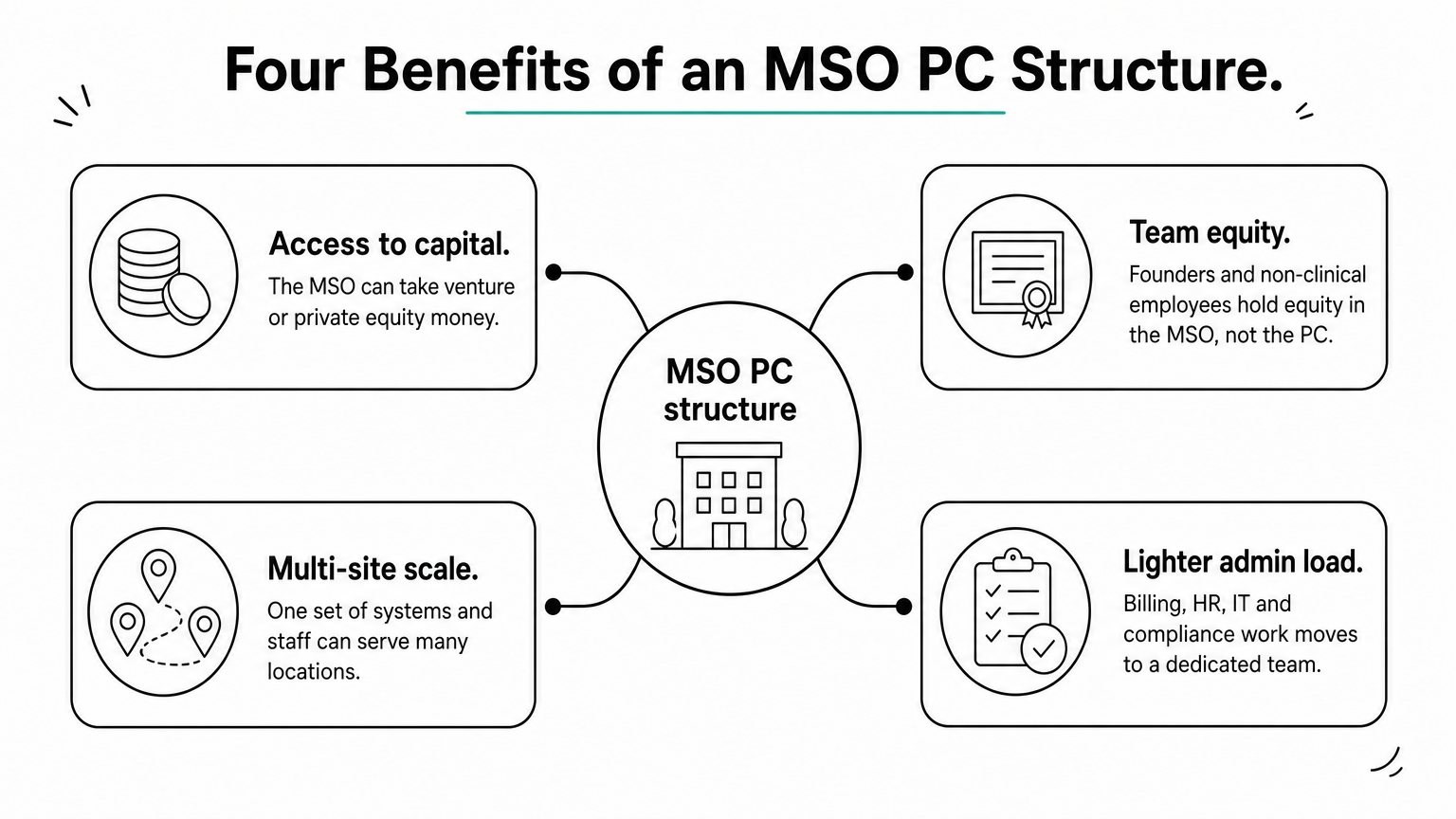
- Access to capital. The MSO can take venture or private equity money. The PC cannot, because only physicians can own it.
- Equity for the team. Founders and non-clinical employees hold equity in the MSO, not in the PC.
- Scale. One set of systems, staff and processes can serve many locations.
- Less administrative load for physicians. Billing, HR, IT and compliance work moves to a dedicated team.
What a breach costs
Getting this wrong is expensive. Penalties can include fines, criminal charges in cases involving fraud, and risk to physicians’ licenses. Contracts that violate CPOM laws can be declared unenforceable. Malpractice insurance may not cover activity that broke the rules, and payers can claw back claims they paid to a group that was improperly organized.
The structure exists to keep clinical decisions with physicians, so every other design choice has to protect that line.
How to set up an MSO PC structure
Setting up an MSO PC structure means forming a physician-owned PC and a separate MSO, signing the MSA and related agreements, putting the right assets and people in each entity, and keeping finances apart from day one. Work through the steps in order, with a healthcare attorney.
The setup steps
- Pick your states and read each state’s rules. CPOM law and PC formation requirements differ by state.
- Form the PC. A physician licensed in that state must own it.
- Form the MSO. Many companies use a corporation if they plan to raise outside capital.
- Decide who holds what. Assign assets, contracts and staff to the correct entity.
- Sign the MSA and companion agreements. These include a succession agreement for the PC’s ownership.
- Separate the money. Open separate bank accounts and keep separate books for each entity.
- Enroll the PC with payers. The PC bills under its own name, so credentialing and enrollment happen in the PC’s name.
Who owns and does what
The split below is the most common way to divide responsibilities. The exact line depends on your state and your counsel’s advice.
| Item | Professional corporation (PC) | Management services organization (MSO) |
|---|---|---|
| Owners | Physicians licensed in the state | Founders, investors or a management firm |
| Core job | Patient care and clinical decisions | Non-clinical operations |
| Staff | Physicians and clinicians it supervises | Administrative and operations staff |
| Payer relationship | Contracts with and bills payers | Supports billing under the MSA |
| Systems | Owns patient records | Runs software, IT and office infrastructure |
| Income | Patient and payer revenue | Management fee paid by the PC |
If your MSO is not yet staffed for revenue cycle work, that is a function you can bring in. InfiniteRCM’s Revenue Cycle Management service covers eligibility verification, clean claim submission, payment posting, denial management and reporting. Its Credentialing & Enrollment service covers provider credentialing, payer enrollment and CAQH profile management.
Choosing the physician owner
In the common "friendly PC" model, the MSO’s leadership has the right to choose the physician owner and replace them if needed. "Friendly" means collaborative. The owner is a real physician who holds the PC and takes responsibility for clinical oversight, and the arrangement lets the business keep a working relationship with that physician.
The owner must be licensed in every state where the PC practices. Multi-state telehealth companies therefore often use a few PCs instead of one per state, with a widely licensed physician as owner. A succession or stock transfer agreement should say what happens if the owner leaves, retires or dies, so the PC never ends up without a qualified owner.
Decide who legally owns what before you sign anything, because the MSA only works if the ownership is already clean.
How the management services agreement links the PC and MSO
The MSA is the contract in which the MSO agrees to provide defined non-clinical services to the PC for a fee. It also records who controls what. In an MSO PC structure, it is the document regulators, investors and auditors read first.
What the MSA should cover
A solid MSA spells out the scope of services in plain terms. Vague language such as "all management functions" invites disputes and compliance questions. At a minimum it should address:

- The services the MSO provides and the clinical areas that stay with the PC
- Service levels and performance measures
- The fee, how it is calculated and when it is paid
- Term, renewal and termination rights
- Hiring and termination rights for staff
- Ownership of new intellectual property
- Ownership of patient records, which belong to the PC
- Dispute resolution
The MSA can authorize the MSO to negotiate contracts for the PC, such as vendor agreements. Clinical decisions still stay with the physicians.
Fee models compared
The fee is where most agreements get into trouble. Three models are common: a fixed fee, cost plus a margin, and a percentage of revenue. Some states limit which methods you may use, so confirm with counsel first.
The example below is illustrative, not a benchmark. Assume the PC collects $100,000 in a month and the MSO’s actual cost to serve it is $40,000.
| Model | How it works | Monthly fee in the example |
|---|---|---|
| Fixed fee | Flat amount set in advance | $42,000 |
| Cost plus | MSO cost plus an agreed markup | $40,000 + 10% = $44,000 |
| Percentage of revenue | Share of PC collections | 42% of $100,000 = $42,000 |
Under any of the three, the PC keeps what remains after the fee to pay physicians and its own expenses. In this example that is between $56,000 and $58,000 a month before those costs.
Fair market value and actual payment
Whatever the model, the fee should reflect fair market value for the services delivered. It is not always easy to determine, and a valuation is often needed before fundraising, a sale or another diligence event. Because the PC bills Medicare and other federal programs in many cases, counsel should also check the fee against federal fraud and abuse rules such as the Anti-Kickback Statute.
Cash must also move. If the PC deducts the fee but never actually pays it, the IRS can disallow the deduction. That leaves the PC exposed to income tax, fines and penalties.
A management fee only protects you when it is set at fair market value and actually paid.
How to keep an MSO PC structure CPOM compliant
Compliance comes down to three habits: physicians control clinical decisions, money and records stay separate, and your documents match how you actually operate. Regulators judge the structure by what happens in the practice, not only by what the paperwork says.
Keep clinical control with the PC
The PC decides diagnoses, treatment plans, clinical protocols, and how clinicians are supervised and evaluated. The MSO supplies tools, staff and systems, but it does not overrule a physician’s judgment. Write that line into the MSA and then follow it.
A simple test: can an MSO manager override a physician’s treatment decision? If yes, the structure is failing, however clean the contracts look. Keep metrics, productivity targets and scheduling policies from becoming back-door clinical pressure.
Separate money, records and identity
Give each entity its own bank account, tax filings and books. Track revenue and expenses by entity and by location, and use accrual accounting, which records income when earned and expenses when incurred. This makes valuation and tax reporting cleaner.

Patient records belong to the PC, and the MSA should say so. Because the MSO touches protected health information, the PC and MSO should sign a HIPAA business associate agreement. Patient-facing materials should also make clear which entity provides care.
Billing is a common weak spot. Claims go out under the PC’s name, so any billing vendor needs to work in the PC’s enrollment and payer setup.
Recheck state rules as you grow
CPOM rules are not uniform. Some states have strict rules, others are looser, and the rules for other professions can follow different lists of states. Even where a state has no formal CPOM law, many companies use the structure to reduce regulatory scrutiny.
Review the structure whenever you enter a new state, add an investor, change the fee or add a new clinical service line. A yearly check with counsel is a sensible minimum.
Regulators judge your structure by how it operates, so the MSA has to describe what actually happens.
Common mistakes and when the structure fits
Most problems come from a handful of predictable errors, and the structure is not right for every practice. Check your plan against the list below before you pay for a full legal build.
Mistakes that cause trouble
- A fee that sweeps all remaining profit to the MSO. It raises questions about who really controls the practice.
- Paperwork that does not match reality. The MSA says the PC controls clinical decisions, but the MSO manager does.
- A physician owner in name only. The owner is not licensed in the state, or has no real oversight role.
- Mixed funds. One bank account, or fees that are never actually paid.
- No valuation. The fee cannot be defended when an investor or buyer asks.
- One-size-fits-all across states. Rules in one state do not carry over to another.
- No succession plan. The PC is stuck if its owner leaves.
When the structure fits
The structure usually makes sense if you are:
- Raising venture or private equity investment
- A non-physician founder starting a clinic or telehealth company
- Expanding to several locations or states
- Losing growth to administrative burden
- Facing rising compliance risk
A small physician-owned practice with simple operations and no outside investor may not need it yet. Two entities mean legal fees, separate books and ongoing administration, so weigh that cost against what you gain. Your attorney can tell you whether your state’s rules make the case for it.
Where to go from here
An MSO PC structure keeps clinical care in a physician-owned PC and puts business operations, capital and growth in a separate MSO. The management services agreement connects them, the fee has to reflect fair market value, and the separation has to be real in daily practice. Get the ownership, the MSA and the finances right at the start and the structure supports growth. Get them wrong and it creates compliance and tax problems.
Billing, credentialing and prior authorization are the functions where an MSO PC structure either works smoothly or leaks revenue. If you want help with those, book a free consultation with InfiniteRCM.