
A management services organization MSO is a business entity that handles the non-clinical work of running a medical practice: billing, HR, IT, purchasing, credentialing, and compliance. It does not practice medicine or make clinical decisions. Licensed clinicians keep control of patient care, and the MSO is paid under a contract for the administrative services it delivers.
This article goes past the definition. You will see why practices use MSOs, how to match MSO services to the problems in your own practice, how MSOs are structured, owned, and paid, and which laws shape the whole arrangement. That includes corporate practice of medicine rules, fee-splitting limits, and the federal Stark and Anti-Kickback laws.
At InfiniteRCM we work on the revenue cycle side of the back office: eligibility checks, claims, denials, AR recovery, credentialing, and prior authorization. Those functions are among the first things an MSO takes over, so we see up close where administrative work costs practices money. We are a service provider, not a full MSO, and the article will show you the difference.
Why practices use a management services organization
Practices use an MSO because administrative work grows faster than clinical revenue, and an MSO lets a small group buy scale it cannot build alone. The benefit shows up in cost, cash flow, and the time physicians get back.
Administrative work crowds out patient care
Every practice runs payroll, claims, payer contracts, credentialing, IT security, and HIPAA programs. Each one calls for specialist skill. A three-physician practice rarely has the budget for a billing manager, a compliance lead, an HR generalist, and an IT administrator.

An MSO spreads those roles across many clients. The practice gets specialist staff without full-time salaries, and physicians stop spending evenings on payer paperwork and staffing problems.
Scale lowers costs and steadies cash flow
MSOs negotiate with vendors on behalf of many practices at once. That buying power can reduce what you pay for supplies, EHR licenses, equipment, and service contracts. The practice keeps its independence and gets pricing closer to what a health system pays.
Revenue is the other half. Dedicated billers and coders reduce preventable denials and speed up payment. The usual gains are:
- Lower unit costs on supplies, software, and vendor contracts
- Specialist staff for billing, compliance, HR, and IT
- Faster, more predictable payer reimbursement
- Consistent policies across every location
Why the structure exists at all
Many states restrict non-physicians from owning or controlling a medical practice. An MSO gives hospitals, investors, and operators a lawful way to provide management expertise and capital without owning the clinical practice. It also helps small and mid-sized groups, and groups that take on financial risk under value-based contracts. In California, for example, risk-bearing physician groups lean on MSOs for claims administration, utilization management, and data analytics they could not afford in-house.
An MSO lets a practice buy administrative scale while physicians keep control of clinical care.
How to put MSO services to work in your practice
Start with the problems you can measure, pick the MSO services that address them, and decide whether you need the full package or only a few functions. Doing this in order prevents you from paying for services you do not need.
Match MSO services to what hurts
MSO services in healthcare fall into a handful of families. This table links each one to the sign that your practice needs it.
| Service area | What the MSO does | Sign you need it |
|---|---|---|
| Revenue cycle management | Eligibility checks, coding, claim submission, payment posting, denial management, AR follow-up, prior authorizations | Rising denials, long days in AR |
| Credentialing and payer contracting | Provider credentialing, payer enrollment, CAQH upkeep, contract management | New providers who cannot bill yet |
| HR and payroll | Recruiting, payroll, benefits, training | High turnover, employment law exposure |
| IT and EHR | EHR selection and support, cybersecurity | Outdated systems, security gaps |
| Compliance and risk | HIPAA program, audit support, policies | Audit requests with no clear owner |
| Purchasing and vendors | Supplies, equipment, vendor negotiation | Paying list price |
| Marketing | Website, local search, patient outreach | Flat new-patient volume |
| Analytics and population health | Reporting, quality measures, risk analytics | Value-based or capitated contracts |
Decide between a full package and single functions
A full MSO takes over most of the back office and often has an ownership tie to the practice. A single-function vendor, such as a billing company, handles one slice and leaves the rest with you. Most practices start with the revenue cycle because the results are easy to measure: denial rate, days in AR, and net collections.
If revenue cycle, credentialing, and prior authorization are your pain points, you can contract for those functions alone. That is the work InfiniteRCM does, including AR recovery for aging claims. Single functions keep your options open and let you add services later.
A five-step way to start
- List every non-clinical task in the practice. Note who does it and what it costs in staff hours and dollars.
- Mark the tasks with the worst numbers, such as denial rate, days in AR, turnover, or vendor spend.
- Decide for each task whether to keep it, hand it to a single-function vendor, or move it to an MSO.
- Get scope, fees, reporting, and exit terms in writing before you commit.
- Pilot one function first and set review dates tied to specific metrics.
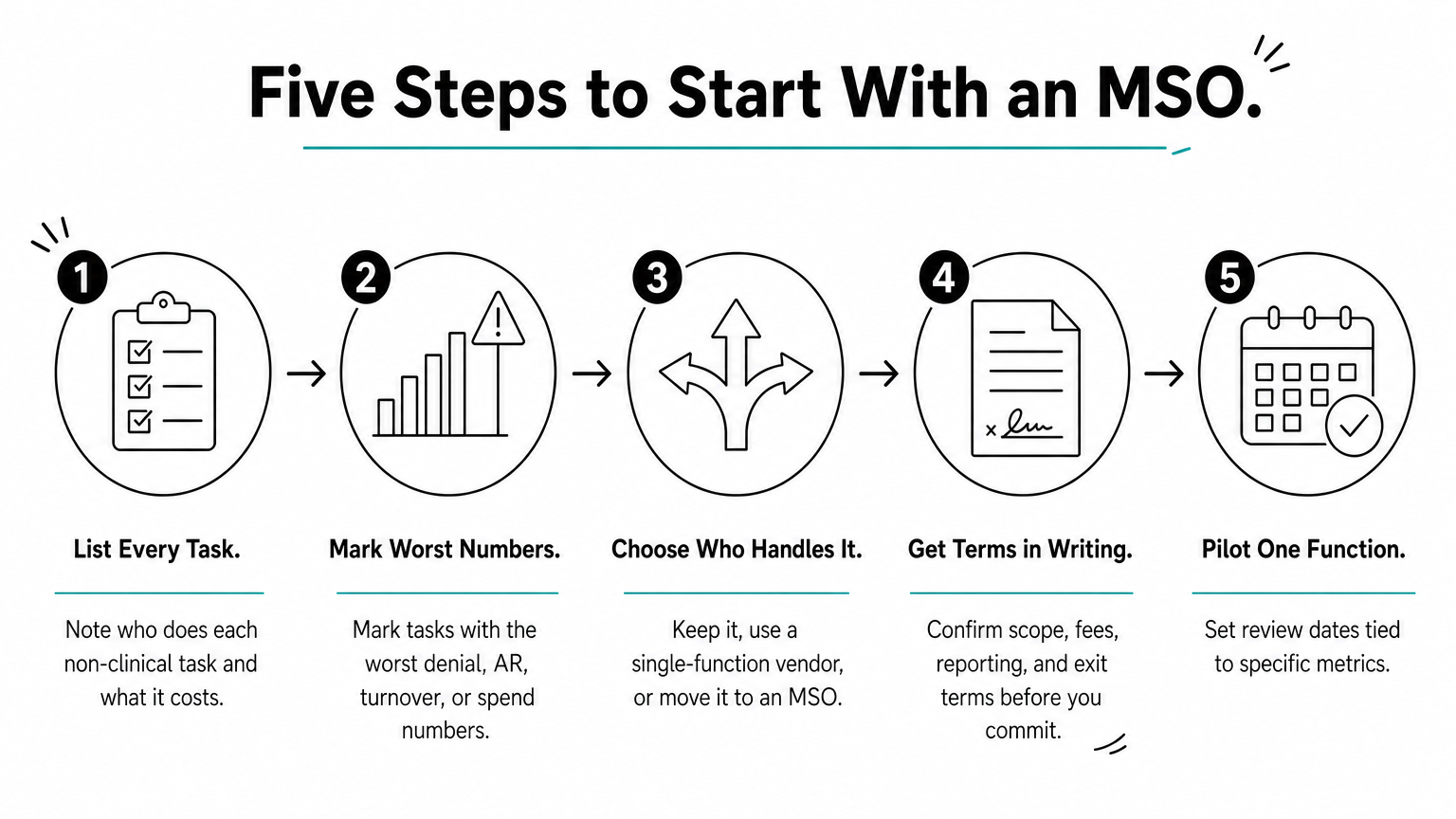
Fix the function with the worst measurable numbers first, then decide how much more to hand over.
How an MSO is structured, owned, and paid
An MSO is a separate legal entity that contracts with one or more medical practices under a management services agreement, and it earns fees for the administrative services it delivers. Most MSOs are LLCs or corporations, but no rule requires an LLC. Entity type is a liability and tax decision, and some MSOs are organized as limited partnerships.
The legal setup: MSO plus professional entity
In the typical arrangement, a physician-owned professional entity holds the licenses, employs or contracts the clinicians, and bills for patient care. The entity may be a professional corporation or a professional LLC, depending on state law. The MSO sits beside it and provides the business side: administrative staff, systems, and often equipment and office space.

There are two broad versions. In one, the MSO buys the practice’s tangible assets, then leases equipment and space back to the physicians. In the other, the MSO provides business services only and the practice remains fully independent. A second split looks at clients. A captive MSO serves one group, while an independent MSO serves several groups and can change its client list over time.
Who owns an MSO
Ownership shapes incentives, so ask who is behind any MSO you consider. Common owners include:
- Hospitals and health systems
- Physician groups
- Private investors
- Payers
- Joint ventures between hospitals and physicians
How an MSO makes money
MSOs earn money through fees, margin on purchasing, and, for owners, equity value as the MSO grows. The fee basis matters most to you. This table uses invented numbers for a practice that collects $2,000,000 a year, so you can compare the models side by side.
| Fee model | How the fee works | Illustrative annual fee |
|---|---|---|
| Flat monthly fee | $8,500 per month | $102,000 |
| Percentage of collections | 5% of $2,000,000 | $100,000 |
| Cost-plus | $90,000 actual cost plus a 15% margin | $103,500 |
All three land near $100,000, but they reward different behavior. A flat fee gives you certainty. A percentage fee ties the MSO’s income to your collections, but some states restrict it and regulators scrutinize it. Cost-plus is transparent, but you need the right to verify the MSO’s actual costs. Some arrangements also give physician owners equity in the MSO or an affiliate.
Compare MSO fee models by incentives and legality in your state, not only by the annual total.
How MSOs are regulated and what to check before you sign
There is no single federal MSO law. Instead, state and federal rules decide whether a given structure is lawful, and the details vary by state. Read this section as orientation, then have a healthcare attorney review your actual agreement. It is not legal advice.
Corporate practice of medicine and fee-splitting
Corporate practice of medicine (CPOM) laws prevent non-physicians from owning or controlling medical practices. States differ in how strictly they apply them, and California, New York, and Texas are often cited as strict. To stay compliant, physicians must keep clinical control. The MSO should not set treatment protocols, dictate care, or make hiring and firing decisions about clinical staff.
Fee-splitting rules in many states limit how professional fees can be shared with unlicensed parties. This is why percentage-based fees draw attention. Some states restrict them for certain services. New York, for example, bars paying a revenue cycle entity a percentage of revenue or collections.
Federal fraud and abuse laws and HIPAA
The Anti-Kickback Statute prohibits payments meant to induce or reward referrals of federal health program business. The Stark Law restricts physician referrals for designated health services when a financial relationship exists. For an MSO, the practical rule is that fees should be fair market value, set in advance, and never tied to referrals. Marketing and patient-referral services deserve the closest review.
An MSO that handles patient information is normally a HIPAA business associate. That requires a business associate agreement and real safeguards for protected health information. Some states also require notice or review of certain healthcare ownership transactions, so check before you form or join an MSO.
A due diligence checklist
Before you sign with any MSO, confirm each of these items:
- Counsel with CPOM experience has reviewed the structure under your state’s law.
- The agreement reserves clinical decisions to physicians in writing.
- The fee basis is clear and supported as fair market value.
- Scope, service levels, and reporting are specific and measurable.
- A business associate agreement and security terms are in place.
- Termination terms say what happens to your data, records, and staff on exit.
- Ownership, equity, and non-compete terms are disclosed.
- The MSO can give references from practices like yours.
If the MSO controls clinical decisions or its fees depend on referrals, the structure is the problem.
What to remember about MSOs
An MSO runs the business side of a practice so clinicians can run the clinical side. The model works when the scope is clear, the fees are lawful, and physicians keep control of care. Start with your own numbers, take on the functions that hurt most, and put the legal terms in writing.
If the revenue cycle is where your practice loses the most time and money, you do not need a full MSO to fix it. You can book a free consultation with InfiniteRCM to look at your billing, AR, credentialing, and prior authorization workflows.