
Medical billing & management services are outsourced services in which a specialist company handles your claims, coding, payer follow-up, and the financial oversight around them. Your practice gets paid accurately and on time without running a billing department of its own. You will also see this called medical billing and management services, or find it sold by a medical billing management company. Billing covers the claim itself. Management covers the reporting, enrollment, and process control that keep claims moving.
This article explains why practices outsource this work, what the scope usually includes, and how to choose a provider without getting burned. It also shows how pricing works with a worked example and what the first weeks after signing look like.
InfiniteRCM provides revenue cycle management, AR recovery, credentialing, and prior authorization support to US healthcare providers. The examples below come from how this work runs day to day, so you can judge any provider against concrete standards, including us.
Why practices outsource billing and management
Practices outsource because small billing errors and slow follow-up quietly drain revenue, while staff time goes to paperwork instead of patients.
Where revenue leaks in an in-house office
Most leaks are small and repeated. Eligibility goes unchecked, a code is wrong, a filing deadline passes, or a denial sits unworked for weeks. Each one looks minor, but together they push AR days up and cash flow down.
Staffing adds risk. Many small offices rely on one or two people for billing, so one resignation or sick week stalls claims. Payer rules and coding updates change constantly, and keeping up is a job in itself.
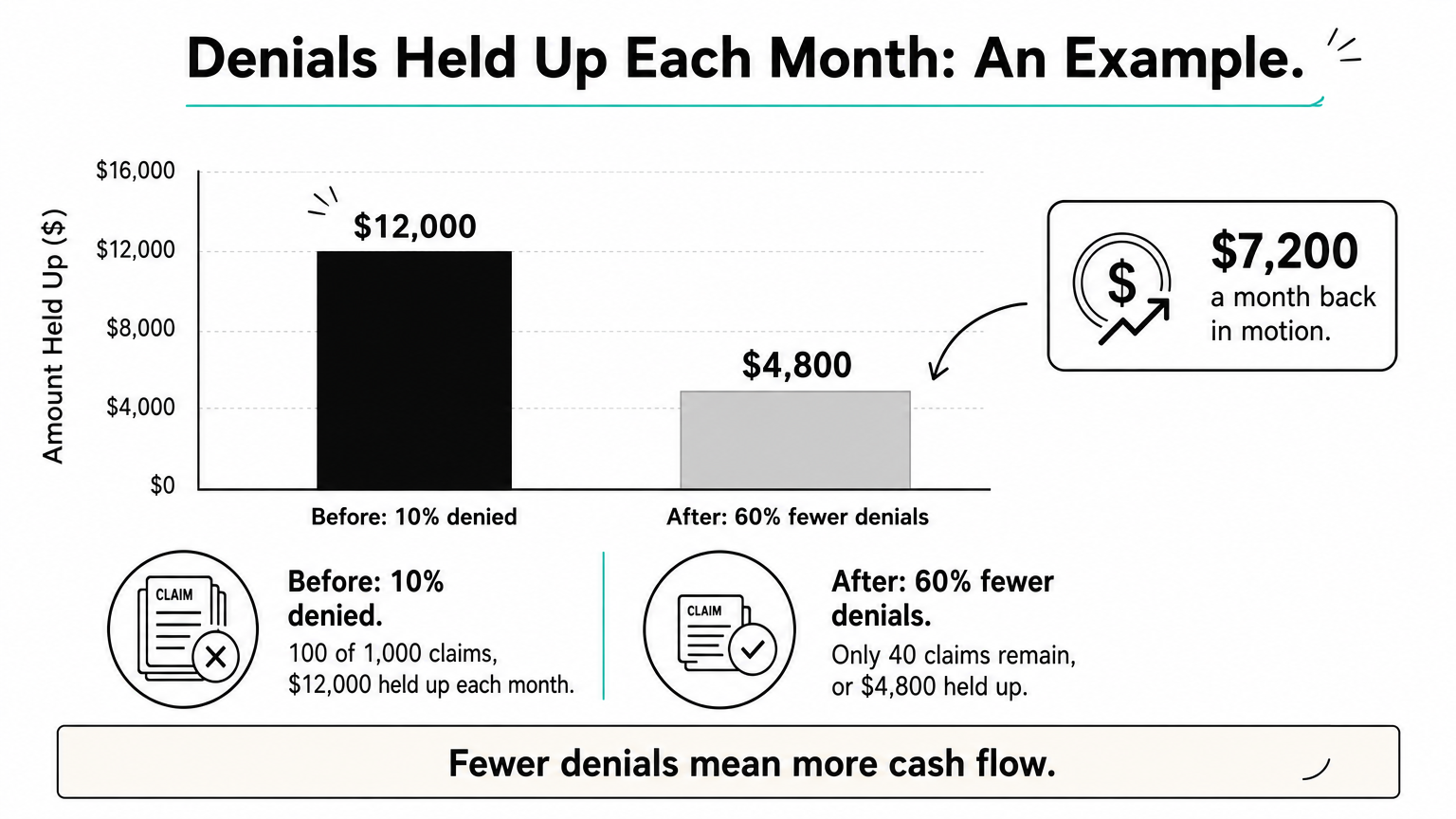
Here is an illustrative example. A practice submits 1,000 claims a month with an average reimbursement of $120. If 10% are denied, that is 100 claims and $12,000 held up each month. Cut denials by 60%, as InfiniteRCM reports for its clients, and only 40 claims remain, or $4,800. That is $7,200 a month back in motion.
Revenue rarely disappears in one big failure. It leaks through small errors nobody has time to fix.
What outsourcing changes
A dedicated billing team works claims every day, tracks payer rule changes, and chases denials on a schedule. Your staff stop juggling billing and the front desk. Your costs also shift from fixed salaries, software, and training to a fee tied to the work.
Results depend on where you start. InfiniteRCM reports that clients see an average 25-35% increase in collections within the first six months. A practice with clean workflows will see less lift than one with a backlog of old claims.
What medical billing and management services include
These services cover the full revenue cycle, from checking eligibility before the visit to appealing denials after it, plus the management layer of reporting and enrollment.
The revenue cycle, stage by stage
| Stage | What the provider does | Why it matters |
|---|---|---|
| Front end | Eligibility verification, prior authorization, credentialing and payer enrollment | Prevents denials before the visit |
| Mid cycle | Charge entry, coding with ICD-10, CPT, and HCPCS, electronic claim submission | Produces clean claims that pay on first pass |
| Back end | Payment posting, denial management, appeals, AR follow-up | Recovers money from unpaid and underpaid claims |
| Management | Financial reports, denial reports, revenue analytics, review meetings | Shows you what is working |
Billing, coding, and management are not the same job
Billing is submitting claims and collecting payment. Coding translates the visit into the codes payers accept. Management is the oversight layer: reports, enrollment, and process fixes. A medical billing management company should cover all three, but the word "management" is vague, so ask for the exact list in writing.

Add-ons worth asking about
Many providers sell extras beyond core billing. These are the ones that most often affect revenue:
- Credentialing and enrollment: payer applications, CAQH profile upkeep, and NPI registration support.
- Prior authorization: requirement checks, document collection, submission, and payer follow-up.
- AR recovery: old unpaid claims, underpayments, and insurance appeals.
- Virtual assistants: remote staff for scheduling, insurance verification, and admin tasks.
If a service is not listed in your agreement, assume it is not included.
How to choose a medical billing management company
Choose by testing six things: specialty fit, system integration, pricing clarity, reporting, compliance, and contract terms. Each one has a clear pass or fail answer you can get before you sign.
Six criteria to check
- Specialty experience. Ask how many practices in your specialty they bill for. Orthopedics, cardiology, and behavioral health each have their own coding and payer quirks.
- System integration. The company should work inside your existing EHR and practice management system, with no forced software purchase.
- Clean claim rate. Ask for the rate and how they measure it. InfiniteRCM guarantees 99% or more.
- Reporting. Look for regular reports on collections, denials, and AR aging, plus a named account manager.
- Compliance. Require HIPAA-compliant data handling, encrypted communication, and restricted access. Ask the same questions of any offshore team.
- Exit terms. Read the notice period and refund policy before you sign.
How pricing works, with an example
Percentage-based pricing charges a share of collections, flat-rate pricing charges a fixed monthly fee, and custom pricing blends the two for unusual volumes or specialties. Percentage fees commonly land in the mid single digits, depending on specialty, volume, and claim complexity. Setup fees depend on onboarding scope.
For an assumed 6% fee, a practice collecting $100,000 a month pays $6,000. Compare that to an in-house biller’s salary, benefits, software, and training. Also compare what each option collects, because a cheaper fee that collects less costs you more.
Walk away from vague quotes. Ask for no hidden fees in writing, and be wary of any provider that will not name its pricing model.
The cheapest fee is not the lowest cost if the provider collects less.
What to expect after you sign
Onboarding typically takes a few days to a few weeks depending on setup complexity, and your own work is mostly handing over access.
Onboarding steps
- A call covers your billing needs and practice volume.
- The provider analyzes your current billing operations.
- Trained staff are assigned and connected to your systems.
- Claims start flowing, with data migration support if you are leaving another biller.
You will need to supply provider information, payer details, software access, and practice documentation. Having these ready is the fastest way to shorten the timeline.
What you should see once live
At InfiniteRCM, most claims go out within 24 to 48 hours after charge entry, and clients get weekly performance reports plus regular review meetings. Hold any provider to a similar rhythm.

Track four numbers monthly: clean claim rate, denial rate, AR days, and net collection rate. If they do not improve within a few months, ask your account manager for a written plan.
Judge a billing partner by your monthly numbers, not by its sales promises.
Next steps for your practice
Medical billing and management services work when they cover the whole revenue cycle, report openly, and fit your specialty and systems. Define the scope in writing, check the six criteria, and compare pricing against what each provider actually collects.
If you want a second opinion on your current billing or a clear picture of what outsourcing would look like for your practice, contact InfiniteRCM for a free consultation.