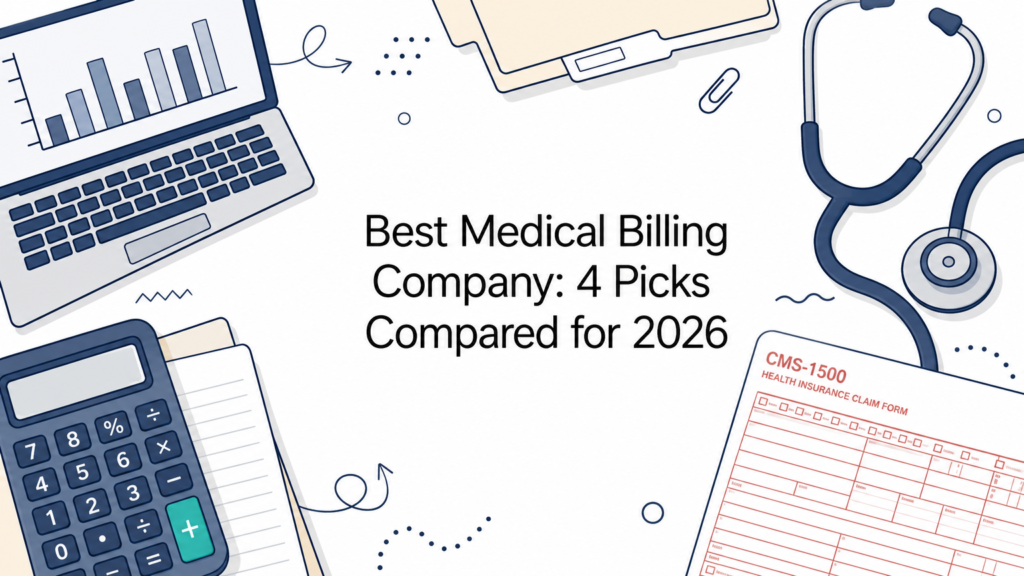
The best medical billing company is the one that fits your practice’s size, specialty, and existing software, and that backs its claims with clean claim rates and clear fees. If you want to hand off billing and keep your current EHR, InfiniteRCM is our first pick. CareCloud suits groups that want software and billing from one vendor. athenahealth suits practices ready to move to a single platform. AdvancedMD suits practices that want a flexible software suite with billing help.
The problem is familiar. Denials pile up, accounts receivable ages past 60 days, and your front desk spends hours on claims instead of patients. Most "best of" lists come from vendors that crown themselves, and we are one of the four companies here. So we judge every company by the same criteria and say plainly where each one fits.
Each pick below covers what the company does, who it suits, and what to ask about pricing. After the four picks, a comparison table and a vetting checklist help you narrow the choice.
1. InfiniteRCM
InfiniteRCM is an outsourced billing company that runs the full revenue cycle remotely, inside the systems you already use. It is our top pick for practices that want billing handled without changing software.
What it does
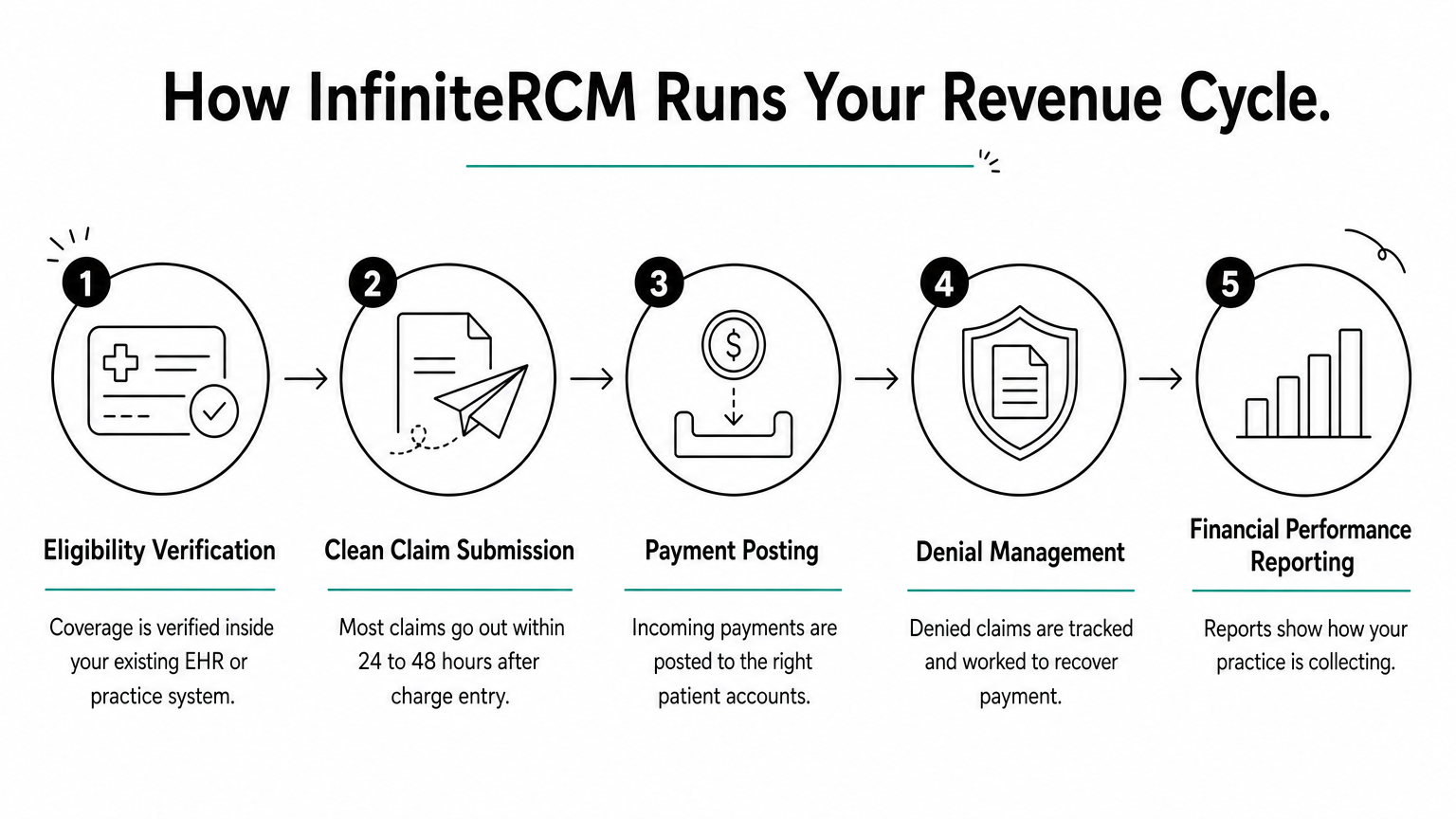
InfiniteRCM covers eligibility verification, clean claim submission, payment posting, and denial management, plus financial performance reporting. Most claims go out within 24 to 48 hours after charge entry, through secure clearinghouses. The team works in your existing EHR or practice management system, so you buy no new software.
Related services can sit on the same contract:
- AR recovery for unpaid claims, underpayments, and appeals
- Credentialing and payer enrollment, including CAQH and NPI support
- Prior authorization, from requirement checks to payer follow-up
- Medical virtual assistants for scheduling, insurance verification, and admin work
Who it suits
It suits solo providers, small clinics, urgent care centers, labs, and multi-provider groups with high denial rates, long AR days, or billing staff stretched thin. InfiniteRCM reports a 99% clean claim rate, 40% faster collections, and 60% fewer denials. It cites 500+ providers served and over $50M recovered for clients. These are company-reported figures, so ask for results in your own specialty.
The strongest outsourcing fit is a partner that works inside your EHR instead of asking you to replace it.
Pricing and terms
InfiniteRCM advertises transparent pricing with no hidden fees. The terms are easy to check before you commit:
- Onboarding takes a few days to a few weeks, depending on setup complexity.
- Monthly contracts cancel with 30 days written notice.
- You get a dedicated account manager, and support responds within 24 business hours.
Its team is HIPAA certified. You can request a quote through the contact page.
2. CareCloud
CareCloud is a good pick for practices that want software and billing services from one vendor. It is a healthcare technology company that pairs cloud-based EHR and practice management tools with revenue cycle services.
What it does
CareCloud sells cloud software and RCM services as a package. One vendor can then handle charting, scheduling, and billing. That cuts the finger-pointing that happens when a billing company blames the EHR for rejected claims.
The tradeoff is dependence. Bundled billing is often built around the vendor’s own platform. Ask early whether the billing service works with your current EHR or only with CareCloud’s.
Who it suits
It fits mid-size and larger groups that are replacing aging systems and outsourcing billing in the same project. A small practice that only needs claims work may pay for more than it uses.
If you are not ready to replace your software, a bundled vendor adds cost you may not need.
Pricing and terms
Expect a custom quote rather than a public price list. Ask whether the fee is a percentage of collections or a flat monthly rate, and whether software licenses are billed separately. Get contract length and exit terms in writing.
3. athenahealth
athenahealth is the right choice when you are willing to run your whole practice on one platform. Its athenaOne product combines EHR, practice management, and revenue cycle services in a single cloud system.
What it does
athenahealth puts billing inside the platform instead of next to it. Charge capture, claims, and payment posting live in the same system as your clinical records. That integration reduces data re-entry, which is a common source of avoidable errors.
Because the service is built around its own software, this is not a billing-only option. You are choosing an EHR as much as a billing partner.
Who it suits
It suits practices that are already unhappy with their EHR and want a single system for clinical and financial work. If your current EHR works well, switching only to change billing vendors rarely pays off. Migration, retraining, and a temporary drop in productivity are real costs.
Choose a platform vendor when you want to change your systems, not just your billing.
Pricing and terms
Platform pricing is usually tied to collections and set by quote. Ask for the percentage, what it includes, and any implementation or training fees. Confirm who owns your data and how you export it if you leave.
4. AdvancedMD
AdvancedMD is a solid pick for small to mid-size practices that want a cloud software suite with billing support available. It offers EHR, practice management, and billing tools, along with billing services.
What it does
AdvancedMD gives you software you can use yourself and billing help on top. You can start by running billing in-house with its tools. Later you can add outsourced support if denials or staffing become a problem. That staged path appeals to practices that are not ready to give up control of billing.
Who it suits
It suits practices that want flexibility and a software suite in one place. Independent practices in particular can start modestly and grow into more services. The cost of flexibility is more work on your side than a fully outsourced model, because staff still use the software daily.
A suite with optional billing help works best for practices that want to keep some billing in-house.
Pricing and terms
Pricing is quote-based and depends on the modules and services you choose. Ask what is included in the base fee, what the billing service costs as a share of collections, and what happens to your data if you cancel.
How to choose a medical billing company
Choose by matching four things: the scope of service, your existing systems, how fees are structured, and how the vendor reports results. Run each candidate through the same checklist, whichever company you pick.
Comparison at a glance
| Company | Model | Best for | Pricing |
|---|---|---|---|
| InfiniteRCM | Remote outsourced billing | Practices keeping their current EHR | Transparent pricing, no hidden fees |
| CareCloud | Software plus RCM services | Groups wanting one vendor | Custom quote |
| athenahealth | Platform with built-in RCM | Practices ready to switch EHR | Quote, usually tied to collections |
| AdvancedMD | Software suite plus billing help | Small to mid-size practices | Quote by modules |
Questions to ask before you sign
Outsourced billing is commonly quoted at roughly 4% to 8% of collections. As an illustration, a practice collecting $60,000 a month pays $2,400 at 4% and $4,800 at 8%. At 6% that is $3,600 a month, or $43,200 a year. Compare that with your in-house billing cost.

- What are your clean claim and denial rates, and how do you measure them?
- Do you work inside my EHR, and who owns the data?
- How fast do claims go out after charge entry?
- What reports will I see, and how often?
- What are the cancellation terms?
Local vendors and AI in billing
You rarely need a billing company in your city. Billing runs remotely, so look for payer experience in your specialty and state rather than a nearby office. Hospital-scale vendors such as R1 RCM tend to target larger organizations, so a small clinic usually gets more attention elsewhere.
AI is changing the work but not replacing billers. Automation now handles eligibility checks and claim scrubbing. Appeals, payer disputes, and complex denials still need people, so pick a vendor that uses both.
Judge a billing company by its denial and clean claim numbers, not by its office location.
Picking your billing partner
The best medical billing company for you depends on whether you want to outsource billing or replace your software. For outsourcing without a system change, InfiniteRCM leads. CareCloud, athenahealth, and AdvancedMD make more sense when software is part of the decision.
Whichever you shortlist, compare clean claim rates, fee structure, and exit terms side by side before you sign. If you want a quote for your practice, contact InfiniteRCM and ask for numbers in your specialty.