

Physician practice management is the work of running the non-clinical side of a medical practice. It covers billing, collections, staffing, scheduling, credentialing, compliance, and financial reporting, so physicians can focus on patient care. The term also names the companies and services that take over some or all of that work for a fee.
This article goes past the definition. You will see why the business side of a practice needs deliberate management, how to organize it, and how physician practice management companies, MSOs, and specialty service providers differ and get paid. You will also get a checklist for choosing between them.
InfiniteRCM works on the revenue cycle and administrative side of practices every day. That view shapes the practical advice here, especially on where practices lose money and which pieces are worth handing to an outside team.
Why physician practice management matters
It matters because a practice can deliver excellent care and still lose money, staff, and patients if the business side runs badly. Clinical skill and operational skill are different jobs, and most practices have to cover both.
Care and business run on different skills
Physicians train for years in diagnosis and treatment. Very few train in payer contracts, coding rules, or staff scheduling. In a small practice, the physician often fills those gaps by default, and every hour spent on paperwork is an hour not spent with patients.
Larger groups face a different version of the problem. With several providers, locations, and payers, no one person can see the whole operation. Good physician group practice management gives each function a clear owner and a way to measure results.
Where weak management shows up
The damage is usually quiet at first and visible in the numbers later. These are the common signs:

- Denied or rejected claims that nobody has time to rework
- Long accounts receivable (AR) days, meaning cash arrives slowly
- Missed prior authorizations that delay care or block payment
- Lapsed credentialing or enrollment, so a provider cannot bill a payer
- Staff burnout from manual billing and phone work
- Compliance gaps, such as weak handling of patient data under HIPAA
A practice that runs well on paper and in practice keeps its physicians treating patients instead of chasing payers.
How to apply physician practice management in your practice
Start by listing every business function, give each one a named owner, then decide which functions stay in-house and which go to outside specialists. That sequence works for a solo clinic and a multi-site group alike.
The functions to cover
Use this table as your audit list. If a row has no clear owner, that is your first fix.
| Function | What it includes | Typical failure point |
|---|---|---|
| Revenue cycle | Eligibility checks, charge entry, claim submission, payment posting, denial management | Slow claim submission, unworked denials |
| Credentialing and enrollment | Payer applications, CAQH profiles, NPI registration | Providers seeing patients before they are enrolled |
| Front desk and scheduling | Appointments, reminders, intake, insurance verification | No-shows, incomplete insurance data |
| Prior authorization | Requirement checks, documents, submission, follow-up | Requests that stall without follow-up |
| Staffing and HR | Hiring, training, payroll, schedules | Turnover, uneven workloads |
| Compliance and security | HIPAA, record handling, audit readiness | Outdated systems, unclear policies |
| Financial reporting | Collections, AR aging, denial rates by payer | Numbers reviewed too rarely to act on |
Choose in-house, hybrid, or outsourced
There are three models. In-house gives you direct control but puts every hire and system on your payroll. Outsourced hands a function to a specialist team. Hybrid keeps oversight inside and outsources the repetitive, rule-heavy work.
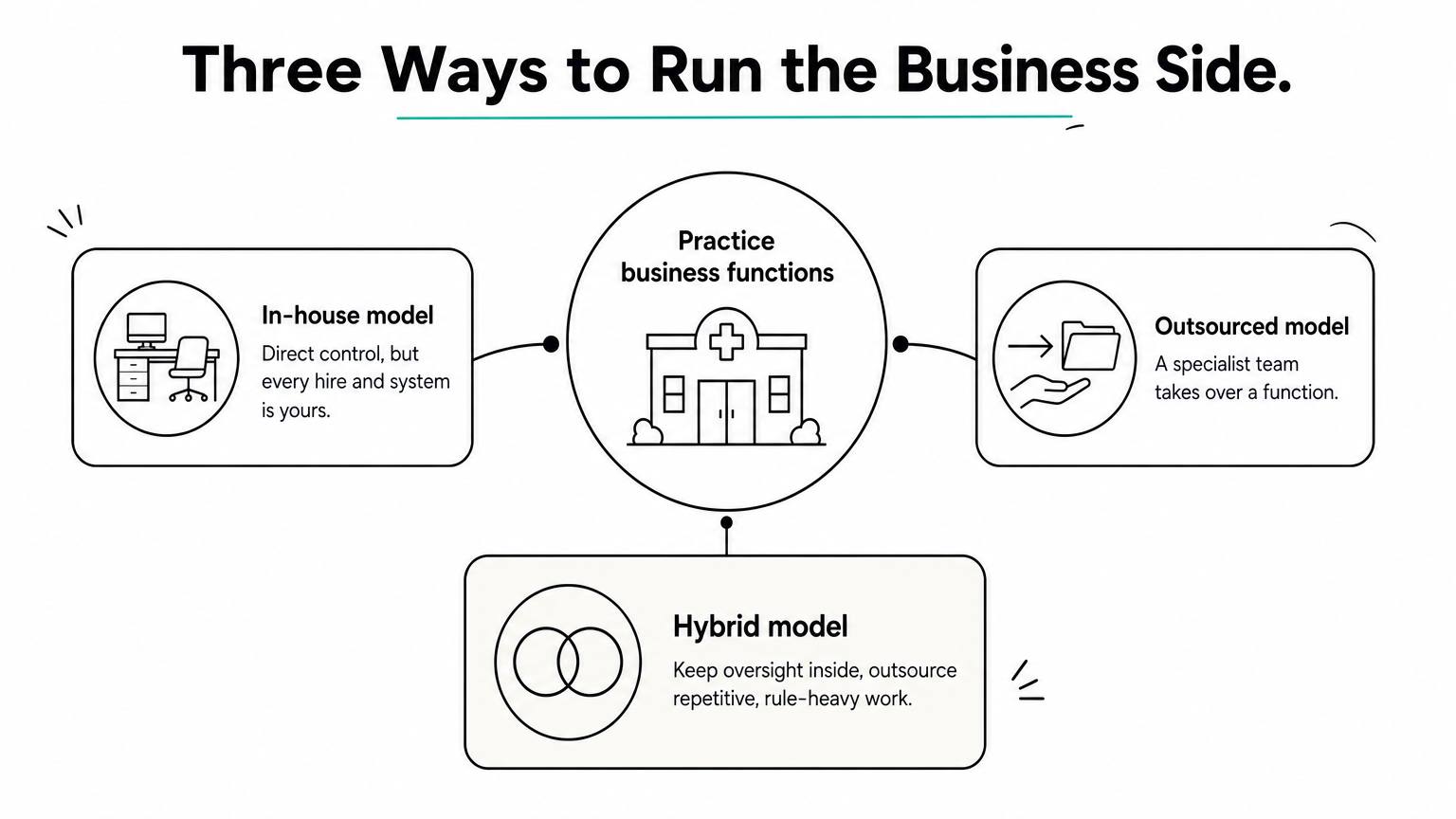
Most small and mid-size practices land on hybrid. Picture a three-provider family medicine clinic. A practice manager runs staff, vendors, and daily operations. Billing, credentialing, and prior authorizations go to outside specialists, with the manager reviewing reports. If you hire that manager, a credential such as the CPPM shows formal training. Experience with your specialty and its payers still counts for more.
Name an owner for every function first, then decide what to outsource.
How physician practice management companies work
A physician practice management company contracts with practices to run business operations in exchange for a fee. The scope runs from a single function, like billing, to full management of the practice, and sometimes includes an ownership relationship.
Types of organizations you will meet
The labels overlap, so compare what each one actually does:
| Type | What it does | Typical fit |
|---|---|---|
| Physician practice management (PPM) company | Manages operations for many practices, sometimes owns non-clinical assets | Groups wanting broad management |
| Management services organization (MSO) | Provides management services to physician-owned practices under a services agreement | Practices that keep clinical ownership |
| Consultants | Advise on strategy, workflows, and finances | Practices fixing a specific problem |
| Specialty service vendors | Run one function, such as billing, credentialing, or prior authorization | Practices with one clear gap |
MSOs are common in states that restrict corporate ownership of medical practices. The physicians own the practice, and the MSO supplies the business services around it.
How these companies get paid
Fee structures vary, so ask for the model in writing. Common arrangements include a percentage of collections, a flat monthly fee, a per-provider fee, or a cost-plus fee. Some MSOs backed by investors also take part in the economics of the practice itself.

A percentage of collections ties the vendor’s income to yours, which is a fair incentive. Confirm what the percentage covers, though, because add-on charges for credentialing, reporting, or software can change the real cost.
Always ask what the fee covers, because the fee model matters less than the scope behind it.
How to choose physician practice management services
Match the service to your biggest gap first, then test each candidate on transparency, integration, security, and exit terms. Private practice management services differ most in what they leave out.
What to check before you sign
Work through this list with every provider you consider:
- Scope in writing. Which functions are included, and which cost extra?
- Pricing model. Percentage, flat fee, or per provider, with no unexplained add-ons.
- System fit. Can they work inside your existing EHR and practice management system?
- Security. Do they have a HIPAA-trained team and secure handling of patient data?
- Reporting. Will you see denial rates, AR days, and collections regularly?
- Named contact. Is there a dedicated person, and how fast does support respond?
- Exit terms. What notice do you give to leave, and is there a long lock-in?
Where InfiniteRCM fits
InfiniteRCM is a specialist, not a full physician practice management company. It covers the revenue and administrative functions in the table above: revenue cycle management, AR recovery, credentialing and enrollment, prior authorization, and medical virtual assistants.
The service is remote and cloud-based. It works in your existing systems, so you buy no new software. Most claims go out within 24 to 48 hours after charge entry. Dedicated account managers are available for communication and support. Monthly contracts require 30 days written notice to cancel, which answers the exit-terms question directly.
Where to go from here
Physician practice management is the discipline of running a practice’s business side so care can come first. Audit the functions, assign owners, and outsource the repetitive, rule-heavy work where a specialist does it better than your staff can. When you compare companies, judge them on scope, pricing, and exit terms.
If billing, credentialing, or prior authorization is your weakest link, contact InfiniteRCM to talk through what an outside team could take off your plate.