

Payer enrollment services are the administrative work of registering a healthcare provider with insurance payers, such as Medicare, Medicaid, and commercial plans, so the provider can join their networks, submit claims, and get paid. If you are asking what payer enrollment services are, think of them as the bridge between a provider who is licensed to practice and a provider who is allowed to bill a specific payer. Until the payer approves the application and sets an effective date, claims for that payer’s members are usually denied or cannot be billed at all.
The work includes completing applications, collecting documents, tracking status, answering payer questions, and keeping the enrollment current after approval. Practices do it themselves or hand it to a specialist. Either way, it is a different task from credentialing, though the two are closely linked.
This guide covers why payer enrollment affects your revenue, how the process runs step by step, and how it differs from credentialing. It also covers what slows applications down and when outsourcing makes sense. InfiniteRCM supports practices with credentialing and enrollment alongside billing, so the advice here comes from how enrollment fits into the full revenue cycle.
Why payer enrollment matters to your revenue
Payer enrollment matters because a provider who is not enrolled with a payer generally cannot bill that payer’s members. Every week of delay is a week of delayed or lost income.
Enrollment decides when you can bill
Credentials and a signed lease do not make a provider billable. The payer must approve the application and assign an effective date, and many payers will not backdate it. Medicare allows only limited retroactive billing.
Until approval, you have three poor options. You can hold claims, send patients elsewhere, or bill under another enrolled provider. That last route carries audit and recoupment risk, so most compliance teams avoid it.
What a delay costs in real numbers
Take a hypothetical primary care physician who collects $450,000 a year. That works out to about $1,233 per day. If enrollment with the payers covering that schedule runs 60 days late, the practice defers or loses roughly $74,000 ($1,233 × 60). Multiply that by several new providers and the cost of slow enrollment passes the cost of doing it well.

A provider is only worth what a payer will pay them, and payer enrollment is what switches that on.
When you need payer enrollment
You need it more often than most practices expect. These events all trigger it:
- A new provider joins your practice
- You open a new practice or add a location
- You add a payer to your network
- Your tax ID, ownership, or billing entity changes
- A payer’s revalidation cycle comes due
How the payer enrollment process works step by step
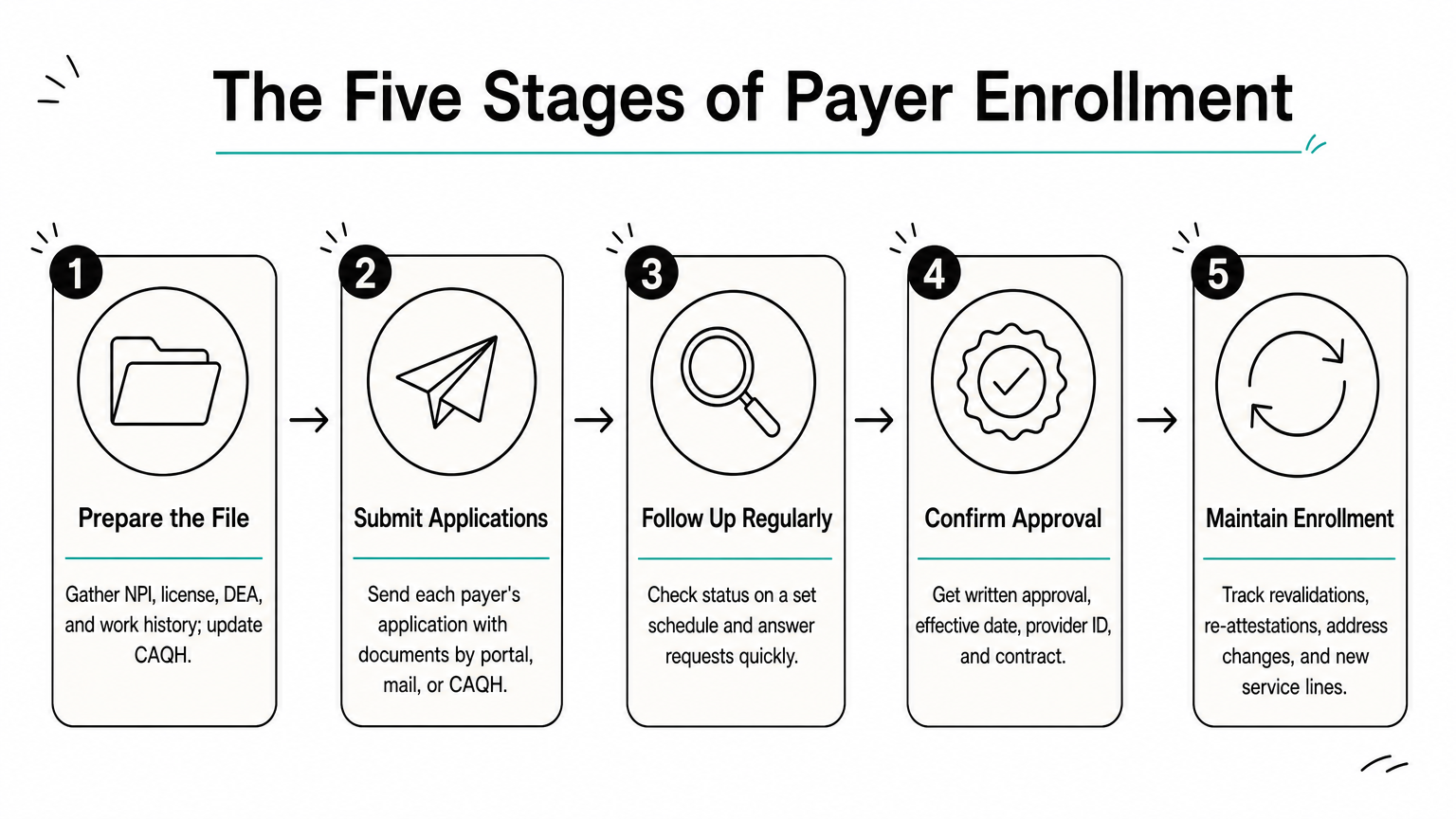
The process follows five stages: prepare, apply, follow up, confirm, and maintain. The details vary by payer, but the order rarely changes.
The five stages
- Prepare. Gather the provider’s NPI, license, DEA registration, board certification, malpractice insurance, work history, and practice details. Update the CAQH profile.
- Apply. Complete each payer’s application and submit it with the supporting documents, through the payer’s portal, by mail, or through CAQH.
- Follow up. Check status on a set schedule and answer payer requests quickly. Payers rarely chase you.
- Confirm. Get written approval, the effective date, the provider ID, and the contract. Load them into your billing system before you send claims.
- Maintain. Track revalidations, re-attestations, address changes, and new service lines.
Medicare, Medicaid, and commercial payers differ
Medicare enrollment runs through CMS applications, the CMS-855I for individuals and the CMS-855B for groups, usually submitted through PECOS. Medicaid rules and forms are set state by state. Commercial payers each use their own portals and contracts, and most pull provider data from CAQH.
How long it takes depends on the payer, how complete your file is, and how fast you answer questions. Expect several weeks to several months, and plan for 90 days or more on slower commercial payers. Start before the provider’s first day.
EFT and ERA enrollment
Approval for billing is not the last step. To receive payments by direct deposit and electronic remittance advice, you also enroll for EFT and ERA with each payer, often through a clearinghouse portal. Optum runs one such portal under the name Payer Enrollment Services, which is why searches for the term sometimes land there. If you need that portal, use the sign-in details your clearinghouse or payer gave you.
Approval is the start of billing, not the finish line, so confirm the effective date and payment setup before claims go out.
Payer enrollment vs credentialing: the difference
Credentialing verifies that a provider is qualified. Payer enrollment registers that provider with a payer so claims get paid. You need both, and a delay in either stalls billing.
Side by side
| Credentialing | Payer enrollment | |
|---|---|---|
| Question it answers | Is this provider qualified? | Can this provider bill this payer? |
| Main work | Verifying education, license, board status, work and malpractice history | Submitting applications, getting a provider ID, contract, and effective date |
| Result | A verified provider file | Network participation and permission to bill |
| Repeats | On a set cycle, such as re-attestation in CAQH | On revalidation and on every change of location, tax ID, or ownership |
Why the two overlap in practice
With commercial payers, the steps often run together. The payer checks credentials as part of reviewing your enrollment application, so a gap in work history or an expired license stalls both. Medicare works more as pure enrollment.
That overlap is why many practices manage the two as one project. Keeping the CAQH profile current serves both, because payers read from it for credentialing and enrollment alike.
Credentialing proves the provider is qualified. Enrollment lets the practice get paid for that provider.
What slows payer enrollment and how to prevent it
Most enrollment delays come from avoidable errors in the application, not from payer slowness. Fixing the file before you submit is the cheapest way to speed up approval.
Common causes of delay
- Mismatched data. Name spellings, NPI numbers, tax IDs, or addresses that differ between the application, CAQH, and the NPPES record.
- Expired or missing documents. An old license, DEA registration, or malpractice certificate.
- Stale CAQH data. CAQH profiles need re-attestation every 120 days, and payers stall on lapsed ones.
- Unexplained gaps. Missing months in work history with no written explanation.
- No follow-up. Applications sit in a queue until someone asks about them.
A pre-submission checklist
Before you send anything, confirm you have these items and that each one matches the others:

- NPI and NPPES record, current
- State license, DEA registration, and board certification
- Malpractice insurance certificate
- Full CV with every gap explained
- Practice location, tax ID, and W-9
- Bank details for EFT
- CAQH ID with a recent attestation
Matching data across every form prevents more delays than any amount of chasing afterward.
Should you handle payer enrollment in house or outsource it?
Handle it in house if you have a few providers, a few payers, and a staff member with time to follow up. Outsource it when volume, turnover, or complexity means applications stall because nobody owns them.
When in-house works
A small practice adding one provider with two or three payers can manage it. The key is a named owner, a tracking sheet, and a follow-up schedule. Without these, the task slips behind patient work.
When outsourcing pays off
Growth, new locations, and frequent hiring strain an in-house process fast. Look for a partner that knows payer-specific requirements, tracks every application’s status, and handles CAQH and revalidation after approval. Ask for clear pricing up front.
InfiniteRCM’s Credentialing & Enrollment service covers group and individual payer enrollment, CAQH profile management, and NPI registration support. InfiniteRCM also offers medical billing and revenue cycle services alongside credentialing and enrollment. Approval decisions and timelines still belong to the payers, so no service can promise a date.
Outsource payer enrollment when no one in your practice has the time to follow up on every application.
Start enrollment before the first patient
Payer enrollment services get providers approved with insurance payers so they can bill and be paid. Credentialing proves a provider is qualified, enrollment makes them billable, and both need clean data and steady follow-up. Start early, keep your files consistent, and confirm the effective date before the first claim goes out.
If enrollment is holding up your revenue or you are about to add providers, talk to the team at InfiniteRCM. Contact InfiniteRCM to discuss credentialing and payer enrollment for your practice.