
Outsourced medical billing services mean you hand part or all of your billing and revenue cycle work to a specialist company. That company submits your claims, posts payments, chases denials and collects from patients on your behalf. Most charge a percentage of what your practice collects, commonly 4% to 10%, and get paid only after you do. For many solo, small and mid-size practices, this costs less than a full in-house team and collects more, as long as you choose the right partner and set clear terms.
This guide covers why practices outsource, how the handoff works step by step, and what it costs, with a worked example. It also covers the real risks, how to evaluate an outsourced medical billing company before you sign, and which numbers to track once the work moves.
InfiniteRCM provides these services to more than 500 healthcare providers, so the advice below comes from the vendor side of the table. It reflects what practices ask us, where handoffs go wrong, and what a fair contract looks like.
Why practices outsource medical billing
Signs your in-house billing is holding you back
Outsourcing makes sense when billing problems keep coming back no matter how hard your team works. Repeating problems point to a capacity or process gap, not a people problem, and that gap is what outsourced medical billing services are built to close. Look for these signs:

- Denials keep climbing. Your team reworks the same rejections, often for missing information or coding errors, and some claims age out before anyone touches them.
- Accounts receivable is aging. Claims sit past 60 or 90 days because nobody has time to call payers.
- One person holds all the knowledge. A resignation or a two-week vacation stops your cash flow.
- Front desk or clinical staff do billing. Billing gets squeezed between check-ins and patient calls.
- Growth or change is coming. A new provider, a second location or a new EHR will strain a small team.
- You cannot see your numbers. Nobody can tell you last month’s clean claim rate or days in A/R.
Three or more of these usually means waiting costs more than switching. Payers enforce timely filing and appeal deadlines, so every month of unworked claims shrinks what you can still collect.
If billing depends on one person, you have a single point of failure, not a billing process.
What you gain from outsourcing
The biggest gain is a change in how you pay for billing. In-house billing is a fixed cost: salaries, benefits, software, training and equipment arrive whether collections are strong or weak. With a percentage-based contract, the fee moves with collections, so a slow month costs you less.
Coverage and depth come next. A billing company staffs by role, so coders, payment posters and denial specialists each do one job every day. Vacations and resignations do not stall your claims. These teams also follow payer policy changes and code updates across many clients, which one biller working alone rarely has time to do.
Cash flow usually improves because of speed and follow-up. Clean claims go out within a day or two of charge entry, denials get worked while the appeal window is still open, and old A/R gets phone calls instead of write-offs. InfiniteRCM reports a 99% clean claim rate, 40% faster collections and 60% fewer denials. Ask any company you evaluate for comparable figures, and ask how it defines each one.
Is outsourcing a good idea for every practice?
No. Outsourcing is a good idea for most solo, small and mid-size practices, because they rarely have enough volume to keep a team of billing specialists busy. Small practices gain the most, since they pay for specialist depth only when claims arrive.
In-house billing still works when you have a stable, experienced biller, reliable reporting, A/R under control and enough volume to justify the team. Even then, a hybrid model is common. You keep daily billing in-house and outsource the hard parts: credentialing, prior authorizations or recovery of old A/R.
How outsourced medical billing works, step by step
What the billing company handles and what you keep
Outsourced billing starts after the provider closes the encounter, and the company takes the claim from there. You still own the front end, meaning accurate patient data and complete documentation, because a billing partner cannot fix a claim built on bad inputs. This table shows the usual split.
| Task | Billing company | Your practice |
|---|---|---|
| Eligibility verification | Confirms coverage and benefits before the visit | Collects accurate demographics and insurance cards at check-in |
| Coding review | Checks codes against the documentation | Documents the visit fully and closes notes on time |
| Claim submission | Scrubs claims and sends them electronically through a clearinghouse | Answers coding queries quickly |
| Payment posting | Posts payments and adjustments, reconciles deposits | Gives access to remittances and bank deposits |
| Denial management | Corrects, resubmits and appeals denied claims | Supplies clinical records when requested |
| A/R follow-up | Works unpaid claims by age and payer | Flags payer problems you see at the front desk |
| Patient statements | Sends statements, answers billing calls | Sets collection policy and collects copays at the visit |
| Reporting | Delivers financial and performance reports | Reviews them and acts on findings |
Speed matters here. At InfiniteRCM, most claims go out within 24 to 48 hours of charge entry, and that is a fair benchmark to ask any partner about.
A billing partner can fix your process, but it cannot fix documentation that was never written.
Choosing full or partial scope, and add-on services
Full-cycle outsourcing hands over everything from eligibility checks to patient statements. Partial scope covers only the parts that hurt, usually denial management and A/R follow-up. Start narrow if you are nervous, but know that splitting the cycle between two teams adds handoffs and can blur who is accountable for a denied claim.
Several adjacent services often get bundled in. Credentialing and enrollment matters because a new provider cannot bill most payers until enrollment is complete. Prior authorization support cuts delays and avoidable denials on services that need approval. A/R recovery goes after old unpaid claims, underpayments and denials that your team never had time to appeal. InfiniteRCM offers all three, plus medical virtual assistants for scheduling, insurance verification and other daily admin work.
A realistic onboarding timeline
Onboarding takes from a few days to a few weeks, depending on how complex your setup is. These steps run in a fixed order, and skipping one is how handoffs go wrong:
- Sign the agreements. The service contract and a business associate agreement come first, before anyone sees patient data.
- Grant system access. The company works inside your EHR or practice management system remotely, so you should not need to buy new software.
- Capture a baseline. Record A/R aging, denial reasons and clean claim rate before anything changes.
- Map the workflow. Agree how charges, documents and payer correspondence reach the billing team and who answers questions.
- Run the first claims together. Review early submissions line by line for a couple of weeks.
- Hold 30, 60 and 90 day reviews. Compare results to the baseline.
If your old biller stops abruptly, expect a dip in cash during the first 30 to 60 days. Ask the new company to work the existing A/R backlog while the old team is still available to answer questions.
What outsourced medical billing costs
Pricing models compared
Most outsourced medical billing services charge a percentage of net collections, commonly quoted between 4% and 10%. Physicians often cite 6% to 8% as typical. Specialty, claim volume and scope drive where you land in that range. Four models are common:
| Model | How it works | Fits best | Watch for |
|---|---|---|---|
| Percentage of net collections | Fee is a share of payments actually collected, invoiced after you are paid | Most practices wanting full-cycle billing | Whether extras are billed separately |
| Flat fee per claim | Fixed price for each claim submitted | Steady, predictable claim volume | Fees on rejected or resubmitted claims |
| Hourly or FTE-based | You pay for a dedicated person’s time, such as a billing virtual assistant | Practices that want control of the workflow | Paying for idle hours, and the work still needs a manager |
| Hybrid | Low monthly base plus a smaller percentage | Practices with irregular collections | Base fees that quietly exceed the percentage |
A percentage model aligns incentives, because the company earns more only when you collect more. A flat per-claim fee does not reward the vendor for chasing a hard denial.
Judge a fee by what you keep after it, not by the percentage printed on the proposal.
A worked example: in-house versus outsourced
Take a practice that collects $100,000 a month. Assume its in-house billing costs $7,500 a month, counting one biller’s salary and benefits, software, a clearinghouse and supplies. That figure is an illustration, so use your own. Now assume an outsourced partner charges 6% and lifts collections by 5%, which is an assumption and not a promise.
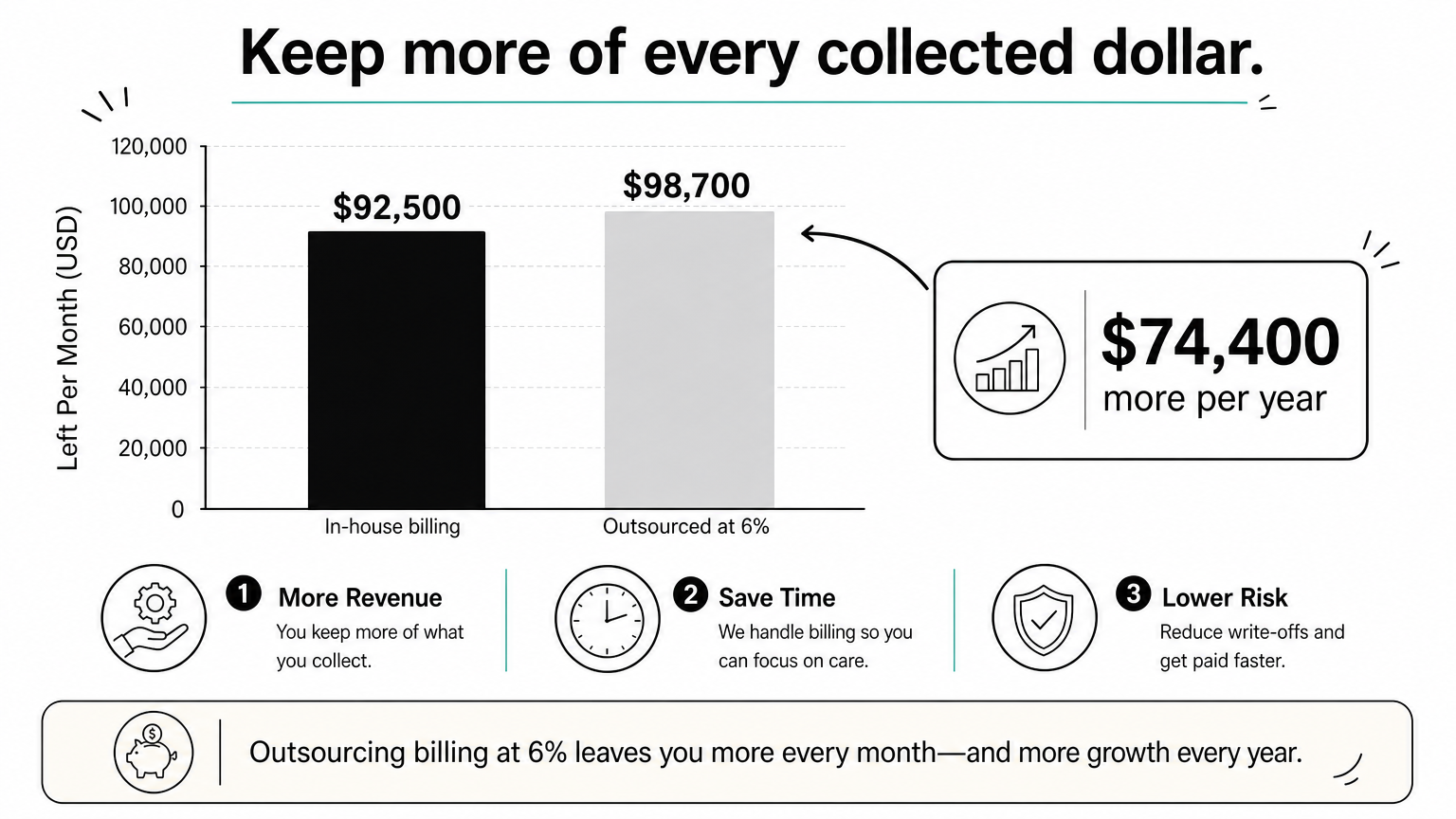
| In-house | Outsourced at 6% | |
|---|---|---|
| Net collections per month | $100,000 | $105,000 |
| Billing cost | $7,500 | $6,300 |
| Left after billing cost | $92,500 | $98,700 |
The difference is $6,200 a month, or $74,400 a year. Even with no lift at all, a 6% fee on $100,000 is $6,000, which still beats the $7,500 in-house cost by $1,500 a month.
The percentage alone misleads. A 5% fee that collects $90,000 leaves you $85,500. A 7% fee that collects $100,000 leaves you $93,000. Compare results, not rates.
Fees beyond the percentage
Ask for every extra charge in writing before you sign. These are the usual ones:
- Setup or onboarding fees
- Data conversion or system migration fees
- Clearinghouse charges
- Statement printing and postage
- Separate fees for A/R cleanup of old claims
- Separate fees for credentialing or prior authorization
- Early termination fees and minimum monthly charges
A fair contract lists all of these or states that none apply. Contract length matters as much. A month-to-month agreement with 30 days written notice, which is how InfiniteRCM structures its monthly contracts, lets you leave if results disappoint. Long lock-ins with exit fees shift risk onto you.
Risks of outsourcing medical billing and how to manage them
The main risks and what to do about each
Outsourcing carries real risks, and each one has a practical fix. Most problems come from vague contracts and weak oversight, not from outsourcing itself.
| Risk | Why it happens | What to do |
|---|---|---|
| Loss of visibility | Billing moves out of sight | Require monthly reports with A/R aging, denial reasons and collections by provider, and keep read access to your own systems |
| Hidden or growing fees | Extras are billed outside the main percentage | Get an itemized fee schedule and have extras capped in the contract |
| Data exposure | More people and systems touch patient data | Sign a business associate agreement, and ask about encryption, access controls and subcontractors |
| Compliance errors | Wrong coding still goes out under your name | Audit a sample of claims every quarter |
| Patient friction | Patients dislike calls from an unknown company | Agree on call scripts and a callback line with your practice’s name |
| Low priority | Your account is small next to larger clients | Ask for a named account manager and written response times |
Outsourcing moves the work, not the responsibility, so oversight is part of the price.
Compliance and data security
You remain responsible for claims filed under your provider numbers, even when someone else prepares them. Review claim samples yourself, and do not treat a clean report as proof of accurate coding.
HIPAA requires a business associate agreement with any vendor that handles protected health information. The HHS sample business associate agreement provisions show what the contract should cover. Beyond that, ask where the work happens, who can see patient records, and whether the company uses offshore subcontractors. A HIPAA certified team is a baseline, as InfiniteRCM’s is, and not a reason to skip these questions.
Will AI replace medical billers?
No, though it is changing the job. Automation now handles data entry, eligibility checks, code suggestions and claim scrubbing, which shrinks the repetitive work. Judgment-heavy tasks still need people: appeals that cite clinical documentation, payer disputes, underpayment analysis and calls to resolve odd denials.
For you, the practical question is how a company uses automation. Ask what is automated, where a human reviews the output, and whether savings show up in your fee or accuracy. A vendor that talks only about software, or only about headcount, is hiding half the picture.
How to choose an outsourced medical billing company
Start with fit, not a ranking
Nobody can name the single best outsourced medical billing company in the USA, because the best one depends on your specialty, size and software. A cardiology group, a behavioral health clinic and a solo family doctor need different workflows. Match the company to your situation before you compare prices.
Write down four fit criteria first:
- Specialty experience. Ask how many practices in your specialty they bill for today.
- System compatibility. They should already work in your EHR or practice management system.
- Scope. Confirm they cover what you need, whether full cycle, A/R only, credentialing or prior authorization.
- Size fit. A small practice should ask about minimums and whether it will get real attention.
Then shortlist three companies. More than that turns the process into a spreadsheet exercise, and fewer leaves you without leverage.
Questions to ask every candidate
Put the same questions to each company and compare answers side by side. Specific answers beat polished ones.
| Question | A good answer | A red flag |
|---|---|---|
| Which specialties and systems do you use daily? | Names both, offers references in your specialty | "We handle everything" |
| What does your fee include? | One written percentage with a list of exclusions | Vague on setup, statements or A/R cleanup |
| Who is my contact? | A named account manager, written response times | A shared ticket queue |
| What will I receive in reports? | Monthly A/R aging, denial reasons, collections by provider | Only a deposit total |
| Where does the work happen? | Disclosed locations, signed BAA, role-based access | Refuses to name subcontractors |
| How do you handle denials? | Worked daily, root causes fed back to your front desk | "We resubmit once" |
| How do I leave? | Short notice, data returned in a usable format | Long lock-in, fees to export your data |
A company that answers these plainly before you sign will answer plainly after.
Verifying claims before you commit
Ask for two or three references from practices like yours and call them. Ask what changed in the first 90 days, how denials are handled and whether surprises ever appeared on an invoice. Request a sample monthly report and check that it shows denial reasons, not only totals.

Also test responsiveness during the sales process. If emails take days now, they will take longer once you are a client. Dedicated account managers are a good sign, and InfiniteRCM provides them, but only a named person with a response-time commitment makes that promise real. Finally, read the contract for term, notice period, fee schedule and what happens to your data if you leave.
How to measure results after you outsource
Metrics to track
Track a small set of numbers from the first month, and compare each against your pre-switch baseline. Six metrics tell you almost everything:
| Metric | What it shows | Commonly cited target |
|---|---|---|
| Days in A/R | Average time to collect | About 30 to 40 days or lower |
| Clean claim rate | Claims accepted without edits | 95% or higher |
| Denial rate | Share of claims denied | Under 5% |
| Net collection rate | Collected versus collectible after contractual adjustments | 95% or higher |
| A/R over 90 days | Share of A/R that is old | Under 15% to 20% |
| Charge entry to submission | Speed of getting claims out | Within 2 days |
Targets vary by specialty and payer mix, so check them against benchmarks for your own field. The key point is that trends matter more than any single month, because seasonality and payer delays move numbers around.
If your baseline is missing, you cannot prove outsourcing worked, so capture it before day one.
Review cadence and when to escalate
Meet weekly for the first 60 days, then monthly, with a quarterly look at denial patterns and payer mix. In each meeting, ask for root causes, not just counts. If denials cluster around one payer or one provider’s documentation, the fix often sits on your side of the table.
Give the new setup 90 days to show movement. If A/R days, denials and collections have not improved by then, escalate in writing with the specific numbers. Use the notice terms in your contract if a plan does not appear. This is why a short exit clause earns its place in the agreement.
Choosing a billing partner with confidence
Outsourced medical billing services work when you match the scope to your problem, pay a fee you understand, and keep watching the numbers. The savings come from variable costs, specialist focus and faster follow-up on claims. The risks come from vague contracts and absent oversight, and both are fixable before you sign.
Capture your baseline, shortlist three companies that fit your specialty and software, and ask each the same questions. Then give the winner 90 days against clear metrics.
If you want to see what a transparent, results-focused arrangement looks like, talk to the InfiniteRCM team about your practice, your current denial rate and which parts of billing are costing you the most.