
The best medical billing services are the ones that fix the part of your revenue cycle that is actually leaking money. Full-service revenue cycle management suits practices and hospital departments that want the whole cycle handled. AR recovery suits a backlog of old or denied claims. Credentialing and enrollment suits new providers and new payer contracts. Prior authorization support suits practices that lose days waiting on approvals. A medical virtual assistant suits practices that want to keep billing in-house and add capacity.
Most practices start looking for a billing company when something hurts. Denials climb, accounts receivable stretches past 60 days, or a biller quits and claims sit unsent. Vendor websites then promise higher collections without saying what they will do, who will do it, or how they charge. That makes comparison hard.
This article sorts the options by function. Each of the five types gets the same three checks: what it covers, who it suits, and how it is priced. A final section shows how to compare costs and providers for a practice or a hospital. InfiniteRCM provides all five services. The cost and comparison advice applies to any vendor you evaluate.
1. Full-service revenue cycle management
Full-service RCM hands the entire billing cycle to an outside team, from the first eligibility check to the last payment posting. It is what most people mean when they search for a billing company for a medical practice.

What it covers
The cycle splits into front-end work before the visit and back-end work after it. A full-service vendor handles both:
- Eligibility and benefits verification before the visit
- Charge entry and claim creation after the visit
- Claim scrubbing and electronic submission through a clearinghouse
- Payment posting, including zero-dollar remittances that carry denial codes
- Denial management and appeals
- Patient statements and financial reporting
InfiniteRCM’s RCM service follows this sequence. Its team sends claims electronically through secure clearinghouses, and most go out within 24 to 48 hours after charge entry.
Who it suits
This option fits practices without a full in-house billing team, and hospitals or regional medical centers that want to offload volume. Hospital medical billing services differ from practice billing in one concrete way. Professional services bill on the CMS-1500, while inpatient facility services bill on the UB-04. A hospital should therefore ask whether a vendor handles institutional claims, not only physician claims.
InfiniteRCM works with solo providers, clinics, urgent care centers, laboratories, specialty practices, and larger healthcare organizations.
Cost and fit
Full-service billing is usually priced as a percentage of collections, covered in the cost section below. On fit, InfiniteRCM’s service is fully remote and cloud-based. The team works inside your existing systems, so you buy no software. Onboarding takes a few days to a few weeks, depending on setup complexity, and a dedicated account manager handles communication.
InfiniteRCM reports a 99% clean claim rate, 40% faster collections, and 60% fewer denials for its clients.
Full-service billing works when one team owns every claim from eligibility check to final payment.
2. AR recovery
AR recovery goes after money you have already earned but not collected. It targets unpaid claims, underpayments, denied claims, and appeals, and it works as a standalone service or as a cleanup before a full billing handover.
What it covers
A recovery team starts with an aging report and works the oldest, highest-value balances first. The work comes down to four jobs:
- Chasing claims that were never paid or acknowledged
- Spotting underpayments by comparing payments against your contracted rates
- Fixing and resubmitting denied claims
- Filing insurance appeals with supporting documentation
Time matters here. Payers set filing and appeal deadlines, and a claim that misses them is typically denied with no option to appeal.
Who it suits
Recovery fits practices with a pile of balances older than 90 days. It also fits practices that just switched billers or software, or whose denial rate has climbed. If your current biller keeps up with new claims but ignores old ones, a recovery specialist fills that gap without replacing anyone.
InfiniteRCM’s AR Recovery service covers all four jobs above, and the company reports having recovered over $50M in revenue for clients.
Cost and fit
Recovery work is often priced as a share of what is collected, which ties the vendor’s income to your results. Confirm what counts as recoverable, how long the contract runs, and whether the vendor keeps working the account after the first pass.
Old claims lose value every month, so recovery pays best when you start early.
3. Credentialing and payer enrollment
Credentialing and enrollment services get a provider approved and set up with insurance payers so claims can be paid at in-network rates. Billing cannot start until this work is finished.

What it covers
The work includes provider credentialing, group and individual payer enrollment, CAQH profile management, and NPI registration support. The CAQH profile is the shared data file many payers pull from. It must stay current, and an out-of-date profile can stall an application for weeks.
InfiniteRCM’s Credentialing & Enrollment service covers these tasks for providers and practices.
Who it suits
This is the right pick for a new practice, a new hire, or a group adding payers. A provider who is not enrolled with a payer cannot bill that payer in-network, so every week of delay is a week of unbillable visits or denied claims. Enrollment often takes weeks to months, so start before the provider’s first day.
Cost and fit
Because this is project work, it is often priced per provider or per payer application rather than as a percentage of collections. Ask whether re-credentialing and profile maintenance are included or billed separately. Pairing enrollment with billing under one vendor means the team that sets up the payer contract also sees the first claims.
Credentialing is the first revenue task, and a delay in it delays every claim after it.
4. Prior authorization services
Prior authorization services handle the approvals insurers require before certain procedures, imaging, or drugs. They keep staff off hold lines and keep claims from denying later for a missing authorization.
What it covers
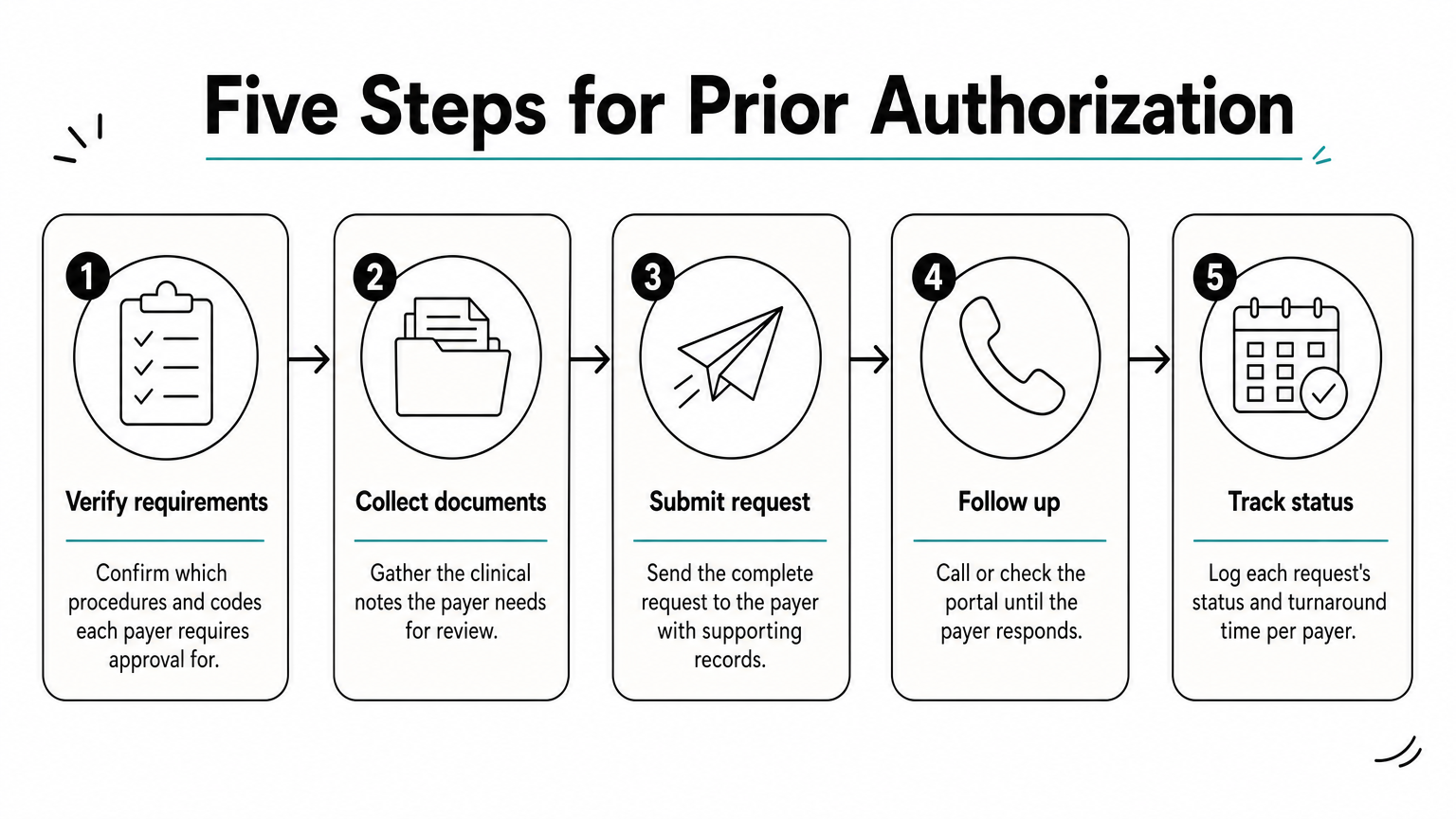
The service has five steps: requirement verification, clinical document collection, request submission, payer follow-up, and status tracking. The first step matters most. Requirements differ by payer, plan, and procedure code, and a missed requirement usually shows up weeks later as a denial. Insurers often make preauthorization a condition of payment, especially outside primary care.
InfiniteRCM’s Prior Authorization service covers these steps and can be tailored for physician practices, specialty clinics, and outpatient facilities.
Who it suits
Practices that order imaging, perform procedures, or prescribe infusions feel this pain most. Orthopedics, cardiology, and other specialty clinics often spend hours each week on approvals. If your front desk is doing authorizations between patient check-ins, errors and delays follow.
Cost and fit
Pricing varies. Some vendors charge per request and others a monthly retainer. Ask what happens when an authorization is denied after submission, and whether the vendor tracks turnaround time per payer. If you already use a full-service biller, check whether authorizations are included before paying for a second vendor.
An authorization handled before the visit prevents a denial that costs far more to fix afterward.
5. Medical virtual assistants
A medical virtual assistant is a remote team member who takes over billing and administrative tasks while you keep control of the workflow. It is the middle path between hiring locally and outsourcing the whole cycle.
What it covers
InfiniteRCM’s Medical Virtual Assistants (VA/FTE) handle billing support, patient scheduling, insurance verification, prior authorization assistance, and daily administrative work. You can engage them part-time or as a full-time equivalent. They work in your systems under your processes, which suits practices that want to stay hands-on.
Who it suits
This fits a practice whose biller is competent but overloaded. It also fits one that wants coverage during vacations or growth without a local hire. It does not fit a practice with no billing knowledge at all, because a virtual assistant follows your process and does not design one. In that case start with full-service RCM.
Cost and fit
Pricing is typically by hours or by full-time-equivalent seat, so cost stays predictable regardless of collections. That helps when volume swings. Ask about training, who supervises the assistant, and how quickly a replacement is provided if the match is wrong.
A virtual assistant adds capacity to your team, while full-service billing replaces the function.
How to compare costs and providers
Expect most billing companies to charge a percentage of monthly collections, so compare the total cost after scope, not the headline rate. Quotes in the range of roughly 4% to 10% are common, and specialty, volume, and included services move a quote within that range.
What billing services cost
Four pricing models cover most proposals:
| Model | How it works | Best when | Watch for |
|---|---|---|---|
| Percentage of collections | A set share of what you collect | You want the vendor paid on results | Low rates that exclude credentialing, AR work, or statements |
| Per-claim fee | A flat charge for each claim | Volume is steady and predictable | Extra charges for resubmissions and denial work |
| Flat monthly fee | One fixed amount for a defined scope | You want a predictable budget | Scope limits that trigger add-on fees |
| Hourly or FTE rate | You pay for assistant time | You keep billing in-house | Idle hours if workload drops |
A worked example shows why scope matters more than rate. Say your practice collects $60,000 a month. A 5% fee costs $3,000 a month, and a 7% fee costs $4,200. The gap is $1,200 a month, or $14,400 a year. If the 7% vendor includes denial appeals, patient statements, and reporting, and the 5% vendor charges extra for them, the cheaper quote may cost more.
InfiniteRCM advertises transparent pricing with no hidden fees. Whichever vendor you pick, get the full fee schedule in writing.
How to compare providers
Because these services run remotely, location matters less than payer knowledge. Look for a vendor that knows your state’s Medicaid program and your top commercial payers. Then ask these questions:
- How do you calculate net collection rate? Vendors advertise figures in the mid-to-high 90s, and the definition decides whether the number means anything.
- What is your clean claim rate, and how quickly do claims go out after charge entry?
- Which EHR and practice management systems do you work in, and do I buy anything new?
- What reports will I see, and how often?
- Is the team HIPAA certified, and how is data access controlled?
- What is the exit process? InfiniteRCM, for example, asks for 30 days written notice to cancel a monthly contract.
Rankings of company names go stale quickly. A vendor that answers these six questions clearly deserves a closer look.
A good billing quote is the one that states exactly what is included, how it is measured, and how you can leave.
Choosing the right billing partner
Start with the problem that costs you the most. If the whole cycle is the issue, choose full-service RCM. If old claims are piling up, start with AR recovery. New providers need credentialing, approval delays call for prior authorization help, and an overloaded biller may only need a virtual assistant. Then compare quotes on scope, definitions, and exit terms, not on the percentage alone.
If you want to see how these services would fit your practice or hospital, get in touch with InfiniteRCM and share your specialty, monthly claim volume, and current systems.