The best medical oncology billing services pair oncology-specific coding skill with proactive prior authorization and denial work, and they report results you can verify. If you want a firm built only around cancer care, look at Oncology Convergence or RC Billing. If you want pre-bill audits on chemotherapy and infusion claims, look at AnnexMed. If you want one multi-specialty partner for billing, prior authorization, AR recovery and credentialing, InfiniteRCM and Plutus Health fit better.
Oncology breaks general billing teams. One infusion visit can carry a chemotherapy administration code from the 96401 to 96549 range, a drug code from J9000 to J9999, exact drug units, an NDC and a diagnosis that supports medical necessity. Add prior authorizations for regimens, targeted therapies and genetic testing, and one missing detail turns an expensive drug claim into a denial.
This article compares five providers with the same breakdown for each: what it covers, who it suits and what to verify before you sign. InfiniteRCM is listed first because it is our company, and we say plainly where we are a general RCM firm and not an oncology specialist. The order after that is not a ranking. Figures for other companies are what they publish about themselves, so confirm them in your own discovery calls.
1. InfiniteRCM for multi-specialty RCM and prior auth
InfiniteRCM suits oncology practices that want a full-service RCM partner with strong prior authorization, denial and AR recovery support. It is a multi-specialty company, not a cancer-only firm, so you should test its oncology workflows before you commit.
What it covers
The service list is broad, and several pieces map directly onto oncology pain points:
- Core RCM: eligibility verification, clean claim submission, payment posting, denial management and financial performance reporting.
- Prior authorization: requirement verification, clinical document collection, submission, payer follow-up and status tracking.
- AR recovery: recovery of unpaid claims, underpayments, denied claims and insurance appeals.
- Credentialing and enrollment: payer enrollment, CAQH profile management and NPI registration support.
- Medical virtual assistants: part-time or full-time virtual assistant support for billing, scheduling and insurance verification.
InfiniteRCM reports a 99% clean claim rate, 40% faster collections and 60% fewer denials, drawn from 500+ providers and more than $50M recovered. Most claims go out within 24 to 48 hours after charge entry. The work is remote and cloud-based, and you buy no software.
A broad RCM partner earns its place in oncology through prior authorization and denial follow-up, so test those two first.
Who it suits
Solo oncologists, small groups and growing multi-provider practices fit best, especially those that want a dedicated account manager and a monthly contract with 30 days written notice for cancellation.
Because we are not oncology-only, ask us to walk through a sample infusion claim before you commit. You want to hear how drug J-codes, units and NDCs are checked against your treatment notes.
2. Oncology Convergence for oncology-only RCM
Oncology Convergence, Inc. suits practices that want a pure oncology specialist with deep drug-coding knowledge. It is an oncology-only billing and revenue cycle company with about 16 years of experience, working from offices in Colorado and Arizona.

What it covers
Its services include billing, coding, claims management and consulting across medical, radiation and gynecologic oncology, plus bone marrow transplant programs.
- Coders trained on cancer drugs, immunotherapy, targeted therapy, checkpoint inhibitors and biologics.
- Medicare and commercial reimbursement for medical oncology procedures.
- 340B program expertise.
- A proprietary Oncology Revenue Recovery platform meant to find lost charges and unbilled revenue.
The 340B experience matters if your practice or health system participates in the program, because those arrangements add reporting rules that general billers rarely handle.
If drug-heavy revenue is your biggest risk, an oncology-only coding team is the cleanest way to reduce it.
Who it suits
It serves everything from small single-specialty private practices to large academic medical centers and hospital-based cancer programs. That range suggests it can scale with you.
Before signing, ask how the recovery platform reports findings and whether lost-charge reviews are included in the base fee. Also ask for a reference from a practice about your size.
3. RC Billing for medical and radiation oncology
RC Billing suits cancer centers that bill medical oncology, radiation oncology, infusion and proton therapy under one roof. It is oncology-only, with more than 20 years in the field and headquarters in Cedar Park, Texas.
What it covers
Its team handles the full cycle, from charge entry and daily claim submission through payment posting, denial resolution and month-end financial reconciliation.
- Credentialing and enrollment with Medicare, Medicaid and commercial payers.
- A stated zero-balance goal for patient accounts.
- Annual SSAE 18 SOC 1 Type 2 audits and HIPAA risk assessments.
It reports serving more than 350 oncology providers. The SOC 1 Type 2 audit is worth noting, since it independently tests the controls that govern how a vendor handles your financial data.
Radiation and proton therapy have different coding logic than infusion, so a vendor that bills both is a real advantage for mixed centers.
Who it suits
Radiation oncology groups and mixed medical and radiation centers get the most from it. It also suits practices that want to outsource billing completely, including enrollment work.
Ask what its 350-provider base looks like by practice size, and who your named contact would be. A large book can mean strong benchmarks or thin attention, and only the answers will tell you which.
4. AnnexMed for pre-bill audits and denial prevention
AnnexMed suits practices that want errors caught before claims leave the building. It markets dedicated oncology billing with certified coders and a focus on pre-bill audits and denial prevention.
What it covers
Its published scope includes chemotherapy, infusion, drug billing and radiation therapy, along with prior authorization and reimbursement workflows. It also lists clinical trial billing, which is a specialized area that many general vendors skip.
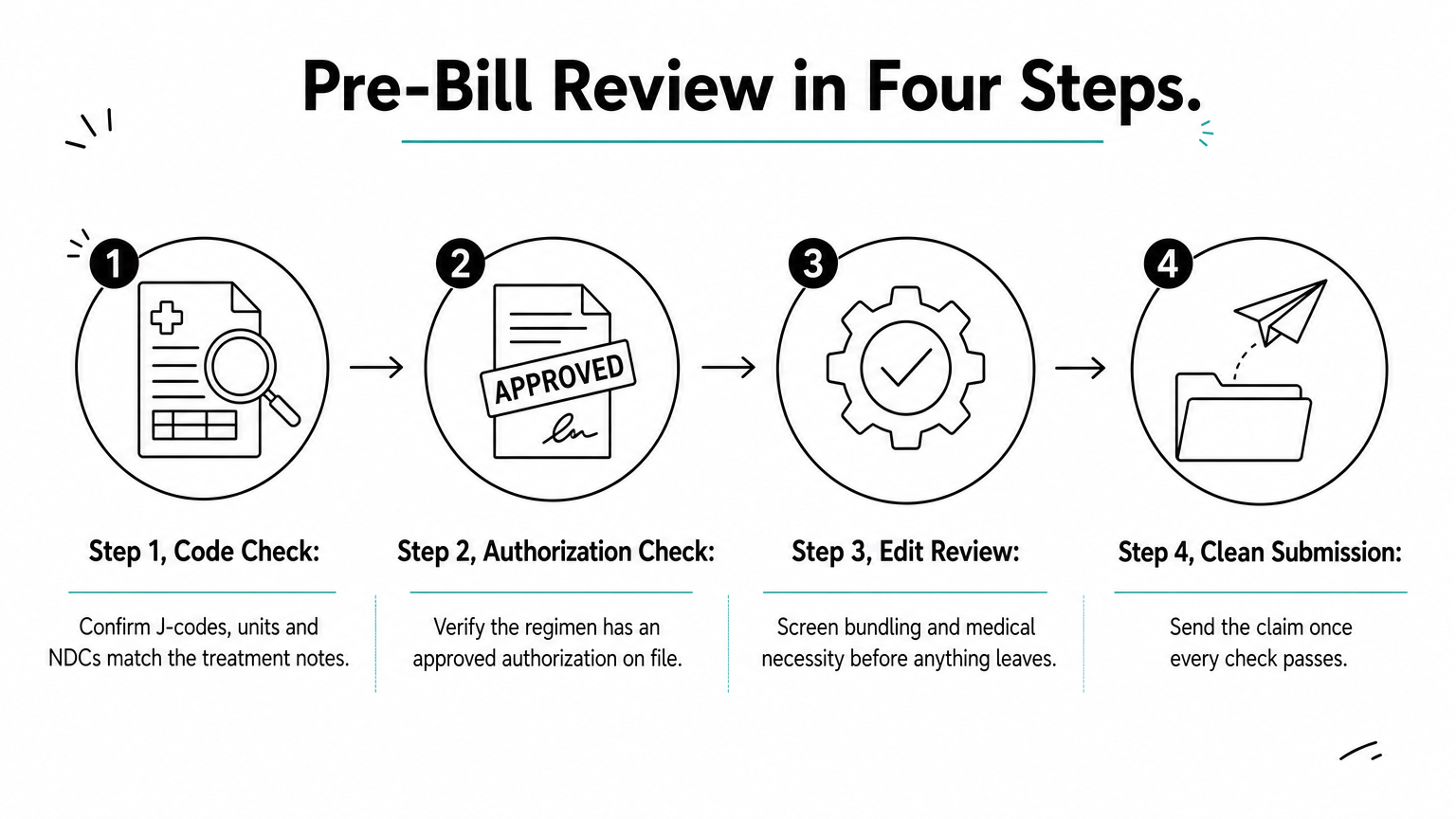
- Pre-bill coding review to cut rejections before submission.
- Prior authorization support.
- Denial prevention strategies built around oncology payer rules.
Clinical trial billing needs careful separation of routine care costs from sponsor-paid items. If your practice enrolls patients in trials, confirm that process in writing.
Fixing a claim before submission costs a fraction of appealing it after a denial.
Who it suits
Clinics that prioritize coding accuracy and compliance, and practices whose denial reports show repeat coding errors, are the best match.
Ask what share of claims go through pre-bill review, how fast the review turns around, and whether audit findings are reported back to your clinical staff. Feedback to the clinic is what stops the same error from recurring.
5. Plutus Health for outsourced billing and eligibility
Plutus Health suits small to mid-sized oncology practices and cancer centers that want outsourced billing with heavy front-end support. It is a multi-specialty firm, with about 15 years of experience and headquarters in Texas.

What it covers
It says its team of roughly 1,600 billers and coders follows CMS oncology billing guidelines, and it offers a free RCM assessment that looks for denial patterns and cash flow gaps.
- Prior authorization and eligibility verification.
- Denial and AR management, plus drug formulary buy-and-bill compliance.
- Patient support that tracks copays and deductibles, which it says lifts patient collections by 35%.
- AI-enabled financial analytics and RCM audits.
Patient responsibility is a real issue in oncology, because deductibles reset and treatment costs are high. Strong statement and collection work can recover meaningful revenue.
Eligibility and prior authorization at the front desk prevent more denials than any appeal team can recover.
Who it suits
It fits practices that want a free assessment first and a vendor with a large coding bench. It is less specialized than the oncology-only firms above.
Ask how many of those coders work on oncology accounts day to day, and request the assessment findings in writing so you can compare them with another vendor’s view.
How to choose among medical oncology billing services
Choose the vendor whose oncology depth, reporting and contract terms match your practice, and use the same questions with each one. A short list from the five above is enough to start.
Side-by-side comparison
| Provider | Focus | Notable detail |
|---|---|---|
| InfiniteRCM | Multi-specialty RCM | Prior authorization, AR recovery, credentialing, virtual assistants |
| Oncology Convergence | Oncology only | 16 years, revenue recovery platform, 340B expertise |
| RC Billing | Oncology only | Medical, radiation and proton therapy, 350+ providers |
| AnnexMed | Oncology billing | Pre-bill audits, clinical trial billing |
| Plutus Health | Multi-specialty | Eligibility checks, patient collections, free RCM assessment |
Pick an oncology-only firm when drug coding and radiation complexity dominate your revenue. Pick a broader partner when prior authorization, credentialing and staffing support matter as much as coding.
Questions to ask before you hire
Use these in every call, and write the answers down:
- How do you check J-codes, units and NDCs against treatment notes?
- Who owns prior authorizations for regimens and genetic testing?
- How do you handle bundling edits under the CMS National Correct Coding Initiative?
- Which reports will I get, and how often?
- What are the contract term, exit notice and fee structure?
A worked example of what denials cost
Suppose your practice bills $3,000,000 a year and 10% of claims are denied on first submission. That is $300,000 of claims to rework, and some will never be paid. Cutting first-pass denials to 5% leaves $150,000 in rework, so $150,000 less money stuck in appeals. Use your own denial rate and ask each vendor what it would change.
Picking the right billing partner
Good medical oncology billing services get drug codes, authorizations and denials right before the claim goes out. Oncology-only specialists such as Oncology Convergence and RC Billing bring concentrated coding depth. AnnexMed leads with pre-bill review, and Plutus Health leans on eligibility and patient collections.
A broader partner works when your biggest gaps are prior authorizations, AR backlog or credentialing. Whichever you choose, test each vendor on a real infusion claim and get reporting terms in writing.
If you want to see how InfiniteRCM would handle your prior authorizations, denials and AR recovery, reach out to InfiniteRCM and bring a recent denial report so we can start with your actual numbers.