
Behavioral health revenue cycle management is the process of tracking every patient encounter at a mental health or substance use practice, from the first intake call to the final payment, so you are paid correctly and on time. It covers eligibility checks, authorizations, coding, claim submission, payment posting, denial follow-up, and patient billing. What sets it apart from general medical billing is the work around time-based session codes, recurring visits, level-of-care authorizations, and strict proof of medical necessity.
This article explains why the discipline matters, walks through each stage in order, and shows how to cut denials and speed up collections. You will also see which metrics reveal problems early and how to decide between an in-house team, billing software, and an outsourced partner. If you are comparing revenue cycle management services or software, the decision framework near the end is meant for you.
At InfiniteRCM, we handle billing, denial recovery, credentialing, and prior authorizations for healthcare practices every day. The advice below reflects how this work actually gets done, including where claims tend to fail and which fixes pay off first.
Why behavioral health revenue cycle management matters
Behavioral health revenue cycle management matters because your margins depend on getting many small, recurring claims right the first time. A patient in weekly therapy generates a claim every week, so one error at intake repeats on every visit until someone catches it. That is why billing problems in behavioral practices grow quietly and then show up as a cash crunch.

How behavioral billing differs from general medical billing
Behavioral billing carries rules that a generic billing workflow often misses. Psychotherapy codes are time-based: 90832 covers 16 to 37 minutes, 90834 covers 38 to 52, and 90837 covers 53 minutes or more. Payers compare the code against the note, and a mismatch leads to a downcode or a denial. Level-of-care programs add authorization requirements that renew while the patient is still in treatment.
Several other features make the work specialized:
- Psychiatrists, psychologists, counselors, social workers, and associate-level clinicians are credentialed and billed differently by each payer.
- Telehealth claims depend on place-of-service codes and modifiers that vary by payer.
- Some plans send behavioral benefits to a separate managed behavioral health vendor, so the card in the patient’s hand does not tell the whole story.
- Sliding scale fees and frequent no-shows make revenue harder to forecast.
- Substance use treatment records may fall under 42 CFR Part 2.
What weak revenue cycle management costs you
The direct cost is rework. Every denied claim needs someone to find the reason, fix it, and resubmit, and payers set timely filing limits that run from roughly 90 days to a year depending on the contract. A denial nobody works before that deadline becomes a write-off. The indirect cost is slow cash flow, which keeps practices from hiring clinicians or opening more appointment slots.
Patients and staff pay too. A surprise bill after a few sessions is a common reason people leave treatment. Clinicians who spend evenings repairing notes for payer reviews have less energy for care, and billing staff who chase the same preventable denials burn out.
A denied behavioral health claim is rarely just a billing problem; it usually starts at intake or in the session note.
Compliance adds another layer
Federal parity law, the Mental Health Parity and Addiction Equity Act, requires most plans to apply limits on mental health and substance use benefits that are no stricter than those on comparable medical benefits. Parity rules give you grounds to challenge visit caps or authorization demands that look heavier than what the same plan applies to medical care. Your billing team should know when to escalate those cases.
Then there is 42 CFR Part 2, which protects the confidentiality of records from certain substance use disorder programs. It shapes what you may disclose to payers and which consent forms must be on file before you bill. Confirm the specifics for your program with compliance counsel, because getting this wrong creates legal risk beyond lost revenue.
How behavioral health RCM works, stage by stage
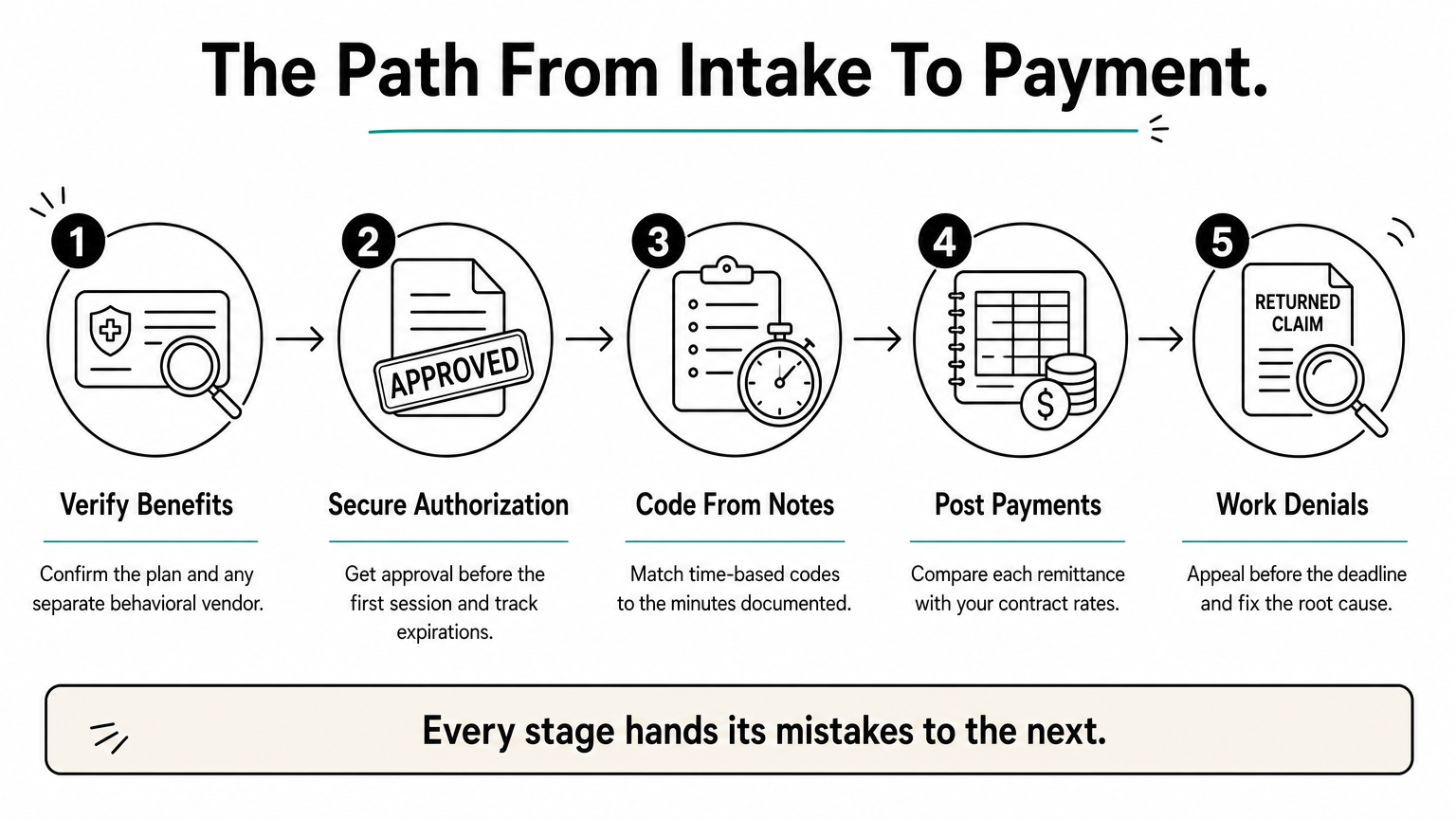
Behavioral health revenue cycle management runs through seven connected stages, with credentialing underneath all of them. Each stage hands its output to the next, so a mistake early on surfaces as a denial weeks later. Knowing the sequence tells you where to look when money goes missing.
The seven stages at a glance
Some frameworks list 12 steps by splitting registration, coding, and posting into smaller pieces, but the work is the same. This table shows the seven-stage version and the failure point you will meet most often at each one.
| Stage | What happens | Where it usually breaks |
|---|---|---|
| 1. Patient access and verification | Collect demographics and insurance, verify behavioral benefits, copay, deductible, and visit limits | Wrong plan, or a carved-out behavioral benefit missed |
| 2. Authorization | Request approval for IOP, PHP, residential care, testing, or extended therapy where required | Missing or expired authorization, no concurrent review |
| 3. Charge capture and coding | Turn services into CPT, HCPCS, and revenue codes with correct modifiers | Wrong time-based code, missing modifier, unbilled sessions |
| 4. Claim submission | Scrub claims and send them through a clearinghouse | Rejections for demographic or provider ID errors |
| 5. Payment posting | Post remittances and patient payments, flag underpayments | Underpayments accepted without review |
| 6. Denial management and AR follow-up | Work denials, file appeals, chase unpaid claims | Appeals filed after the deadline |
| 7. Patient billing and reporting | Send statements, set payment plans, review performance | Late statements, no root-cause reporting |
Before the claim: credentialing, verification, and authorization
Credentialing comes first. A clinician must be enrolled with each payer, and the effective date matters, because services before it often cannot be billed. Applications can take weeks to months, so start early and keep the CAQH profile current.
Verification comes next, and it needs a behavioral-specific check. Confirm whether the plan manages mental health benefits through a separate vendor, and record visit limits and cost sharing. For IOP, PHP, and residential care, the initial authorization is only the start. Concurrent reviews extend it, so track expiration dates for every patient and submit clinical updates before the last authorized day.
After the service: coding, claims, and collections
Coding must match the documentation. Outpatient professional claims use CPT codes such as the psychotherapy codes above, plus telehealth modifiers and place-of-service codes where the payer requires them. Facility-style programs bill institutional claims that pair HCPCS codes with revenue codes, such as 0905 for IOP and 0912 or 0913 for PHP.
After submission, distinguish rejections from denials. A rejection is bounced at the clearinghouse or payer front door before processing, so you correct and resend. A denial is a payer decision after review, and it needs a correction or an appeal. Post every electronic remittance and compare it with your contract rates, because underpayments hide in claims that look paid.
Every stage hands its mistakes to the next one, so the cheapest fix is always the earliest.
How to reduce denials and improve cash flow
You reduce denials by fixing the front end, documenting medical necessity, working every denial by root cause, and collecting patient balances early. Most avoidable denials in behavioral health revenue cycle management trace back to one of those four areas. Start at the top, because each fix downstream is more expensive than the same fix upstream.
Fix the front end first
Intake staff set the quality of every claim that follows. Give them a short, firm checklist and measure compliance with it:
- Verify benefits before the first visit, and again at the start of each plan year or when coverage changes.
- Check whether behavioral benefits run through a separate vendor, and bill the right payer.
- Confirm the treating clinician is credentialed with that payer before you schedule.
- Request authorizations before the first session and calendar every expiration date.
- Collect copays and known deductibles at the time of service.
Document for medical necessity
Notes win or lose appeals. Each note should record start and stop times, link the session to a goal in the treatment plan, describe symptoms and progress, and support the level of care. Build these as required fields in your EHR templates so a clinician cannot close a note without the time or the plan reference.
For IOP and PHP, document the clinical reason for continued stay every day. Concurrent reviewers decide on those notes. Run a pre-bill audit on a sample of notes each week, focused on the highest-volume codes, and feed the findings back to clinicians while the sessions are still fresh.
Work denials by root cause
Appealing every denial one by one treats symptoms. Group them so you can see the pattern, then stop the pattern at the source:

- Sort denials by payer and by reason code, using the claim adjustment reason codes on the remittance.
- Fix the upstream cause, such as a missing modifier or an expired authorization, not just the single claim.
- Appeal before the payer’s deadline with the note, the treatment plan, and a letter that cites medical necessity.
- Track overturn rates by payer so you know where appeals are worth the effort.
Collect patient balances and manage no-shows
High-deductible plans push more cost onto patients, so give an estimate at intake and collect at the visit when you can. Offer payment plans for larger balances rather than letting statements age. Insurers generally do not pay for missed appointments, so a written late-cancellation and no-show policy, signed at intake, is your protection.
Sliding scale programs need clear, documented criteria applied consistently. Check your payer contracts before discounting patient responsibility, because routine copay waivers can breach them. A clean financial policy protects revenue and keeps patient conversations about money short and predictable.
Metrics that show whether your revenue cycle is healthy
Track a small set of metrics every month, by payer, to see problems before cash drops. The figures below are common benchmarks, and your own targets should reflect your payer mix and service lines. Used together, they tell you whether the problem is at the front end, in coding, or in follow-up.
The core metrics and common targets
| Metric | What it measures | Common benchmark |
|---|---|---|
| Clean claim rate | Claims accepted and paid on first submission without edits | 95% or higher |
| Denial rate | Share of claims denied by payers | Under 10%, lower is better |
| Days in AR | Average time to collect on billed claims | Roughly 30 to 40 days |
| AR over 90 days | Share of open balances aged past 90 days | Under about 20% |
| Charge lag | Days between the date of service and claim submission | A few days at most |
| Net collection rate | Payments collected divided by what you were contractually owed | 95% or higher |
| Appeal overturn rate | Share of appealed denials that are reversed | Rising over time |
How to review the numbers
Reading these metrics as practice-wide averages hides the cause. Split them by payer, by CPT or level of care, and by clinician. If one payer drives your denials, the fix may be a contract or authorization issue. If one clinician’s notes drive them, the fix is documentation training.
Set a monthly review where billing, clinical leadership, and intake each see the same dashboard. Keep the meeting short and focused on the top three denial reasons and what will change before the next review. Real-time dashboards help, but only if someone owns the follow-through.
A metric you do not review by payer and by code will average away the exact problem you need to see.
How to choose RCM services or software
Choose based on who will actually do the work: your staff, a software tool, or an outside team. Software automates parts of behavioral health revenue cycle management, but it does not call payers, correct notes, or file appeals. Be honest about your capacity before comparing features or prices.
In-house, software, or outsourced
| Option | Best for | Main tradeoff |
|---|---|---|
| In-house billing team | Larger programs with steady volume and an experienced billing lead | Hiring, training, turnover, and coverage during absences |
| Billing software or EHR billing module | Practices that already have a skilled biller | Tools flag errors but do not work denials or follow up with payers |
| Outsourced RCM partner | Small and mid-size practices, or growing programs | Needs clear reporting access and transparent terms |
Staff certifications such as CRCR or CPB are useful signals, but experience with behavioral codes and payer rules matters more than any credential.
What to ask any vendor
Put these questions to every provider, and expect specific answers rather than general claims:
- Do you bill behavioral health codes and level-of-care claims, including IOP and PHP?
- Are eligibility checks, authorizations, and credentialing included or sold separately?
- Which EHR and practice management systems do you integrate with?
- What do you report each month, and can I see clean claim rate, denial rate, and days in AR by payer?
- How is pricing structured, and are there fees beyond the quoted rate?
- How do you handle HIPAA and 42 CFR Part 2 requirements?
- What happens to my data and claims history if I leave?
Where InfiniteRCM fits
InfiniteRCM covers the full revenue cycle: eligibility verification, clean claim submission, payment posting, denial management, AR recovery, credentialing and enrollment, and prior authorization support. Cloud-based access, integration with existing EHR and practice management systems, real-time analytics, and transparent pricing with no hidden fees support the practice side of the work.
We report a 99% clean claim rate, 40% faster collections, and 60% fewer denials across our client base, and we have recovered more than $50M in revenue for 500+ providers. Ask any vendor, us included, to show how those figures are measured and to apply them to your payer mix.
Fix the front end first
Behavioral health revenue cycle management comes down to a repeatable chain: credential the clinician, verify benefits, secure authorizations, code from the note, send clean claims, and work every denial to a root cause. Most lost revenue sits in the first links of that chain, not at the end.
Pick one number to improve this quarter, such as clean claim rate or days in AR, and trace it back to the stage that drives it. If your team is stretched or the denials keep repeating, outside help can take over the follow-up so clinicians stay with patients. To see what that would look like for your practice, speak with the InfiniteRCM team about your billing.