The best medical billing coding services pair certified coders with a clean claim rate near 95% or higher, documented HIPAA compliance, and reporting you can read at a glance. InfiniteRCM suits small and mid-size practices that want the whole revenue cycle handled by one team. Medical Billers and Coders fits multi-specialty groups, and CureMD fits practices that want an EHR and billing from one vendor. TruBridge and GeBBS are built more for hospitals and large groups.
Every miscoded claim costs you twice, once in the rework and again in the delay. Denials pile up, AR days stretch, and your front desk spends its afternoons on hold with payers. Outsourcing fixes this only when the company you pick is accurate, compliant, and honest about its numbers.
This article gives you the criteria to judge any provider, then walks through seven companies using the same three questions for each: what it offers, who it suits, and what to verify. InfiniteRCM publishes this blog, so it is listed first and held to the same checklist as everyone else. A comparison table, a pricing explainer, and advice on local versus remote providers close the article.
How to compare medical billing and coding services
Compare providers on four measurable outcomes, three compliance safeguards, and the quality of their answers to direct questions. Anything a vendor will not put in writing should not influence your decision. Every pick below was judged against this checklist.
The four numbers that matter
Ask each company for its clean claim rate, first-pass denial rate, net collection rate, and days in accounts receivable (AR). The targets below are commonly cited for outpatient practices. They are benchmarks, not guarantees, and they shift with specialty and payer mix.
| Metric | What it tells you | Commonly cited target |
|---|---|---|
| Clean claim rate | Claims accepted without edits or rejections | 95% or higher |
| First-pass denial rate | Claims denied on first submission | 5% or lower |
| Net collection rate | Share of collectible revenue actually collected | 95% or higher |
| Days in AR | How fast you get paid | Roughly 30 to 40 days |
Insist on the definition behind each figure. A “98% collection rate” measured against whatever was billed means little, while a rate measured against contracted allowed amounts means a lot. Ask for 12 months of data from a practice of your size and specialty.
A collection rate without a definition is a marketing number, not a performance number.
Compliance safeguards
Any company that touches patient data must sign a business associate agreement. HHS explains the requirement in its guidance on HIPAA business associates. Also confirm that the vendor screens staff against the OIG exclusion list, because billing for excluded individuals creates liability for you.
Check credentials too. Coders should hold a CPC from AAPC or a CCS from AHIMA, and the team should update its ICD-10-CM edits each October and its CPT edits each January.
Questions to ask before you sign
A strong medical billing coding company answers these without hesitation:
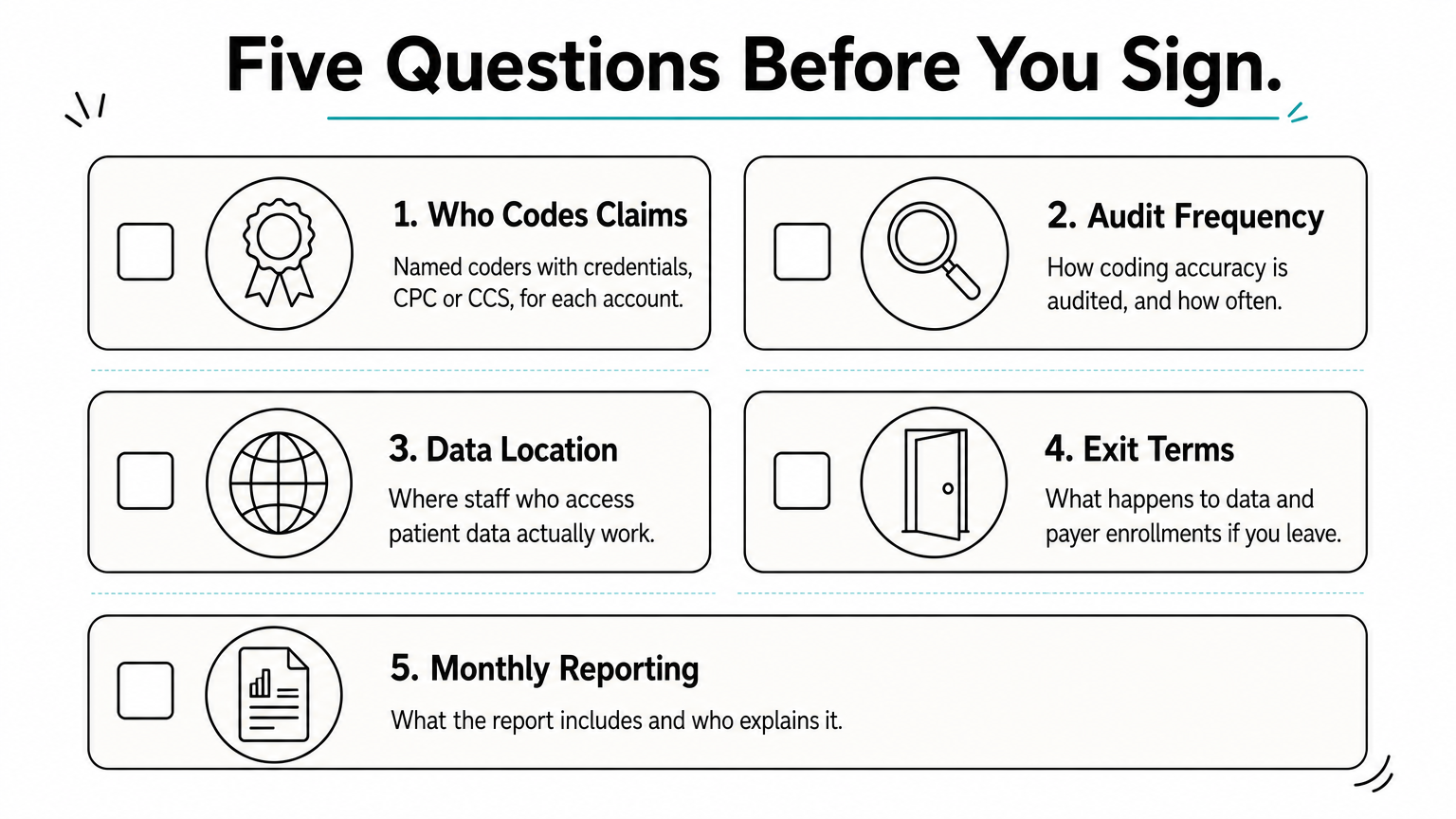
- Who codes my claims, and what credentials do they hold?
- How do you audit coding accuracy, and how often?
- Where do staff who access my patient data work?
- What happens to my data and my payer enrollments if I leave?
- What does your monthly report include, and who explains it to me?
1. InfiniteRCM
InfiniteRCM is the strongest all-around pick for independent and mid-size practices that want billing, denial work, and administrative support under one roof. It treats medical billing and coding services as one connected workflow, from eligibility check to final payment.
What it offers
InfiniteRCM covers the full cycle: patient eligibility verification, clean claim submission, payment posting, denial management, and financial performance reporting. Add-on services include AR recovery for unpaid and underpaid claims, insurance appeals, provider credentialing and CAQH management, prior authorization, and medical virtual assistants. The company states these results across its client base:
- 99% clean claim rate
- 40% faster collections
- 60% fewer denials
- 100% compliance rate
- 500+ providers served and over $50M recovered
InfiniteRCM’s edge is breadth: one team owns claims, denials, credentialing, and authorizations, so nothing falls between vendors.
Who it suits
It fits family medicine, cardiology, orthopedics, and general clinics, from small independent practices to multi-provider groups. It is a particularly good match if you live with high denial rates, long AR, or staff burned out on manual billing. It connects to your existing EHR and practice management system, gives you cloud-based analytics dashboards, and offers 24/7 support. Pricing is transparent, with no hidden fees.
What to verify
Hold InfiniteRCM to the checklist above. Ask how it defines clean claim rate, request a sample monthly report, and confirm who on the team is accountable for your account. Confirm the scope you need, whether that is full billing, AR cleanup only, or credentialing alone, and get it in the agreement.
2. Medical Billers and Coders
Medical Billers and Coders is a good pick for multi-specialty practices that want a long-established national billing company. It is one of the more visible names in medical billing coding services, and it leads its marketing with a high collection number.
What it offers
The company advertises more than 25 years of experience, multi-specialty billing, HIPAA compliance, and a 98.7% net collection rate. Those are its own claims, and the rate is among the best you will see quoted. It sells billing and revenue cycle support to practices across the United States.
Who it suits
Practices with several specialties under one roof benefit most, because specialty-specific rules for modifiers and payer edits are where generalist billers slip. It also suits groups that value a long operating history over a newer, technology-led approach.
A 98.7% net collection rate is impressive only if the definition and measurement period are shown to you.
What to verify
Ask how the 98.7% is calculated, which period it covers, and whether it holds for practices in your specialty. Request client references with similar volume. Confirm whether coding is performed by dedicated staff on your account or pooled across clients.
3. CureMD
CureMD is the best fit when you want your EHR, practice management, and billing from a single vendor. It has been in healthcare software since the late 1990s and sells coding and billing services alongside its platform.

What it offers
CureMD combines an EHR, practice management software, and medical billing and coding services. It describes its coding as supported by AI that suggests codes from clinical documentation, with human coders behind it, and it offers coding audits, clinical documentation improvement, and revenue cycle management. The company states coding accuracy of up to 95%.
Who it suits
Practices that are replacing their EHR anyway get the most from CureMD, because documentation and coding live in the same system. That tight link can reduce the handoff errors that happen when notes move between tools. Small and mid-size practices are the core audience, and larger groups are supported too.
Bundling an EHR with billing simplifies life until you want to leave one of them.
What to verify
Ask whether the billing service is available if you keep your current EHR, and what exit terms look like for each product. Treat the 95% accuracy figure as a starting point and ask how it is measured. AI suggestions should always be reviewed by a credentialed coder, so confirm that review step exists.
4. TruBridge
TruBridge is the better choice for hospitals and health systems that need inpatient and outpatient medical coding and billing services. It is less obviously tailored to a three-physician clinic.
What it offers
TruBridge provides HIPAA-compliant coding with certified inpatient and outpatient coders. Its stated accuracy is 95% or higher. Inpatient coding is a different discipline from office coding, with DRG assignment and longer, more complex records, so a team that handles both is a real advantage for facilities.
Who it suits
Community hospitals, critical access facilities, and health systems fit best. Large multi-site groups with hospital-affiliated services may also benefit. A small practice that only needs E/M and procedure coding may be paying for capability it will not use.
Match the vendor’s coding depth to your setting: inpatient expertise is wasted on an office practice.
What to verify
Ask about minimum volumes and whether a smaller account gets senior attention. Confirm how coding accuracy is audited, whether by internal reviewers or an external party. Ask how quickly coders turn around charts at your expected volume, since coding delays hold up billing for the whole facility.
5. Coding & Billing Solutions
Coding & Billing Solutions suits practices that require onshore-only work. It describes itself as a leader in 100% domestic medical coding and billing and health information management.

What it offers
The company offers coding and billing plus health information management services, with all work performed domestically according to its own description. That domestic commitment is its main differentiator among medical coding and billing companies, since many competitors mix in offshore teams.
Who it suits
Organizations with contractual, payer, or internal policy requirements about where patient data is handled will find the offer straightforward. Practices that simply prefer to deal with US-based teams for communication and time-zone reasons also fit. Groups needing HIM support alongside billing get a single point of contact.
Domestic-only is a policy choice, and it matters most if your contracts or your comfort level demand it.
What to verify
Get the domestic-only commitment written into the contract, including subcontractors and any overflow staff. Ask for collection and denial metrics like any other vendor, since location alone does not guarantee accuracy. Request details on credentialing of its coders and the quality review process.
6. CodeEMR
CodeEMR is worth a look if you want a medical coding and billing company that bundles coding with revenue cycle management in one contract. It positions itself around maximizing reimbursement, ensuring compliance, and managing the full cycle.
What it offers
The company provides coding and billing services combined with revenue cycle management. That combination matters because coding errors usually surface later as denials, and a vendor that owns both sides sees the feedback loop. Specific performance figures are less prominently published than at some rivals, so you will need to ask for them.
Who it suits
Practices that want to hand off coding, claims, and follow-up together will find the bundled approach convenient. It suits groups that have already decided to outsource and need a single accountable vendor rather than separate coding and billing partners.
When a provider publishes few numbers, your due diligence has to supply them.
What to verify
Request clean claim rate, denial rate, and net collection rate in writing, with definitions. Ask for reference practices in your specialty and a sample report. Confirm coder credentials and how coding audits are run and shared with you.
7. GeBBS Healthcare Solutions
GeBBS Healthcare Solutions is aimed at large groups and health systems that need scalable outsourced coding, billing, and revenue cycle capacity. It offers onshore and offshore delivery, so you can match cost to your risk tolerance.
What it offers
GeBBS provides coding, billing, and revenue cycle management, plus coding audits and clinical documentation improvement services. It handles large claim volumes across many specialties, which suits organizations whose workload swings with seasons or acquisitions.
Who it suits
Multi-site physician groups, hospital systems, and organizations consolidating billing offices fit best. Cost-conscious groups that are comfortable with offshore work can lower per-claim cost. A small practice would likely find the scale unnecessary.
Scale lowers cost per claim, but only if your account still gets named, accountable people.
What to verify
Ask exactly which functions are performed offshore and how protected health information is accessed from outside the US. Confirm the business associate agreement covers every location. Ask for the team structure assigned to your account and the escalation path when a payer issue stalls.
How to choose the right provider for your practice
Choose by matching a provider’s strengths to your size, setting, and tolerance for lock-in. Start with the table, then compare costs and location.
Side-by-side comparison
| Provider | Best for | Core scope | Notable point |
|---|---|---|---|
| InfiniteRCM | Small to mid-size practices | Full RCM, AR recovery, credentialing, prior auth | One team across the cycle |
| Medical Billers and Coders | Multi-specialty groups | Billing and revenue cycle | States 98.7% net collection rate |
| CureMD | Practices wanting EHR plus billing | Coding, billing, EHR | AI-assisted code suggestions |
| TruBridge | Hospitals and health systems | Inpatient and outpatient coding | Facility-level coding depth |
| Coding & Billing Solutions | Onshore-only requirements | Coding, billing, HIM | 100% domestic work |
| CodeEMR | Coding plus RCM bundle | Coding and billing | Single-vendor contract |
| GeBBS | Large groups | Coding, billing, RCM, audits | Onshore and offshore options |
What these services cost
Most medical billing coding services charge a percentage of collections, which aligns the vendor’s income with yours. Rates vary by specialty, volume, and scope, so any figure you see online is only a rough guide. Flat monthly fees and per-claim pricing also exist. Ask for a written quote that lists every fee, including setup, credentialing, and reporting, and avoid contracts that tie you in for years without a performance exit.
Finding medical billing and coding services near me
Location rarely affects billing quality, because nearly all of this work is done remotely through your EHR and a secure portal. What matters is who is accountable and how fast they respond. A local company can help if you want in-person meetings or a vendor familiar with regional payers, so state Medicaid plans and local Blue Cross plans are worth asking about. Otherwise, choose a national provider with a named account manager and weekly contact, then judge it on the numbers in the first section.
Choosing a billing partner you can measure
The right provider is the one that proves its accuracy, compliance, and collections with numbers you can verify. Use the same four metrics, three safeguards, and five questions with every vendor, and the ranking tends to sort itself out. Hospitals and large groups should look at TruBridge and GeBBS, while multi-specialty groups and EHR shoppers have solid options in Medical Billers and Coders and CureMD.
If you run an independent or mid-size practice and want one accountable team for claims, denials, credentialing, and authorizations, talk to InfiniteRCM and bring your own checklist.