

Chiropractic billing looks simple until the denials start stacking up. Visit limits, medical necessity rules, modifier errors like CMT with the -25 modifier, and payer-specific documentation requirements quietly drain revenue. If you are comparing chiropractic medical billing services, you likely want to know who handles claims best, what it costs, and whether outsourcing beats in-house software.
Here is the short answer. Outsourcing usually wins once your denial rate climbs or your front desk spends hours on claim follow-up. Software alone only submits claims. A billing company also codes, appeals, and chases unpaid balances. Most services charge a percentage of collections, typically 4% to 8%, so compare what that fee actually includes.
Below, we compare seven top picks side by side. For each, you will see services offered, pricing model, EHR compatibility, and the kind of practice it suits best. We build revenue cycle solutions for providers at InfiniteRCM, so we know which questions to ask before you sign a contract, and we share them along the way.
1. InfiniteRCM
How its chiropractic billing works
InfiniteRCM runs the whole billing cycle for your practice, from eligibility check to final payment. Your team keeps treating patients while ours works the claims. For chiropractic, that means close attention to CMT codes and modifiers like -25, plus payer visit limits. The workflow looks like this:
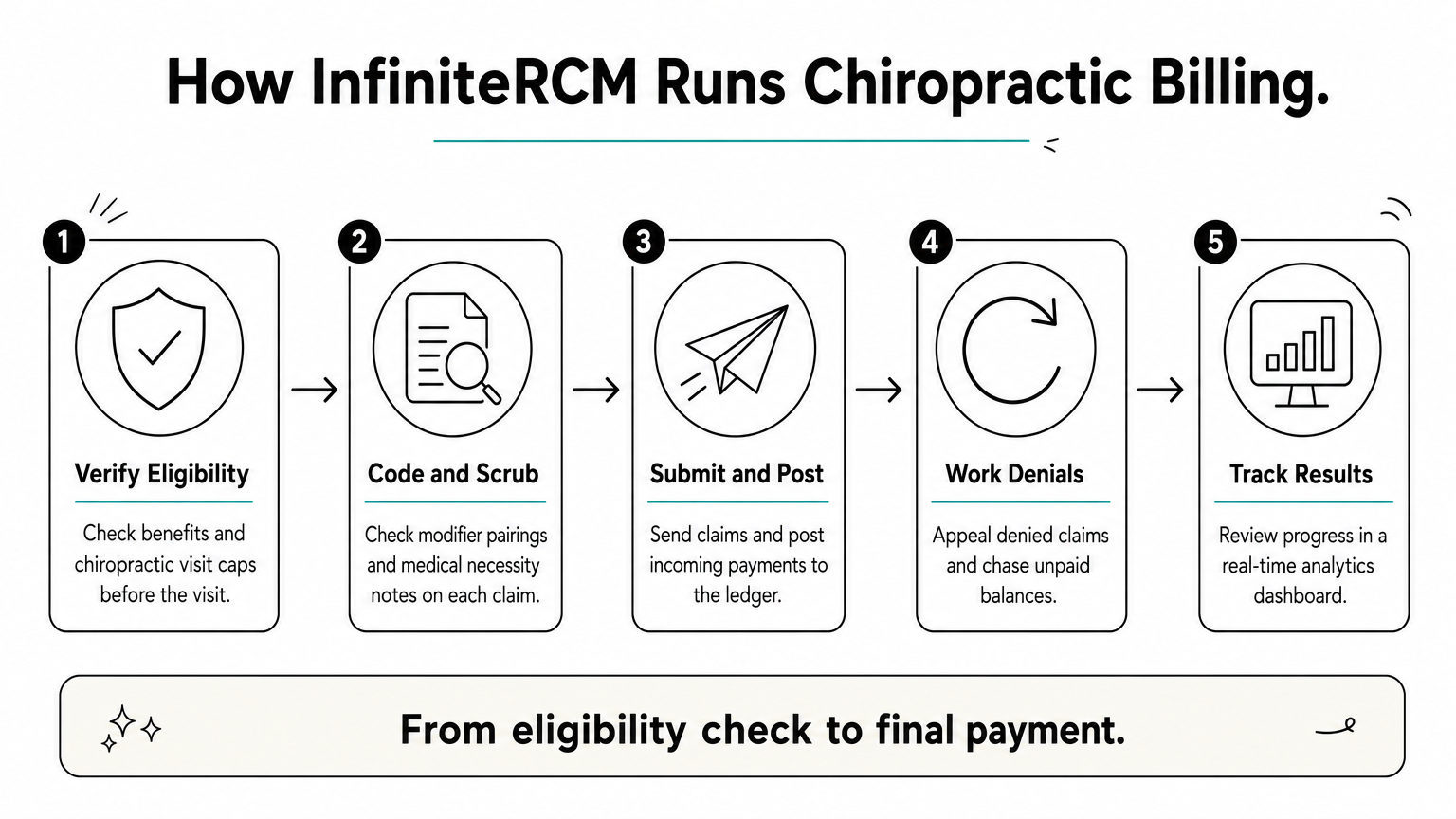
- Verify eligibility and benefits, including chiropractic visit caps, before the visit.
- Code and scrub each claim, checking modifier pairings and medical necessity documentation.
- Submit claims, post payments, and work denials and appeals.
- Track results in a real-time analytics dashboard.
Who it is best for
Small and mid-size clinics fit best, especially solo doctors and multi-provider practices with rising denials or long AR days. If you also need credentialing, prior authorization, or a medical virtual assistant, you can get it from one vendor instead of three.
Cash-only practices gain little here. If most of your revenue skips insurance, a billing partner is probably overkill, and simple in-house software will do.
Pricing and contract terms
Pricing is quoted to your practice’s volume and scope, and InfiniteRCM states it charges no hidden fees. We do not publish a flat rate here, so ask for a written proposal. Before you sign, confirm what the fee covers:
- Setup or onboarding charges
- Whether appeals and AR recovery are included
- Contract length and notice period for leaving
- Who owns your claim data if you leave
Strengths and limitations
Results are the main draw. InfiniteRCM reports a 99% clean claim rate, 40% faster collections, and 60% fewer denials, drawn from 500+ providers and more than $50M recovered. These are company figures, so ask for references from practices like yours.
Clean claims at submission cost far less than appeals after a denial.
The limitation is focus. InfiniteRCM is a broad revenue cycle company, not a chiropractic-only shop, so ask who will handle your account and how much chiropractic experience that person has. In return you get EHR integration, 24/7 support, and services beyond billing.
2. AnnexMed
How its chiropractic billing works
AnnexMed is a U.S. medical billing company that handles claim submission, payment posting, and denial follow-up for chiropractic practices. It also lists coding support and credentialing among its services. Confirm these points on your demo call:
- Which EHR or chiropractic software it works inside
- How often you get collections reports
- Whether one named biller handles your account
Who it is best for
Practices with steady insurance volume and no appetite for hiring a biller will get the most from AnnexMed. It suits clinics that want a hands-off outsourced setup more than a software subscription.
Solo chiropractors with mostly cash patients should skip it. Fees tied to collections make little sense when few claims go out.
Pricing and contract terms
We could not find published pricing for AnnexMed, so plan on requesting a custom quote. Get the fee structure in writing and compare it with the 4% to 8% range mentioned earlier.
- Ask about setup fees and minimum monthly charges
- Ask how long the contract runs and how you exit
Strengths and limitations
Its strength is breadth. You get billing, coding support, and credentialing under one roof, which cuts the number of vendors you manage. Ask for chiropractic-specific references, since that is the proof that matters.
A billing company is only as good as the person who answers your calls.
Limitations are mostly about transparency. Without public rates or clear performance numbers, you must verify results yourself. Request denial rates and days in AR from current clients before committing.
3. Money Tree Billing
How its chiropractic billing works

Money Tree Billing positions itself as a specialty billing company for chiropractors, so its staff should already know CMT coding, modifier rules, and payer visit limits. Expect it to handle claim submission, payment posting, and denial follow-up for you. Confirm these points on your demo call:
- Which chiropractic EHR platforms it can work inside
- How it handles Medicare documentation, including the AT modifier
- How often it reports denials and days in AR
Who it is best for
Solo and small-group chiropractors who want a billing team that speaks chiropractic from day one are the natural fit. It suits practices with a steady mix of commercial and Medicare claims that need careful coding.
Practices that also want credentialing, prior authorization help, or virtual staff from the same vendor may need to look elsewhere.
Pricing and contract terms
We could not confirm published rates for Money Tree Billing, so ask for a written quote. Most chiropractic billers charge a percentage of collections, so compare any offer with the 4% to 8% range mentioned earlier.
- Ask whether the rate changes with claim volume
- Ask about onboarding, statement, or minimum monthly fees
- Confirm the notice period for ending service
Strengths and limitations
Specialization is the draw. A team that sees chiropractic claims all day tends to catch coding errors before submission, and that is where most denials begin.
Specialty knowledge pays off before the claim goes out, not after it comes back.
The tradeoff is scope. A narrow focus can mean fewer add-on services than a broader company offers, and public performance data is thin. Ask for references from practices your size before you sign.
4. Premier Chiropractic Billing
How its chiropractic billing works
Premier Chiropractic Billing is a specialty company, so its core work is claim submission, payment posting, and denial follow-up for chiropractors. We could not verify its full service list, so confirm the details on your demo call:
- Does it code from your SOAP notes or only submit what you send?
- How does it handle Medicare documentation and maintenance care?
- Will one named biller own your account?
Who it is best for
Solo and small-group chiropractors who want a specialist team and a simple outsourced setup will get the most from it. It fits practices where the doctor still covers the front desk and nobody has time to chase denied claims. Groups that need credentialing or prior authorization support should compare broader vendors.
Pricing and contract terms
Published rates were not available when we reviewed it, so request a written quote. Most chiropractic medical billing services charge a percentage of collections, so measure any offer against the 4% to 8% range mentioned earlier.
A percentage fee only protects you if the contract defines what counts as collections.
- Ask whether the fee applies to patient payments as well as insurance payments
- Ask about setup, statement, and minimum monthly fees
- Confirm the notice period and how you get your data back
Strengths and limitations
Focus is the strength. A team that handles only chiropractic claims should spot CMT and modifier errors before submission, which is where most denials start.
The limits are scope and proof. Expect fewer add-on services than a full revenue cycle company, and public performance data is thin. Ask for denial rates and references from practices your size before you commit.
5. TJ Billing
How its chiropractic billing works
TJ Billing is an outsourced medical billing company that handles claim submission, payment posting, and denial follow-up. We could not verify how deep its chiropractic focus goes, so ask for chiropractic-specific workflows on your demo call:
- Does it scrub CMT claims for -25 modifier and visit-limit errors?
- Which EHR or chiropractic software does it work inside?
- Who files appeals when a payer disputes medical necessity?
Who it is best for
Clinics that bill across several service lines will get the most from it. Think of a chiropractor working beside physical therapy or a medical provider, who wants one vendor for every specialty. Practices that want a chiropractic-only coding team should ask pointed questions about experience before signing.
Pricing and contract terms
Published rates were not available when we reviewed TJ Billing, so request a written quote. Billing companies usually charge a percentage of collections, so hold any offer against the 4% to 8% range mentioned earlier.
- Ask whether the fee covers appeals and old AR cleanup
- Ask about setup, statement, and minimum monthly charges
- Confirm the notice period and how you get your data back
Strengths and limitations
Flexibility is the upside. A company that serves many specialties can handle a mixed practice without forcing you to split billing between vendors.
A quote is only comparable when every vendor prices the same scope of work.
The tradeoff is proof. Public performance data is thin, and general billers can miss chiropractic-specific rules like maintenance care limits. Ask for denial rates and chiropractic references before you commit.
6. ChiroFusion
How its chiropractic billing works

ChiroFusion is best known as a cloud-based chiropractic EHR and practice management platform with billing built in. That makes it the odd one out on this list, because it mixes software with services. We could not verify every detail of its billing offer, so ask which model you are buying:
- Software only, where your staff builds and submits claims
- Software plus a billing team that works claims for you
- One shared record for charting, scheduling, and billing
Who it is best for
Chiropractors who want to replace a patchwork of tools with one system will get the most from it. It suits practices that plan to run billing in-house with software, or add outside help later.
Offices that want someone else to own denials and AR from day one should look closely. If you choose the software-only route, the claim work stays with your staff.
Pricing and contract terms
Published rates were not confirmed when we reviewed ChiroFusion, so request a written quote. Software is often priced per provider per month, while billing services use a percentage of collections, so compare both models against the 4% to 8% range mentioned earlier.
- Ask whether billing fees are separate from the software subscription
- Ask about setup, data migration, and training charges
- Confirm the contract length and how you export your records
Strengths and limitations
Integration is the strength. When charting and claims live in one system, documentation flows straight into billing, which helps support medical necessity and cuts double entry.
Software can send a claim, but it cannot argue an appeal.
The limits are scope and proof. Moving your whole EHR just to get billing is a big change for your team, and public performance data is thin. Ask for denial rates and references from practices that use the billing service, not just the software.
Choosing the right billing partner
The best choice comes down to fit. Specialists suit practices that want chiropractic-only coding, while broader companies suit clinics that also need credentialing, prior authorization, or virtual staff. Software-first options work if you plan to keep claim work in-house.
Whichever you pick, compare chiropractic medical billing services on scope, not just the percentage. Get the fee in writing, and ask for denial rates and references from practices your size. Those answers tell you more than any sales page.
If you want one team to own eligibility, coding, appeals, and AR, start with a written proposal and see what it covers. You can request a proposal from InfiniteRCM and find out how much revenue your current process is leaving behind.