

A virtual medical assistant is a remote professional who handles administrative work, and sometimes documentation support, for a medical practice through secure software instead of from your front desk. Typical duties include scheduling, insurance verification, prior authorizations, billing follow-up, records upkeep, and patient messages. They do not deliver hands-on care. You will also see the role called a medical virtual assistant or a virtual assistant for a medical office. The work is the same.
This article explains why practices use one, what a virtual medical assistant does task by task, and how to hire one through a freelancer, an agency, or a company. It also covers what you need if you want to work in the role yourself.
InfiniteRCM provides medical virtual assistants alongside its billing and revenue cycle work. That gives us a close view of where admin gaps turn into denied claims and stalled authorizations, and that view shapes the advice below.
Why a virtual medical assistant is worth considering
A virtual medical assistant is worth considering because administrative work consumes time your clinicians and front-desk staff cannot spare, and unfinished admin work resurfaces later as denied claims and delayed care. Moving the repeatable parts to a remote specialist frees your team without adding desk space or equipment.
The hidden cost of admin work
A widely cited 2016 study in the Annals of Internal Medicine found that physicians spent nearly two hours on EHR and desk work for every hour of direct patient care. That time is not free. Staff who juggle phones and paperwork also skip steps, and skipped steps cost money. An eligibility check missed at scheduling becomes a denial weeks later. A prior authorization nobody follows up on becomes a delayed procedure and an unhappy patient.

Remote support also scales more easily than a local hire. You can add hours when volume jumps or a provider joins, and you can draw on candidates beyond your commuting area.
A worked example
Take a hypothetical three-provider practice. Its front desk spends its week like this:
| Task | Hours per week |
|---|---|
| Eligibility and benefits checks | 12 |
| Prior authorization calls and portal work | 8 |
| Reminder, reschedule, and recall calls | 10 |
| Total | 30 |
That is 30 hours a week, three quarters of a 40-hour position. A part-time virtual assistant covering those hours hands the time back to your staff. The work also gets done on a schedule instead of between interruptions at the counter.
A virtual medical assistant earns their place by taking repeatable admin work off the people who should be seeing patients or greeting them.
What a virtual medical assistant does day to day
A virtual medical assistant handles the repeatable, screen-based work of the front and back office. That means scheduling, insurance, authorizations, billing follow-up, records, and patient messages. Exact duties depend on what you assign and on the systems you already use.
Core tasks at a glance
The table below shows the areas where practices most often delegate work.
| Area | Typical tasks |
|---|---|
| Scheduling and patient contact | Booking, reminders, rescheduling, recall lists, intake forms, portal messages |
| Insurance verification | Checking eligibility and benefits before the visit |
| Prior authorization | Confirming requirements, gathering clinical documents, submitting requests, payer follow-up, status tracking |
| Billing support | Claim follow-up, denial work, payment posting, patient balance questions |
| Records and data | Updating demographics and insurance details, chart prep, tracking referrals and lab orders |
Insurance verification and prior authorization work deserve special attention. They are tedious, deadline-driven, and directly tied to revenue, which makes them ideal to hand off. The clinician still signs off on anything that involves clinical judgment.
Where the role stops
A remote assistant cannot take vitals, give injections, triage symptoms, or offer medical advice. Clinical decisions stay with licensed staff. Some remote roles, such as telehealth intake under provider supervision, sit closer to clinical work. State rules on what unlicensed staff may do differ, so check yours before assigning anything near patient care.

Some search results for this term describe AI chatbots that assess symptoms. That is a different product. A human virtual medical assistant works inside your systems, under your policies, and answers to your practice.
Think of a virtual medical assistant as an extension of your administrative team, never a stand-in for clinical staff.
How to hire a virtual medical assistant
To hire a virtual medical assistant, define the tasks first, choose a sourcing model, verify HIPAA and EHR experience, and run a structured first month. Skipping the task list is the most common mistake, because it leaves you comparing vendors on price alone.
Choose between a freelancer, an agency, and a company
You can source virtual medical assistant services three ways. Each trades price against control and risk.
| Option | Strengths | Watch for |
|---|---|---|
| Freelancer | Lowest cost, direct control | You carry HIPAA paperwork, training, and backup when they are out |
| Staffing agency | Pre-screened pool, replacements available | Varying training levels, markups, unclear HIPAA terms |
| Billing or RCM company | Assistants who work next to billing and authorization teams | Check that the scope matches your needs |
InfiniteRCM falls in the third group. Our Medical Virtual Assistants service covers billing support, scheduling, insurance verification, prior authorization assistance, and daily admin tasks, on a part-time or full-time equivalent basis. We work remotely inside your existing systems and require no software purchases.
Vet before you sign
Run every candidate or company through this checklist:
- A signed business associate agreement. HIPAA requires one when a vendor handles your patients’ health information, as the HHS guidance on business associates explains.
- Hands-on experience with your EHR and practice management system.
- Familiarity with your specialty’s terminology and payers.
- Role-based access, individual logins, and encrypted connections.
- Clear pricing, notice terms, and no hidden fees.
- A plan for absences, holidays, and time-zone overlap.
- References, or a short initial term to test the fit.
Onboard in four steps
- Write a short procedure for the first three tasks you are delegating.
- Grant only the access those tasks require.
- Review the output daily for the first week, then weekly.
- Track results: denial rate, days to schedule, authorization turnaround, and callback time.
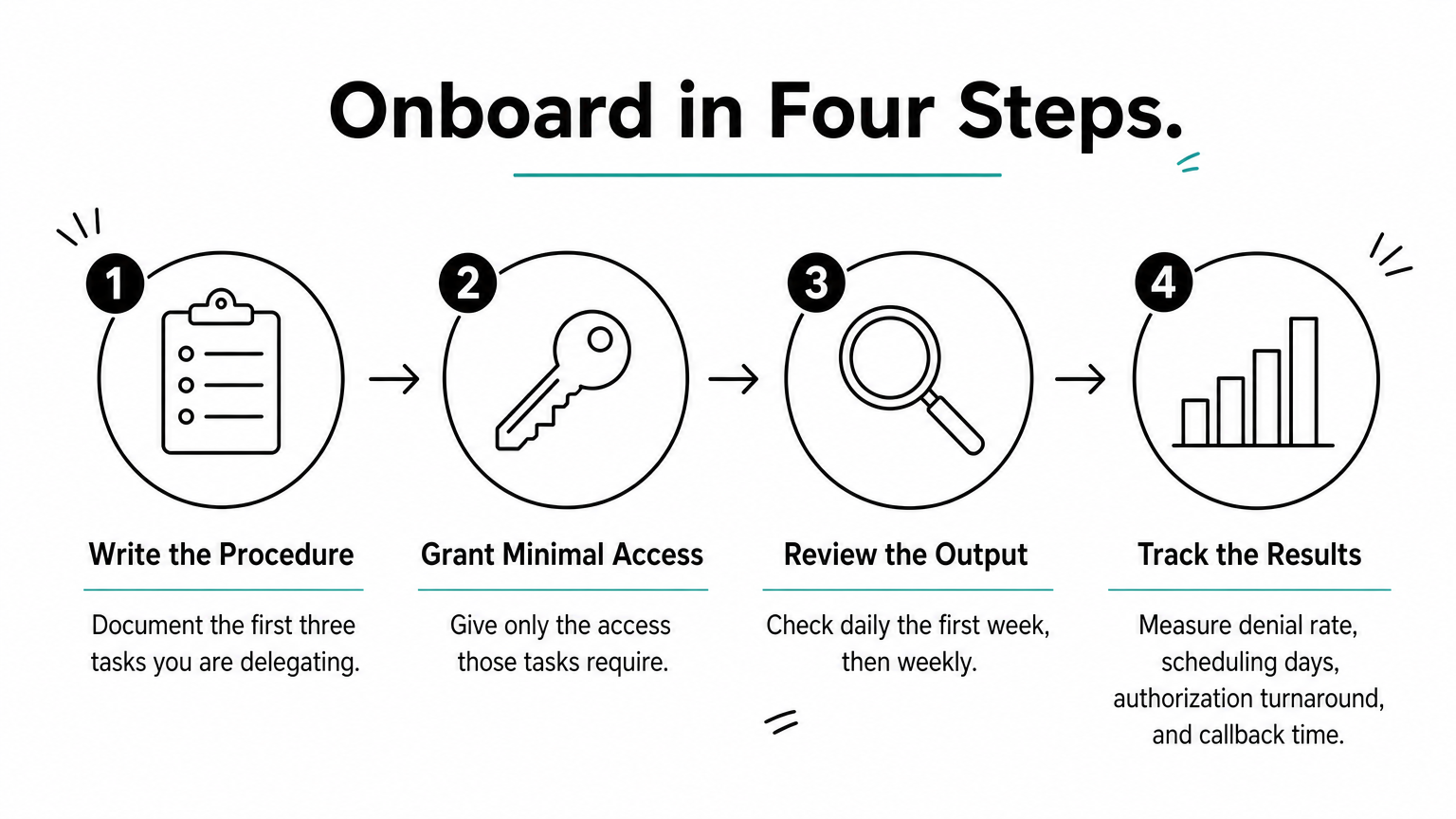
Add tasks only after the first three run cleanly. Measuring results early tells you whether the arrangement works before you commit more hours.
The best hire is the one you can hand a written procedure to on day one and measure by the end of week two.
How to become a virtual medical assistant
To become a virtual medical assistant, build front-office or billing experience, learn the major EHRs, and add HIPAA training. Remote employers rarely hire beginners for patient-facing admin work, because nobody is sitting beside you to catch mistakes.
Skills, training, and credentials
Employers look for medical terminology, insurance basics, scheduling skills, and clear written communication. Credentials help but are not always required. The Certified Medical Administrative Assistant (CMAA) from the National Healthcareer Association targets administrative work. Clinical credentials such as the CMA (AAMA) or RMA (AMT) require an accredited program and suit hands-on roles, though they also signal credibility for remote work.
Finding work and understanding pay
Remote openings come from agencies, billing and RCM companies, telehealth groups, and practices hiring directly. Pay varies with tasks, experience, schedule, and whether you are an employee or a contractor, so check current listings in your target segment instead of trusting a single figure.
Can a medical assistant work remotely? Yes, for administrative and telehealth-support roles. Hands-on duties still need you in the clinic.
Remote work suits medical assistants who can show administrative depth, because nobody is nearby to catch mistakes.
Where to start
A virtual medical assistant is a remote specialist who takes scheduling, insurance verification, prior authorization, billing follow-up, and records work off your team. They do not replace clinical staff. The practices that benefit most write down the tasks first, check HIPAA and EHR experience before signing, and measure results from the first week.
If you want to see what that looks like for your practice, start with a list of the hours your staff lose to admin each week. Then match those hours to a part-time or full-time equivalent arrangement. You can talk with InfiniteRCM about hiring a medical virtual assistant to scope the work and see how it fits your systems.