The best revenue cycle management software is the one that matches how your practice already works. Choose a standalone claims engine if you like your EHR, an all-in-one cloud suite if you want a single system, or a managed service if you would rather not run software at all. Small and mid-size practices will usually shortlist athenahealth, AdvancedMD, or eClinicalWorks. Waystar suits teams that keep their EHR and want a stronger claims layer. Epic suits large health systems. InfiniteRCM suits practices that want the results without buying a platform.
If you run a practice, you probably know the symptoms already. Denials keep coming back, accounts receivable ages past 60 days, and your staff spend their afternoons on rework instead of patients. Every vendor site promises fewer denials and faster cash, and many comparisons mix software licenses with outsourced services as if they were the same purchase.
This guide separates them. You get eight options, each with the same breakdown: what it does, who it suits, and where it falls short. A short buying checklist follows. InfiniteRCM publishes this guide and is a billing service, not a software license, so it is listed first and described plainly. Vendor figures are labeled as vendor claims.
What revenue cycle management software does
Revenue cycle management software automates the financial path of a patient visit, from scheduling and eligibility checks through claim submission, denial follow-up, and final payment. A good platform catches errors before a payer does and shows you where money is stuck.

The steps it should cover
Any healthcare revenue cycle management software worth shortlisting should support the whole chain, not just claim submission. Here are the steps to check against every demo:
- Scheduling and registration: capture demographics and insurance details accurately, because a wrong detail here triggers a denial later.
- Eligibility and prior authorization: confirm coverage before the visit and track approvals.
- Charge capture and coding support: turn the encounter into correct procedure and diagnosis codes.
- Claim scrubbing and submission: flag missing modifiers and bundling errors before the claim leaves.
- Payment posting and patient billing: reconcile remittances and collect patient balances.
- Denial management and A/R follow-up: group denials by cause, appeal them, and chase unpaid claims.
- Reporting: track clean claim rate, days in A/R, and collections by payer and provider.
Front-end errors cause most back-end pain. Software that only works on claims after they are built fixes symptoms, while software that checks eligibility and data at registration prevents them.
The best revenue cycle management tool prevents denials at registration instead of working them after the fact.
Three ways vendors package it
Revenue cycle management technology reaches you in three forms, and the form matters as much as the feature list. Comparing a standalone engine to an enterprise EHR is like comparing a toolbox to a workshop.
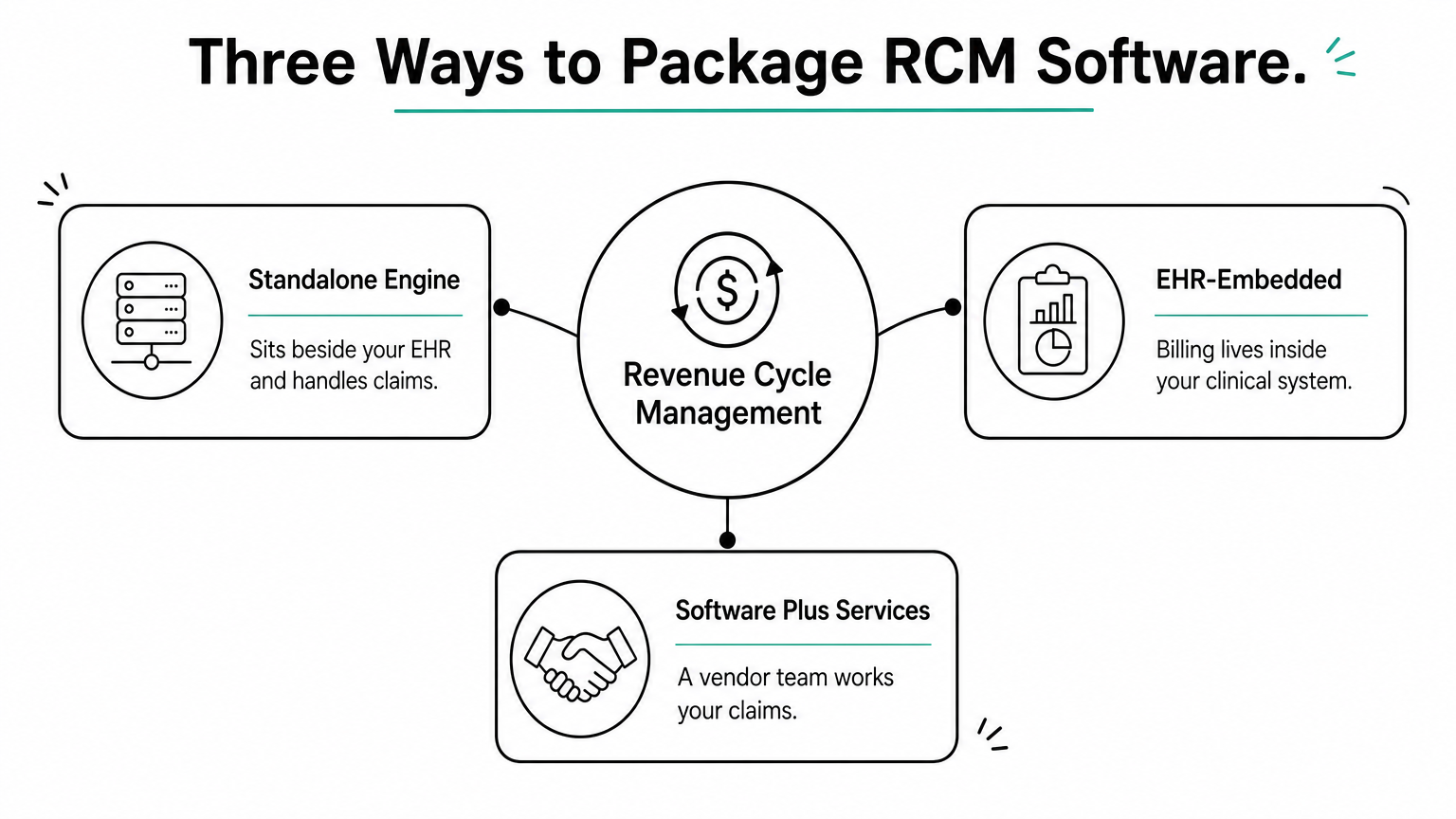
- Standalone RCM engine: sits beside the EHR you already own and handles claims, denials, and payments.
- EHR-embedded RCM: billing is a module of the clinical system, so one record feeds everything.
- Software plus services: a vendor team works your claims, with or without its own platform.
Each form trades control against effort. The standalone engine keeps your EHR but adds another vendor. The embedded module reduces handoffs but ties billing to your clinical choice. Services remove staff workload but move daily control to someone else.
1. InfiniteRCM: managed RCM with no software to buy
InfiniteRCM is a managed revenue cycle service for providers who want billing results without licensing, installing, or learning a new platform.
What it does
InfiniteRCM is a company your team hands billing work to, not a platform you install. Its staff access your existing EHR and practice management system remotely, so you buy no software. Claims go out electronically through secure clearinghouses, and most are submitted within 24 to 48 hours after charge entry. The service covers:
- Patient eligibility verification and clean claim submission
- Payment posting and denial management
- Accounts receivable recovery for unpaid claims, underpayments, and appeals
- Prior authorization handling, from requirement checks to payer follow-up
- Provider credentialing and payer enrollment, including CAQH profiles
- Financial reporting through real-time analytics dashboards
Who it suits
It suits solo providers, small clinics, and larger multi-provider organizations that want to outsource billing instead of running it in-house. It fits practices with high denial rates, aging A/R, or staff burned out on manual billing, across specialties such as family medicine, cardiology, and orthopedics.
It is a weaker fit if you want to keep a full in-house billing team and simply need a better tool. It is also not the right choice if you are selecting an enterprise EHR, because it does not replace one. Virtual medical assistants are available too, for scheduling and insurance verification on a part-time or full-time basis.
Strengths and trade-offs
The company reports a 99% clean claim rate, 40% faster collections, and 60% fewer denials across 500+ providers, with a HIPAA certified team. Dedicated account managers are available for communication and support, and support responds within 24 business hours. Onboarding takes a few days to a few weeks depending on setup complexity.
The trade-off is control. You hand over daily billing work, so insist on dashboard access and a regular review call. Monthly contracts need 30 days of written notice to cancel, so read the terms before you start.
If your real goal is cash flow, not owning software, a managed service skips the platform decision entirely.
2. Waystar: claims-first engine for any EHR
Waystar is a cloud-based, end-to-end platform focused on claims, payments, and denials. It sits on top of the EHR you already have.
What it does
Waystar covers claim scrubbing and submission, eligibility checks, prior authorization, denial management, and patient payments. Its public materials cite connections to more than 5,000 payers, which matters if you bill many payers with complex remits. It also offers AI-driven clinical documentation tools through its Iodine acquisition.
- Pre-submission edits that flag common errors before they become denials
- Real-time claim status tracking by payer
- Denial categorization and root-cause analysis
- Digital statements, payment plans, and point-of-service collection tools
Who it suits
Waystar suits organizations that already have a clinical or practice management system and want a mature revenue layer on top. It integrates with many EHRs, including Epic, Oracle Health, MEDITECH, athenahealth, eClinicalWorks, and NextGen, according to its public materials.
Skip it if you want a single system for charting and billing. It is not an EHR, so you still manage that vendor relationship separately.
Strengths and trade-offs
The strengths are claims depth, payer breadth, and visibility into denials and underpayments in one dashboard. Independent reviews describe its foundation as unusually mature.
The trade-offs are commercial. Waystar often prices per claim, which can be efficient at modest volume and expensive at high volume, so model your annual claims before signing. Some public reviewers also report slow support responses and unclear contract terms, so get support expectations in writing.
Waystar is the benchmark when claims and denials are the problem and your EHR is not.
3. athenahealth: all-in-one cloud suite for small to mid-size practices
athenahealth combines EHR, practice management, and revenue cycle services in one cloud ecosystem, so billing data flows from the same record clinicians use.
What it does
Its revenue cycle features are spread across its product family, including athenaOne and the enterprise-oriented athenaIDX. Together they cover registration, eligibility, charge capture and coding support, claim submission, payment posting, denial tracking, and patient billing. Reporting dashboards track revenue, denials, and days in A/R by payer, provider, and code.
- Unified patient record and scheduling that feeds billing
- Automated insurance verification at the front desk
- AI-assisted coding suggestions and payer-based rules
- Denial categorization and appeal routing
Who it suits
It suits practices that want fewer systems, not more. Small and mid-size groups, and multi-specialty practices that still want unified processes, are the natural fit. It also appeals if vendor stability and a broad partner network matter to you.
It is a poor fit if you only want a billing engine or a very niche, specialty-specific tool, or if you prefer lightweight screens with minimal configuration.
Strengths and trade-offs
Tight integration is the headline strength. Data moves from scheduling and documentation into billing without re-keying, which cuts handoff errors. The cloud architecture also means automatic updates and remote access.
The trade-offs are the learning curve and mixed public feedback on support and pricing transparency. A large integrated platform needs real onboarding and training time. Test support responsiveness during demos, and ask for written pricing and service-level commitments before you commit.
Consolidation is athenahealth’s selling point, so judge it on how well one system replaces three.
4. AdvancedMD: configurable cloud platform for independent groups
AdvancedMD is a cloud-first suite of practice management, EHR, and billing aimed at independent and ambulatory practices.
What it does
The billing module covers charge capture, claim submission, remittance posting, and reporting, with dashboards that track A/R by payer. The vendor promotes AI-assisted claim scrubbing, eligibility checks, and payer-specific rules. Its 2026 Winter Release notes AI ambient listening and scribing to reduce provider documentation time.
- Centralized scheduling and patient records feeding billing
- Cloud EHR with telehealth support
- Configurable workflows, reports, and billing logic
- KPI dashboards for A/R and payer performance
Who it suits
It suits independent practices and growing ambulatory groups that want configurability instead of a locked template. If you add providers or locations over time, a modular cloud platform can grow with you.
It is less suited to very small practices that only need a light billing tool, to large enterprise systems that need Epic-level depth, or to buyers who insist on on-premise hosting.
Strengths and trade-offs
The strengths are cloud hosting with lower IT overhead, a single environment for scheduling, charting, and billing, and flexible workflows. The AI documentation and scrubbing features add value if you use them.
Flexibility has a price in setup. Expect real time for workflow design, role configuration, and training. Public review scores for the platform are moderate, which usually signals power with some friction. Ask which advanced tools are add-ons, and talk to current customers in your specialty and practice size.
AdvancedMD rewards practices that will invest in configuring it and frustrates those who expect it to work out of the box.
5. NextGen Healthcare: software plus services for ambulatory practices
NextGen Healthcare ties revenue cycle software to its ambulatory EHR and practice management tools, and adds optional human services on top.
What it does
NextGen offers claims submission, payment posting, and A/R cleanup, plus eligibility verification and prior authorization support. It also provides coding support and credentialing services, and its analytics reportedly track more than 100 KPIs, including denials, collection rates, and days in A/R by specialty and payer.
- Claims and A/R management across payers
- Specialized A/R recovery teams for aged balances
- Eligibility, coding, and credentialing services
- Dashboards paired with consulting from dedicated client managers
Who it suits
It suits independent ambulatory and multi-specialty practices that want technology plus guided support, especially if they already run or are considering NextGen’s EHR. You can pick services a la carte, such as eligibility, coding, or A/R recovery, instead of buying a bundle.
It fits poorly for very large health systems that need a full enterprise suite, practices that want software only, and buyers who want a fully outsourced turnkey service.
Strengths and trade-offs
The standout is A/R recovery. NextGen reports returns of 3x to 10x on some recovery engagements, which is a vendor figure you should test against your own aged balances. Specialty-aware workflows and consultative analytics help you spot weak payers and codes.
The trade-off is that you manage a software relationship and a service relationship at once. Results depend on your willingness to review analytics and change front-office workflows, not just hand over data. Model the expected return on services like recovery and coding before you sign.
NextGen works best when you treat it as a partnership that changes your workflow, not a license you install.
6. CureMD: AI-driven billing services for outsourcing practices
CureMD is a cloud health IT company whose RCM business combines AI-driven automation with managed billing support.
What it does
CureMD promotes AI tools for claims processing, payment posting, and denial management. It supports real-time and batch insurance verification, including dual-eligibility checks, handles prior authorization, and automates patient statements. Reporting and BI tools show income, collections, and performance.
- Eligibility checks and prior authorization workflows
- Automated payment posting and patient statements
- Managed denial resubmission and appeals
- Reporting dashboards on collections and A/R
Who it suits
It suits small to mid-size practices that want to outsource part or all of billing while keeping visibility through reports. It is a reasonable pick when you want automation but lack the staff to build and maintain it.
It is less suited to buyers who want full control of every billing decision, very large systems with mature RCM infrastructure, or practices that want a basic low-cost tool without services.
Strengths and trade-offs
CureMD markets an average collection rate of up to 96%, denial resubmission within 48 hours, up to 40% lower A/R days, and up to 25% higher collection rates. Treat these as marketing-level maximums, and ask for results from practices like yours.
The trade-offs are control and clarity. Revenue performance depends on the vendor’s execution, and pricing is quoted only on contact. Ask for a written breakdown of fees, responsibilities, and what stays with your staff versus the vendor.
Marketing maximums tell you what a vendor can do at best, so ask for typical results in your specialty.
7. eClinicalWorks: EHR-first billing for ambulatory care
eClinicalWorks builds revenue cycle workflows directly into its EHR and practice management suite instead of selling billing as a separate product.
What it does
The vendor positions its RCM layer as a way to keep claims, eligibility, and patient billing inside one environment. Features include automated claim management, eligibility verification and prior authorization shown in clinical context, denial and underpayment reporting, and patient-facing statements with online payment options.
- Claim submission and management inside the EHR
- Coverage and approval visibility for front-desk staff and clinicians
- Dashboards on denials and workflow bottlenecks
- Clearer statements and online payments for patients
Who it suits
It suits ambulatory and community-based organizations, including health center style practices, that want one EHR and one billing workflow across sites. Multi-location groups get consistent processes without stitching vendors together.
It is not for buyers who want a pure RCM engine detached from an EHR, or tiny practices that only need simple billing. Many organizations also pair it with an outside RCM vendor, which tells you the built-in layer may not cover everything.
Strengths and trade-offs
The strength is consolidation: clinical and financial teams work from the same record, and you deal with one vendor for support. Eligibility and authorization appear where staff already work.
The trade-off is that you cannot judge it in isolation. Evaluating its billing means evaluating the EHR, so a weak charting fit sinks the whole purchase. Ask for a demo run on your own payer mix and specialty rules, and check whether you would still need an outside denial or A/R vendor.
Buy eClinicalWorks for the EHR decision first, and treat its billing as part of that package.
8. Epic: enterprise EHR with built-in revenue cycle
Epic is not standalone RCM software. It is a large EHR platform whose revenue cycle capability is built into its clinical and financial architecture, and it anchors most major health systems.
What it does
Epic connects clinical records, orders, procedures, and charges to billing, so charges reflect what happened in care. Health systems often use it as the single source for charge capture, claim submission, and remittance handling, and its reporting tools support system-wide dashboards on denials, collections, and payer performance. Many outside RCM vendors offer Epic-native integrations. Oracle Health plays a similar enterprise role and often appears beside Epic on large-system shortlists.
Who it suits
Epic suits hospitals, academic medical centers, and multi-site systems that need centralized charge capture and billing rules across many departments and payers. It also suits organizations already on Epic that want to get more from that investment.
It does not suit small or independent practices. For them it is oversized, and the implementation effort alone rules it out.
Strengths and trade-offs
The strengths are deep clinical-financial integration, scalability, governance, and organization-wide data visibility. When orders, documentation, and charges share one data model, missing and misaligned charges drop.
The trade-offs are scale and cost. An Epic rollout is a multi-year transformation with heavy training and internal staffing, and its interface carries a steep learning curve. Improving RCM on Epic usually involves Epic, a software partner, and your IT team, which adds coordination work. It is a platform commitment, not a denial-reduction app.
Epic solves enterprise integration problems, and a ten-provider clinic does not have them.
How to choose healthcare RCM software for your practice
Start with the form that fits your size and staffing, then test vendors on integration, pricing terms, and measurable results. Features matter less than whether the tool works with your EHR, your payers, and your people.
Match the type of tool to your size
This table sets the eight options side by side, using vendor materials and public reviews.
| Option | Type | Best for | Pricing or contract note |
|---|---|---|---|
| InfiniteRCM | Managed service, works in your systems | Any size practice wanting to outsource billing | Transparent pricing; 30 days written notice to cancel monthly contracts |
| Waystar | Standalone claims platform | Teams keeping their current EHR | Often per claim |
| athenahealth | All-in-one cloud suite | Small to mid-size practices | Get pricing and service levels in writing |
| AdvancedMD | Cloud practice management, EHR, billing | Independent and growing groups | Ask which tools are add-ons |
| NextGen | Software plus services | Ambulatory practices | Services selected a la carte; model return first |
| CureMD | AI software plus managed billing | Small to mid-size practices outsourcing | Quoted on contact |
| eClinicalWorks | EHR-embedded billing | Ambulatory, multi-location groups | Evaluate with the EHR purchase |
| Epic | Enterprise EHR with built-in RCM | Large health systems | Multi-year implementation |
Questions to ask every vendor
Ask the same questions of every vendor so the answers compare cleanly:
- Is the EHR and practice management integration native, or does it run through middleware?
- What is the pricing model (per claim, per provider, percent of collections, add-ons), and can you have it in writing?
- Who works denials and appeals, your staff or theirs?
- What reports will you receive, and how often are they reviewed with you?
- Who handles data migration, and how long does implementation take?
- What are the support response times and the escalation path?
- How do you exit, and how is your data returned?
Numbers to hold vendors to
Pull a baseline from your last 90 days before any demo: clean claim rate, days in A/R, denial rate, and net collection rate. Then ask each vendor what change they commit to against that baseline.
A worked example shows why small percentages matter. A practice sending 1,000 claims a month at a 95% clean claim rate reworks 50 of them. At 99%, it reworks 10. That is 600 reworked claims a year versus 120, and each one costs staff time and delays payment.
A vendor that will not tie its promises to your baseline numbers is selling a brochure, not a result.
Picking your shortlist
Revenue cycle management software comes in three forms: standalone engines, EHR-embedded modules, and software with services. Your size, your EHR, and how much billing work you want to keep in-house decide which form fits. Pick one or two options per form, run the same questions and baseline numbers against each, and let the answers make the call.
If a managed service sounds closer to what you need, you can ask the InfiniteRCM team how it would work inside your current systems.