A revenue cycle management consultant is a specialist who audits how a healthcare practice gets paid, from scheduling and insurance verification through claims, denials, and patient balances. The consultant then recommends changes that raise collections. You hire one when your denial rate, days in accounts receivable (AR), or net collection rate point to a problem your team cannot find on its own. Revenue cycle management consulting delivers a diagnosis and a plan. It is not a billing service.
InfiniteRCM handles medical billing, AR recovery, credentialing, and prior authorization for more than 500 healthcare providers. We see the same revenue leaks that consultants are hired to find. That daily view of claims shapes the practical advice below.
This guide explains why the role matters, how to hire the right consultant, and what an engagement includes. It also shows how consulting differs from outsourced billing, and how you can become a consultant yourself.
Why a revenue cycle management consultant matters
A revenue cycle management consultant matters because revenue leaks are rarely visible from inside the practice. Your staff works claims one at a time. A consultant reviews thousands of claims at once and finds the pattern behind them.
Where revenue leaks without anyone noticing
Most lost revenue is not dramatic. It is a recurring eligibility error at registration, a code that one payer rejects every time, or a denial that nobody works before the deadline. Each one looks small. Together they drain cash flow and staff time.

Internal teams also grow used to workarounds. Billers learn to resubmit a rejected claim instead of asking why it was rejected. An outsider has no habits to protect and asks the obvious question.
- Eligibility and benefit errors caught only after the visit
- Missing or late prior authorizations
- Coding and modifier mismatches with payer policy
- Denials that expire unworked
- Underpayments accepted without checking the contract
Small errors that repeat every day cost a practice more than any single big mistake.
Signs it is time to bring in outside help
Watch the numbers first. A rising denial rate, growing balances in the over-90-day AR bucket, and slow payment after submission all say the process is failing somewhere.
Staffing and change events matter too. Billing turnover, an EHR migration, a new payer contract, or a new location can each break a workflow that used to work. Revenue cycle management consulting pays off most at those moments, because it costs less than months of unnoticed drift.
How to hire a revenue cycle management consultant
Hire a consultant by naming your problem first. Then test candidates on specialty experience, data skills, and proof of results. Walk away from anyone who offers a generic checklist before seeing your claim data.

Define the problem before you shop
"Reduce denials" and "fix cash flow" are too vague to buy. Pull the last 6 to 12 months of data and pick one or two specific targets, such as a denial rate that keeps climbing or AR days that never come down. A tight scope lets you compare proposals fairly and keeps fees from drifting.
Decide up front whether you want a diagnosis only or help carrying out the fixes. Many disappointing engagements come from a mismatch on this point.
Questions to ask before you sign
Use these questions to separate real expertise from a polished pitch:
- Which specialties and payers have you worked with, and what did you find?
- What data do you need from us, and from which systems?
- Which metrics will you baseline, and how will you report progress?
- Will senior experts do the work, or junior analysts?
- Is pricing fixed, hourly, or tied to results, and what is excluded?
- Will you sign a HIPAA business associate agreement before touching patient data?
Ask for references from practices of similar size and specialty. A revenue cycle management consultant who has fixed cardiology denials may not know behavioral health authorization rules.
The best consultant is the one who asks for your claim data before quoting a fix.
What revenue cycle management consulting includes
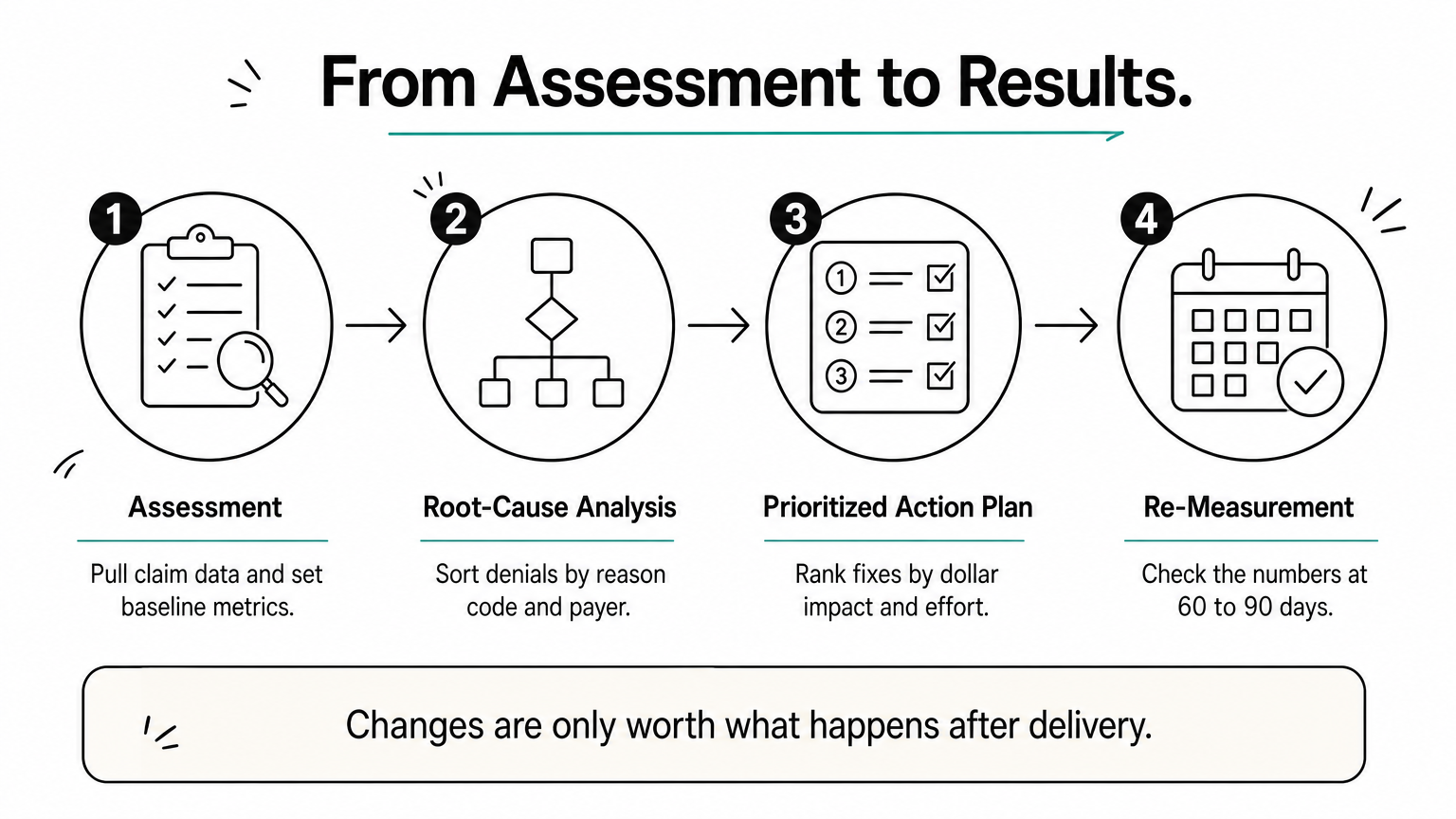
Revenue cycle management consulting usually runs in three stages: assessment, recommendations, and follow-through. The assessment sets the baseline that everything afterward is measured against.
Assessment and baseline metrics
Consultants start by pulling claim and remittance data from your practice management system. They calculate baseline metrics and compare them with industry benchmarks. Typical measures include:
- Clean claim rate
- Denial rate by payer and reason code
- Days in AR
- Percentage of AR over 90 days
- Net collection rate
Next comes root-cause analysis. Sorting denials by reason code shows whether the problem starts at the front desk, in coding, or in how a specific payer behaves.
Recommendations and follow-through
Good revenue cycle management consultants rank fixes by dollar impact and effort. You receive a prioritized action plan covering workflow changes, staff training, payer escalation, and automation where it fits.
The work is not done at delivery. Ask for a re-measurement at 60 to 90 days, so you can see whether the changes moved the numbers.
A consulting report is only worth what changes after it is delivered.
Consulting versus outsourced revenue cycle management
Consulting tells you what to fix, while outsourced revenue cycle management does the billing work for you. Many practices need one, and some need both.
How the two models differ
| Consulting | Outsourced RCM | |
|---|---|---|
| Main output | Assessment and action plan | Claims, posting, and denial work done daily |
| Who executes | Your staff | The vendor’s team |
| Duration | Project-based | Ongoing |
| Best for | A specific problem and a capable in-house team | Staffing gaps, burnout, or growth |
| Fee structure | Project, hourly, or retainer | Percentage of collections or flat fee, depending on provider |
The table hides one trade-off. A consultant leaves, and your team must carry out the plan. An outsourced partner stays and owns the results.
Which one fits your practice
If your team is skilled but overloaded or blind to patterns, a consultant is the faster and cheaper fix. If billing staff are scarce or burned out on manual work, an outsourced partner solves the cause rather than the symptom.
InfiniteRCM works as the outsourced partner. We handle eligibility verification, clean claim submission, payment posting, denial management, and AR recovery, with real-time dashboards for reporting. You get analysis and execution from one team.
Consulting diagnoses the problem. Outsourcing removes the workload that caused it.
How to become a revenue cycle management consultant
You become a revenue cycle management consultant by building hands-on billing experience, adding a business or healthcare credential, and moving into analysis. Experience carries the most weight.
Education and experience
Consultant roles commonly ask for a bachelor’s degree in business, finance, accounting, or health administration, plus several years in healthcare finance. Entry roles such as billing specialist often do not require a degree, so you can start there and study later. A typical path looks like this:
- Billing or coding specialist
- AR or denials analyst
- Revenue cycle manager
- Consultant
Certifications and skills
Certifications help when employers name them. Well-known options include the Certified Revenue Cycle Representative (CRCR) from HFMA, the CPB and CPC from AAPC, and the CCS from AHIMA. Choose the one that appears in the job postings you want.
Credentials show billing fluency, but data skills win engagements. You need comfort with spreadsheets, knowledge of payer policy, and the ability to explain findings to executives. Payer rules and codes keep changing, so the work stays in demand, which makes this a sound career for analytical people.
Experience with real claims builds a consultant. Credentials only open the door.
Pick the help that matches the problem
A revenue cycle management consultant earns their fee by finding the cause of lost revenue and ranking the fixes. Define your problem, check specialty experience, ask for baseline metrics, and demand a follow-up measurement. If you want to enter the field, start in billing and build toward analysis.
Some practices find that the real problem is capacity, not insight. If your team is stretched and denials keep piling up, a billing partner may do more than a report. You can see how InfiniteRCM handles medical billing and revenue cycle management for practices that want the work done, not just diagnosed.