
Private equity and healthcare meet when investment firms raise money from pension funds, endowments and wealthy individuals, add borrowed money, and buy healthcare businesses such as physician groups, hospitals and nursing homes. They then try to sell those businesses at a profit, usually within three to seven years. The research points one way on price and a murkier way on quality. Prices and spending tend to rise after an acquisition, and the evidence does not show systematic improvements in care.
This article explains why the trend matters, how firms buy and run healthcare companies, and what studies find on costs, safety and access. It also weighs the real pros and cons and shows what to do whether you own a practice, work in one, or receive care in one.
InfiniteRCM is a revenue cycle management company, and a practice’s billing performance is one of the first things a private equity buyer examines. That is why the last section covers what practice owners should know before they take a call from an investor.
Why private equity in healthcare matters to you
Private equity in healthcare matters because it now owns a meaningful share of the practices and facilities where Americans get care. Its ownership model changes how that care is priced, staffed and kept open. You feel the effects as a patient, a clinician or a practice owner.
How big the footprint has become
Private equity firms began targeting healthcare in the mid 2000s, after earlier pushes into manufacturing, telecom and grocery. Physician practices have since become the main target, because they are cheap to buy and easy to combine. The table collects the most cited figures.
| Measure | Figure |
|---|---|
| Physician practices owned by private equity | 816 in 2012, 5,779 in 2021 (UC Berkeley researchers) |
| Hospitals owned by private equity | About 460 as of February 2024, or 8% of private hospitals and 22% of for-profit hospitals (Private Equity Stakeholder Project) |
| Deal spending | More than $200 billion in 2021 alone, and about $1 trillion over the prior decade (Commonwealth Fund) |
| Local concentration | In 13% of metro areas, one firm owns over half the physician market in certain specialties |
| Physicians employed by a hospital or corporation | Nearly 80%, up from just over 60% in 2019 (Avalere Health) |
The last row covers every corporate employer, not only private equity. It shows the same drift, though: independent practice is shrinking.
Private equity went from owning hundreds of physician practices to thousands in less than a decade.
Which healthcare companies private equity owns
Private equity firms own acute care, rehabilitation and psychiatric hospitals, long-term acute care facilities, nursing homes, home care agencies and fertility clinics. In physician practices, they favor high-margin specialties such as dermatology, urology, gastroenterology, cardiology and anesthesiology.
Named examples show how varied the outcomes are. Cerberus Capital Management bought a Massachusetts hospital system in 2010 and turned it into Steward Health Care, which filed for Chapter 11 bankruptcy in 2024. Steward’s physician network was later bought by Rural Healthcare Group, which is owned by the private equity firm Kinderhook Industries and rebranded the network Revere Medical.
Who feels the effects
The consequences differ by role:
- Patients face possible price increases and, in the worst cases, service cuts or closures.
- Clinicians are more likely to be employed rather than self-employed, often under non-compete clauses, with staffing set by the owner’s financial targets.
- Practice owners get acquisition offers that can look generous, and need to understand what comes with them.
How private equity firms buy and run healthcare companies
Private equity firms buy healthcare companies mostly with borrowed money, push profits up quickly, and exit through a sale within a few years. The model is built around a short holding period and a target of at least doubling the investment.
What makes private equity different from other owners
Healthcare has always had private investors. Physicians who own their practices are one example, and so are publicly traded companies such as Hospital Corporation of America and UnitedHealth Group. Public companies sell shares on a stock exchange and answer to federal securities rules. Private equity funds are not traded publicly, so they face lighter disclosure requirements.
Two things have changed. First, the investors are now often professional fund managers who may know little about healthcare and treat it as one more market. Second, the way they invest is more aggressive, with heavy debt and fast exits.
A worked example of the deal math
Suppose a firm buys a group practice for $20 million. It puts in $8 million of fund money and borrows $12 million against the practice. Five years later it sells for $40 million after growing earnings, repays the $12 million, and keeps $28 million.
The practice’s value doubled, but the fund’s $8 million became $28 million, a 3.5 times return ($28M divided by $8M). This ignores fees and interest. Leverage multiplies the gain, and the practice carries the debt and pays the interest meanwhile.
In many states, corporate practice of medicine rules bar non-physicians from owning a medical practice outright. Firms often work around this with a management services organization that owns the business side while a physician-owned entity holds the clinical side.
The practice, not the fund, carries the debt that makes the return possible.
Four ways firms generate returns
Firms rarely rely on one lever. These are the common ones:
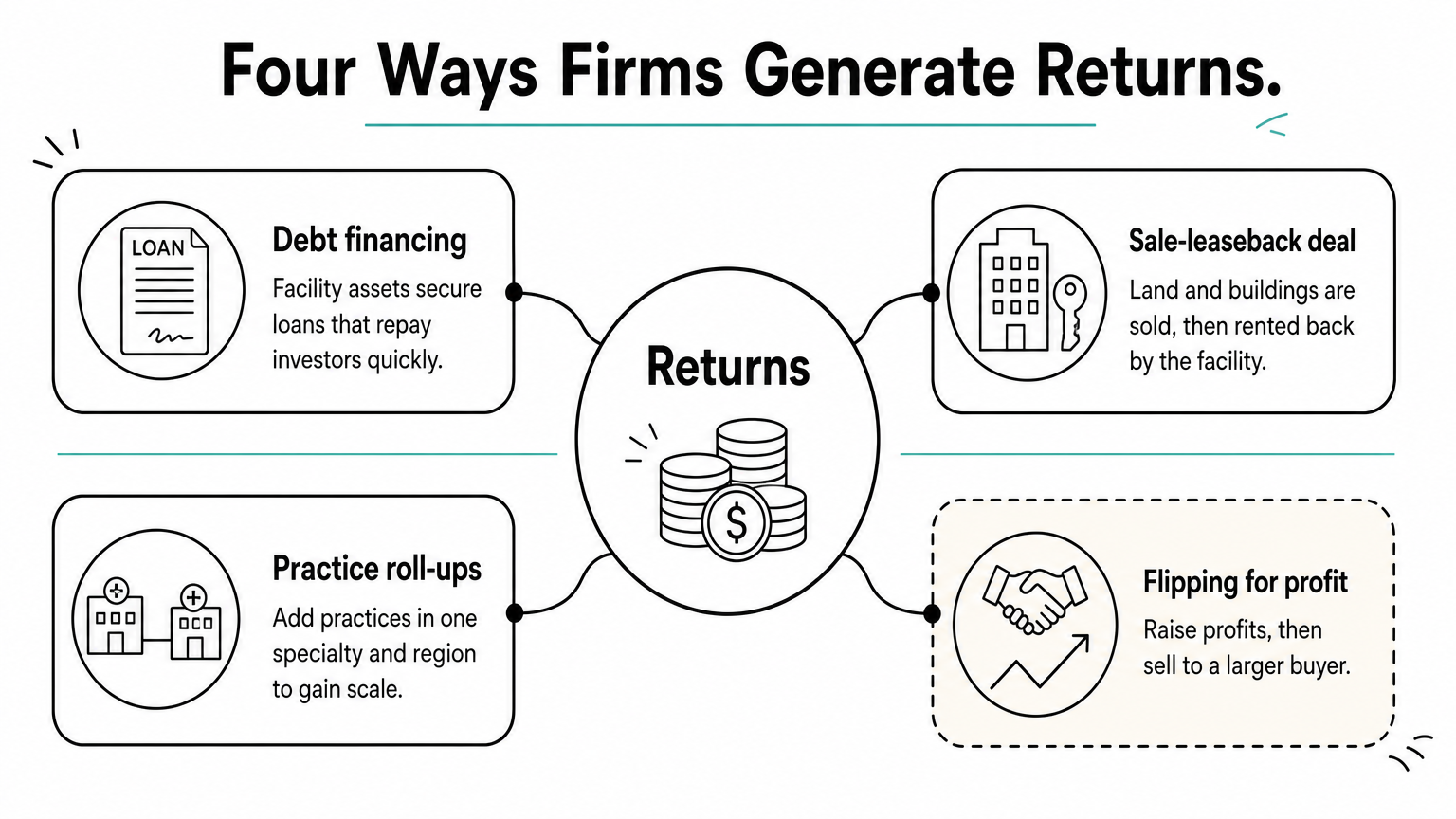
- Debt financing. The acquired facility’s assets secure loans that repay investors quickly while the facility carries the debt.
- Sale-leaseback. The firm sells the land and buildings to a real estate investor, then the facility rents them back. Steward’s 2016 deal with Medical Properties Trust raised $1.25 billion this way, and critics saw the rents as inflated.
- Roll-ups. The firm buys one practice as a platform, then adds more in the same specialty and region to gain scale and negotiating power with insurers.
- Flipping. The firm raises profits, often by cutting costs, raising prices or adding services, then sells to a larger buyer.
All of these are legal. They have simply not been used so widely in healthcare before.
What the evidence says about costs, quality and access
The research is clearest on costs, mixed to negative on quality, and most worrying on access in poor and rural areas. Studies differ by setting, and the field is still young.
The main findings side by side
| Setting | Finding |
|---|---|
| Hospitals, patient safety | Medicare patients had 25% more hospital-acquired complications. Surgical site infections doubled, and falls rose 27% in relative terms (2023 JAMA study) |
| Hospitals, finances | Income was 27% higher after acquisition, with charges up 7% to 16% depending on department (JAMA Internal Medicine) |
| Nursing homes | A widely cited study found a 10% increase in mortality among Medicare patients (NBER) |
| Physician practices | Higher charges and out-of-pocket costs for patients (policy review in PMC) |
Private equity ownership reliably raises prices, but it has not been shown to improve care.
Why the numbers move
The authors of the hospital safety study link the results largely to staffing cuts. New debt and short-term profit targets create pressure to cut labor costs, and inpatient care depends heavily on people rather than machines. Price effects come from higher charges, more charges per day and a shift toward better-paying commercial insurance and away from Medicare.
Firms also tend to buy financially healthier hospitals rather than struggling ones, because those can carry more debt. So the evidence does not describe rescues of failing facilities.
Access, closures and the limits of the research
Access risk shows up when debt or rent becomes unpayable. After Steward’s collapse, two Massachusetts hospitals closed. Carney Hospital served low-income neighborhoods in Boston, and Nashoba Valley Medical Center served 17 communities, where first responders now drive about 15 miles instead of three. About a quarter of private equity-owned hospitals serve rural populations, which have few alternatives.

Be careful with the evidence. Some studies cover one setting, and the nursing home mortality result has not been repeated at that scale. The cost findings are the most consistent.
Benefits and drawbacks of private equity in healthcare
Private equity can bring capital and management discipline to healthcare, but the drawbacks are better documented than the benefits. The outcome depends on how much debt the deal carries and how long the owner plans to hold.
Where private equity can help
The argument for private equity is real. A small practice may lack capital for new equipment, a modern billing system or an additional location. A firm can supply that money and professional management, and can consolidate purchasing and back-office work. Some privately funded models, such as CareMore, have redesigned care for high-risk older adults.
Practice owners also gain from a buyout. A founder nearing retirement gets liquidity and a path to hand off the practice. These are legitimate reasons that many physicians say yes.
Where it tends to hurt
The drawbacks come from structure rather than bad intent. Acquisition debt and rent obligations take cash out of the facility. A short holding period rewards cuts that pay off before the sale, and consolidation can give one owner pricing power in a local market.
| Potential benefit | Documented concern |
|---|---|
| Fresh capital | Debt placed on the acquired facility |
| Professional management | Staffing cuts and short-term profit targets |
| Scale and purchasing power | Higher prices and local market concentration |
| Owner liquidity | Closure risk for weaker facilities |
A fair read of the evidence
Private equity is not the only problem. Nonprofit hospitals are the majority of U.S. hospitals, yet a 2020 study found no significant difference between nonprofit and for-profit hospitals in charity care as a share of expenses. Some scholars argue private equity is a symptom of market failures that already existed.
What sets private equity apart is the combination of leverage and a fixed exit date. When a deal is modest on debt and the owner commits to staffing levels, the risk drops. The evidence does not support the claim that private equity improves care on average.
The ownership label matters less than how much debt the deal carries and how long the owner plans to stay.
What to do when private equity enters your practice or market
You can respond in practical ways, and the right steps depend on whether you own a practice, work in one or receive care in one. The common thread is to find out who owns what, and what they are committed to.
If you own or manage a practice
Before you talk with an investor, ask these questions and get the answers in writing:

- How much debt will the deal place on the practice, and who repays it?
- Who controls clinical decisions, hiring and staffing levels after closing?
- What do the non-compete and employment terms say for you and your physicians?
- How will payer contracts and enrollments carry over to the new entity?
- How long does the buyer plan to hold, and who is the likely next buyer?
- Will the practice be part of a management services organization?
Buyers also examine your revenue cycle. High denial rates, long accounts receivable days and slow collections lower the price you can get. Cleaning up eligibility checks, clean claim submission, denial follow-up and credentialing before diligence strengthens your position, whether or not you sell. InfiniteRCM provides billing, AR recovery and credentialing support for that work.
If you are a patient or a clinician
Patients can ask who owns their practice or hospital, since ownership is often hidden behind a local name. Harvard’s Meredith Rosenthal offers a simple rule: be skeptical, and ask about the benefit of any recommended test or treatment, because more services are not always beneficial but are always profitable.
Clinicians should read non-compete and employment terms closely before signing. Many physicians now work for corporations, and some are organizing, with unionization and advocacy groups pushing for corporate practice of medicine laws.
Policy changes to watch
Regulators are paying closer attention. In 2023, the Federal Trade Commission sued a private equity firm over its roll-up of anesthesia practices in Texas. Proposals include ownership transparency rules, stricter corporate practice of medicine enforcement, limits on acquisition debt and tougher merger review. As of late 2024, California, Indiana, Minnesota, New Mexico and Oregon had programs that review these deals, and others were considering them. Rules change often, so check your state’s current requirements before any transaction.
What to take away
Private equity and healthcare are now closely tied. Firms buy with borrowed money, aim to double their investment within a few years, and exit by selling. The evidence shows higher prices, mixed or worse quality, and real closure risk, while the claimed benefits of capital and management skill remain mostly unproven. Your best response is to ask who owns your practice or provider, read the terms, and get your finances in order.
If you run a practice and want your billing, collections and credentialing in strong shape before any ownership conversation, contact the InfiniteRCM team to talk through your revenue cycle.