
The right pain management medical billing company treats interventional coding, prior authorization, and drug testing claims as daily work, and shows you its denial numbers for pain claims specifically. Of the five below, Medical Billers and Coders suits interventional and multi-site groups. Neolytix suits small clinics. 5 Star Billing Services suits practices whose denials start at intake. CareCloud suits multi-specialty groups. InfiniteRCM suits practices that want a full-service remote team for billing, prior authorization, and AR recovery.
Pain practices lose revenue in places other specialties never see. Epidurals, facet injections, radiofrequency ablation, and stimulator trials draw authorization requests. Fluoroscopy is bundled into many injection codes. Urine drug testing gets audited, and modifiers 25 and 59 get questioned. A generic vendor misses these details, and you see the result as denials and long AR days.
This article compares five providers on the same points: what each offers, who it suits, and what to verify before you sign. InfiniteRCM is our company, so it comes first and gets the same scrutiny as the rest, including where you should press us. A comparison table and a list of vendor questions follow.
1. InfiniteRCM
InfiniteRCM is a fully remote billing company that fits when you want billing, prior authorization, and AR recovery handled by one team. It serves practices across specialties, not pain alone.
What it offers
The core service covers eligibility verification, clean claim submission, payment posting, and denial management, with financial reporting on top. Most claims go out within 24 to 48 hours after charge entry, and the team works inside your existing systems, so you buy no software. The company reports a 99% clean claim rate and 60% fewer denials across 500+ providers.
- Prior authorization: requirement verification, clinical document collection, submission, payer follow-up, and status tracking.
- AR recovery: unpaid claims, underpayments, denied claims, and insurance appeals.
- Credentialing and enrollment: payer enrollment, CAQH profile management, and NPI support for new providers.
- Medical virtual assistants: scheduling, insurance verification, and authorization help.
Who it suits
Solo providers and multi-provider groups that want a dedicated account manager and a HIPAA certified team get the best fit. Pricing is transparent with no hidden fees, and a monthly contract cancels with 30 days written notice.
Hold us to the same test as every other vendor. We are a multi-specialty company, so ask for a pain-specific coding walkthrough covering fluoroscopy bundling, modifiers 25 and 59, and presumptive versus definitive drug testing. Onboarding takes a few days to a few weeks, depending on setup.
A multi-specialty biller earns a pain practice’s trust by showing its pain-specific coding rules, not by listing specialties.
2. Medical Billers and Coders (MBC)
Medical Billers and Coders is the most pain-focused vendor here, and it describes a dedicated pain management center rather than a general specialty list.

What it offers
MBC’s published material describes procedure-level prior authorization for epidural steroid injections, facet joint injections, radiofrequency ablation, and spinal cord stimulator trials and implants. It also lists named account managers and a denial rate under 5% on its pain portfolio.
- Dedicated authorization escalation rather than a shared support queue.
- Separate handling of presumptive and definitive drug testing.
- Modifier 25 logic for same-day evaluation and management visits.
Who it suits
Interventional clinics, ambulatory surgery centers running pain procedures, and multi-site groups with visible denial problems get the most from it. If your AR aging report already shows denials above the 15% to 22% range cited for interventional practices, this is the closest specialty match.
The denial figure is the vendor’s own, so ask how it is measured: first-pass or after appeal, and over which period. Pricing is custom-quoted by claim volume and specialty complexity, so get the quote in writing.
A low denial rate means little until the vendor tells you how it counts one.
3. Neolytix
Neolytix is a sensible shortlist pick for smaller pain clinics that want a billing partner with visible coding knowledge.
What it offers
The company publishes reference material on pain management CPT codes and modifier logic. It also warns that modifiers 59 and XU need chart-level justification, which is the right instinct, since unsupported modifiers invite audits.
- Pain-specific code and modifier guidance.
- Standard prior authorization tracking.
- Basic urine drug testing coding.
Who it suits
Small to mid-size clinics with a lean back office fit best, because education and coding transparency matter most when you have no in-house coder. It is a good choice if you want to understand why a claim was changed.
Its public material does not break out pain-specific denial rates, and multi-site proof is thin. Ask for those figures and for references from practices with a similar procedure mix.
Coding knowledge that you can read in advance is a fair test of how a vendor will handle your claims.
4. 5 Star Billing Services
5 Star Billing Services is a verification-first vendor, built around catching problems before a claim is filed.

What it offers
Its model leans on front-end insurance verification, which catches eligibility and authorization gaps at intake. That matters because most pain denials trace back to missing or mismatched authorizations rather than coding errors.
- Eligibility checks before the visit.
- Authorization checks at intake.
- Claim submission after verification.
Who it suits
Practices whose denials cluster at the front desk, such as lapsed coverage, missing authorizations, or wrong procedure approvals, will see the fastest payback. It also works for groups that already have a capable coder in-house.
Its public documentation shows less on interventional coding depth and drug testing compliance. Ask how its team handles bundled fluoroscopy and frequency limits on drug testing before you rely on it for back-end work.
If your denials start at intake, fix intake first.
5. CareCloud
CareCloud is a reasonable pick when pain management is one department inside a larger group.
What it offers
It is known for dashboard-based tracking and visibility across claims, which helps administrators who oversee several specialties at once. Its logic is general specialty logic, not a pain-specific protocol.
- Claim and payment dashboards.
- Multi-specialty billing under one contract.
- General prior authorization tracking.
Who it suits
Mid-size multi-specialty groups that bill pain procedures alongside other services fit best, since one vendor and one report simplifies oversight. Practices where interventional procedures drive most revenue should look at a pain-focused option first.
Ask who actually codes your procedures and how many coders work pain claims every day. Hospital-affiliated programs may also look at enterprise vendors such as Athenahealth or R1 RCM, but those serve larger systems.
A dashboard shows you the leak, but only a pain-trained coder fixes it.
How to compare pain management billing vendors
Compare vendors on pain-specific evidence: denial rates, authorization tracking, and coding for injections, ablations, and drug testing. A long list of specialties tells you nothing.
Side-by-side comparison
| Company | Best for | Pain-specific signal | Verify first |
|---|---|---|---|
| InfiniteRCM | Full-service remote RCM with prior authorization and AR recovery | Authorization and AR recovery services, multi-specialty | Pain coding walkthrough |
| MBC | Interventional and multi-site groups | Dedicated pain workflow, self-reported denial rate under 5% | How denial rate is measured |
| Neolytix | Small to mid-size clinics | Pain CPT and modifier reference material | Pain-specific denial rates |
| 5 Star Billing Services | Intake-stage denials | Verification-first workflow | Interventional coding depth |
| CareCloud | Multi-specialty groups | Dashboard tracking | Pain-trained coders |
Questions to ask before you sign
Put the same questions to every vendor, and ask for answers in writing:
- What is your denial rate on pain CPT codes, not your overall average?
- How do you handle epidural (62320-62327), facet injection (64490-64495), radiofrequency ablation (64633-64636), and neurostimulator (63650-63688) claims?
- How do you track authorizations against payer decision windows, which shorten under CMS’s prior authorization rule?
- What is the fee structure, and what is excluded?
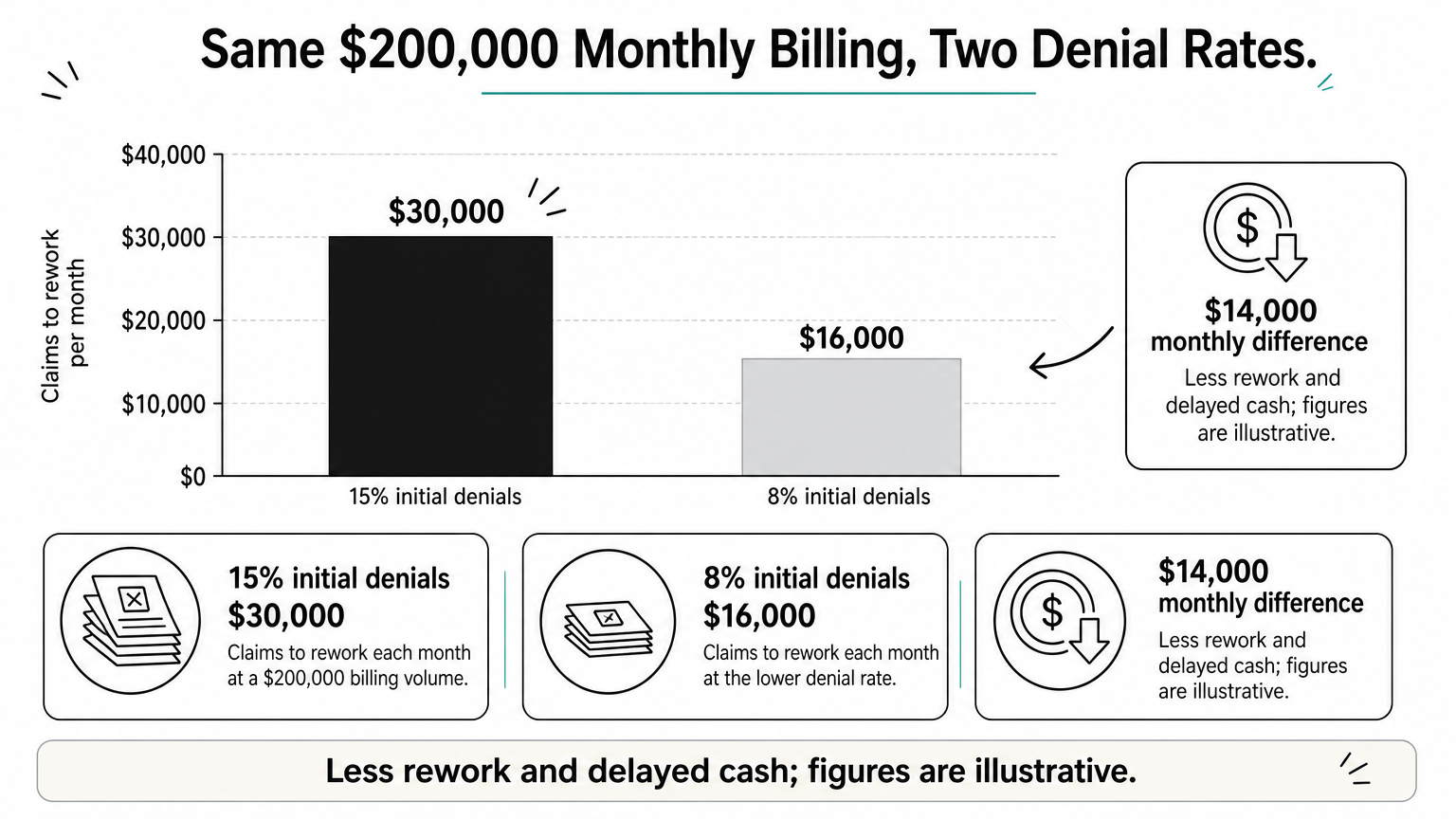
Run the numbers on your own claims. A practice billing $200,000 a month with a 15% initial denial rate has $30,000 in claims to rework. At 8%, that drops to $16,000, a $14,000 monthly difference in rework and delayed cash. The figures are illustrative, but the arithmetic is worth doing with your own data.
Ask every vendor the same five questions, and let the written answers do the ranking.
Choosing your billing partner
The best pain management medical billing company is the one that proves pain-specific skill: coding depth, authorization tracking, and denial numbers measured in a way you can verify. A dedicated specialist like MBC fits interventional-heavy groups, while smaller clinics, intake-driven denials, and multi-specialty groups each have a closer match among the others.
If you want one remote team for billing, prior authorization, AR recovery, and credentialing, InfiniteRCM is built for that. Bring a sample of your recent denied claims and your authorization workflow. To start, talk to the InfiniteRCM team about a review of your pain management billing.