
MSO companies are management services organizations: businesses that run the non-clinical side of a medical practice, including billing, staffing, technology, and compliance, so physicians can focus on patients. In most states, an MSO also lets non-physician founders and outside investors build a healthcare business without breaking rules against corporate ownership of medical practices. Some firms spell it "managed services organization," but the meaning is the same.
You will see the term across healthcare, from telehealth startups to private equity-backed physician groups. It matters to anyone who runs, joins, or invests in a practice, because an MSO changes who owns what, who gets paid, and who makes which decisions. At InfiniteRCM, we handle billing and revenue cycle work, which is one of the functions an MSO bundles with others, so this topic sits close to our daily work.
This guide explains why healthcare MSO companies exist, how they are structured, what services they provide, which well-known companies use the model, and how to evaluate one.
Why MSO companies matter for medical practices
MSO companies matter because they solve two problems at once: state ownership rules for medical practices and the administrative overload that comes with running one.
The corporate practice of medicine problem
Most states have corporate practice of medicine (CPOM) laws. These laws bar ordinary corporations and other non-physician entities from practicing medicine or employing physicians, so only licensed physicians can own a medical practice. The goal is to keep medical decisions free of commercial influence. The catch is that founders without a medical license, and the investors who back them, still need a legal way to build a business. An MSO splits the business in two: the MSO runs the administrative operation, and a separate physician-owned entity owns the clinical practice.

An MSO exists so that business decisions and medical decisions sit in separate legal entities.
The administrative load
Running a practice means billing payers, verifying insurance, credentialing providers, managing payroll, and keeping up with regulation. None of that treats a patient. An MSO company takes on these tasks as a shared back office, often at a scale a single practice could not afford alone. That is why independent clinics, group practices, and investor-backed groups all use the model, each for different reasons.
How an MSO works with a physician-owned practice
An MSO company works through a contract with a separate physician-owned practice. It does not own the clinical side itself.
The two-entity structure
The clinical entity is usually a professional corporation (PC) or professional LLC (PLLC), owned by physicians licensed in that specific state. The MSO is an ordinary business entity, such as a Delaware C-corp or a Texas LLC, so an MSO can be an LLC. The PC employs clinicians, makes medical decisions, and delivers care.
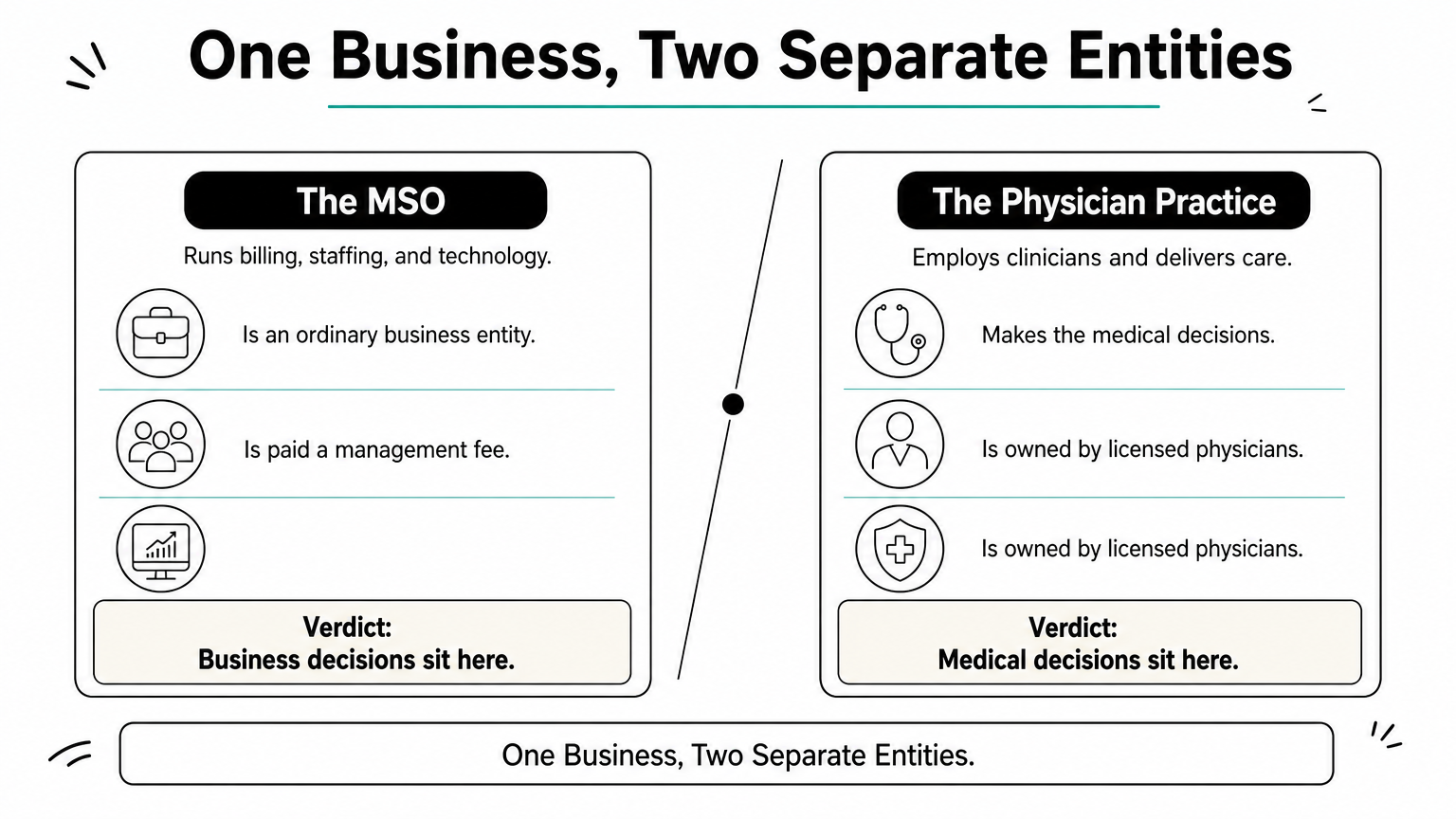
This pairing is often called a friendly PC model, because MSO leadership usually has the right to choose and replace the physician owner. The physician keeps independent medical judgment, and the MSO gets continuity in how the business operates.
The management services agreement
The management services agreement (MSA) is the main contract between the two entities. It states which services the MSO provides, how it is paid, and how both sides stay compliant. Several other agreements usually sit around it:
- Security transfer restriction (succession) agreement
- Technology agreement
- Employee lease agreement
- Physician advisor agreement
- Indemnification agreement
The management fee is the term to watch. It may be fixed, tiered, or cost-plus, and some states, such as New York, may require a fixed fee. Many companies have an independent assessor set a fair market value for the services, which lowers fee-splitting and anti-kickback risk.
The management fee should pay for services at fair market value, never for referrals.
What services MSO companies provide
MSO companies provide the non-clinical functions a practice needs to operate, from billing and payroll to technology and compliance.
Core service areas
The table below shows the usual scope. Individual MSOs may offer all of it or a subset.
| Service area | What the MSO handles |
|---|---|
| Administrative support | Daily operations, HR, staff training |
| Financial management | Billing, payroll, accounting |
| Technology | EHR, telehealth platforms, other software |
| Regulatory compliance | Licensing, primary source verification, adherence to healthcare law |
| Revenue cycle | Credentialing, payer contracting, billing |
| Strategic planning | Business development, growth strategy |
The clinical side stays with the physician-owned practice, which employs clinical staff, makes medical decisions, and delivers care. That line is what keeps the arrangement compliant.
Who owns and runs MSOs
Ownership varies. Some MSOs are physician-owned, set up so independent doctors can share administrative costs. Others belong to hospitals or health systems, or are backed by private equity or venture capital. Some operate as outside vendors that sell management services to many practices. Ownership tells you whose interests the MSO serves, so ask about it early.
The scope of services is easy to compare, but ownership is what shapes how an MSO behaves.
Examples of well-known MSO healthcare companies
Well-known examples fall into two groups: digital health companies and investor-backed physician groups. This list of MSO healthcare companies reflects names commonly cited as using an MSO and affiliated-practice model. Exact legal structures differ by state and change over time.
Digital health and telehealth
Telehealth and digital health founders often are not physicians, and they raise outside capital. The MSO and affiliated-practice model lets them build the technology and operations while physicians control care. Companies commonly cited include:

- Teladoc
- Lyra
- One Medical
- Hims & Hers
- Ro
- Headway
- Alma
- Carbon Health
- Thirty Madison
- Cityblock Health
- Hinge Health
- Virta
Private equity and large physician groups
Outside investors in physician groups face the same ownership rules, so investor-backed healthcare MSO companies use the same split. Commonly cited names include:
- CityMD
- Envision Healthcare
- Team Health
- MedExpress
- Concentra
- US Anesthesia Partners
- Curo Health Services
The model is not limited to large players. Independent entrepreneurs use it to open urgent care, primary care, behavioral therapy, physical therapy, and medical aesthetics practices.
Whether the company is a telehealth startup or a private equity platform, the logic is the same: administration in the MSO, medicine in the practice.
How to evaluate an MSO company
Evaluate an MSO company by matching its scope to the problem you need solved, then checking its fee structure, legal fit with your state, and exit terms.
Questions to ask before you sign
- How does the structure comply with your state’s CPOM rules? Ask to see how the entities and agreements are set up.
- How is the management fee set? Ask whether it is fixed, tiered, or cost-plus, and whether fair market value was assessed.
- Who can replace the physician owner, and under what terms? The succession agreement answers this.
- What happens at termination? Check who keeps patient records, systems, and staff.
- Which services will you use? Pay only for the scope you need.
Have a healthcare attorney licensed in your state review any MSA. This article is general information, not legal advice.
The right MSO is the one whose scope, fee, and exit terms you can explain in a sentence each.
When you only need one function
A full MSO structure is heavy if your real problem is denials, slow collections, or payer enrollment. InfiniteRCM is a revenue cycle company, not an MSO, and it does not replace a legal structure. But a practice that already has its structure can hand us specific functions: medical billing, credentialing and enrollment, prior authorization, AR recovery, and medical virtual assistants. Our billing services are remote and cloud-based, and we need no software purchases from you.
Choosing your next step
MSO companies run the administrative side of a medical practice through a contract with a physician-owned entity, which keeps the business compliant with state ownership rules. They matter because they free clinicians from back-office work and let non-physician founders and investors build healthcare businesses. The model is common, from telehealth leaders to private equity-backed groups.
Before you commit to one, check the management fee, the ownership, and the exit terms, and get legal review. If your pain point is billing, enrollment, authorizations, or unpaid claims rather than ownership structure, a focused partner may fit better. To talk through which functions you could hand off, contact the InfiniteRCM team.