
The best medical billing services do four things well: they submit clean claims fast, work denials instead of writing them off, report results by provider and payer, and price without surprises. InfiniteRCM suits practices that want billing, AR recovery, credentialing and prior authorization from one remote team. Medical Billers and Coders suits larger groups on Epic, Cerner or Athena that want an audit before they commit. Transcure suits practices that want heavy automation across many specialties. Vision Medical Billing Services suits smaller offices that want a focused scope and help training their staff.
Most practices that go looking for a billing partner share the same problem. Denials pile up, accounts receivable ages, and your front desk spends hours on the phone with payers. Every vendor homepage then promises a 98% or 99% number, and none of those numbers are measured the same way, so comparing them is hard.
This article compares four providers on the same three points: what each covers, who it suits, and how it prices and structures its contract. A section on typical fees follows, with a worked example. InfiniteRCM is our company and is listed first, so weigh that accordingly. Performance figures for all four are company-reported and are labeled that way.
1. InfiniteRCM
InfiniteRCM is a remote revenue cycle company that handles billing and the administrative work around it. It is the broadest option here, because one account covers billing, recovery, credentialing, prior authorization and staffing support.

What it covers
The core service is full-cycle billing: eligibility verification, clean claim submission, payment posting, denial management and financial performance reporting. Most claims go out within 24 to 48 hours after charge entry, electronically through secure clearinghouses. The same team can also take on:
- AR recovery: unpaid claims, underpayments, denied claims and insurance appeals
- Credentialing and enrollment: CAQH profile management, NPI registration support, and group and individual payer enrollment
- Prior authorization: requirement checks, clinical document collection, submission, payer follow-up and status tracking
- Medical virtual assistants: billing support, scheduling, insurance verification and admin work, part-time or full-time
- Web development for practices: website, SEO and Google Business optimization
InfiniteRCM’s edge is breadth: billing, recovery, credentialing and prior authorization under one dedicated account manager.
The company reports a 99% clean claim rate, 40% faster collections, 60% fewer denials and over $50M recovered across 500+ providers, with a HIPAA certified team and more than 10 years of experience.
Who it suits
InfiniteRCM works with solo providers, small clinics, urgent care centers, laboratories, hospitals and specialty practices such as family medicine, cardiology and orthopedics. It is a good fit if your staff is burned out on manual billing and you want to keep your current EHR. The team works inside your existing systems remotely, so you buy no software.
Pricing and terms
InfiniteRCM advertises transparent pricing with no hidden fees, and you get a quote through its contact page. Onboarding takes a few days to a few weeks, depending on how complex your setup is. Monthly contracts can be canceled with 30 days written notice, and support replies within 24 business hours.
2. Medical Billers and Coders
Medical Billers and Coders (MBC) is a long-running national billing company, in business since 1999. It leads with an audit and a heavy emphasis on reporting.

What it covers
MBC covers claims management, coding and audit, denial management and appeals, AR follow-up, physician credentialing and old AR recovery. It also provides a dashboard that shows denial trends, AR aging and net collection ratio by provider, location and payer. It integrates with Epic, Cerner and Athena and lists 40+ specialties.
MBC starts every engagement with a revenue audit, so you see your leaks before you sign anything.
The audit is described as no cost and no commitment. The company says most transitions finish in under two weeks.
Who it suits
MBC fits multi-provider groups and multi-location practices that need CFO-level reporting. It also says it has payer knowledge for all 50 states, which helps if you deal with a state Medicaid program or a dominant regional plan. The company reports a 98.7% net collection ratio and $2.4B+ in processed claims. Those are self-published comparisons, so check them against your own collection data.
Pricing and terms
MBC does not publish rates. It says it requires no multi-year contracts and charges no exit penalties. Request a quote after the audit, and ask whether credentialing and old AR recovery are priced separately.
3. Transcure
Transcure is a billing company built around automation. It says AI agents handle steps from prior authorization through coding and AR follow-up.
What it covers
Transcure bills for 40+ specialties and says it works with 40+ EHR systems. Behind the software it lists 1,100+ AAPC-certified coders and billers, and it holds HIPAA and ISO 27001 certifications. Extras include dedicated account dashboards, MIPS reporting, and a free practice audit.
Transcure’s pitch is scale: automated claim work backed by a very large certified coding team.
It also offers complimentary credentialing and old AR recovery, which can lower your setup cost if you need both.
Who it suits
Transcure lists small practices, medical groups, urgent care centers, surgical centers and hospitals as its fit. It makes sense if your specialty is niche and you want a vendor that has seen it before. Its claim accuracy and denial reduction numbers are company-reported, and the company gives different denial reduction figures on different pages. Ask which one applies to a practice like yours.
Pricing and terms
Transcure says its rates start at 5% of collections, adjustable for larger practices or long-term plans. Confirm what that percentage includes before you compare it to other quotes.
4. Vision Medical Billing Services
Vision Medical Billing Services is a nationwide provider with 25+ years of experience. It positions itself as an extension of your office team rather than a black box.
What it covers
Its homepage lists eligibility and benefit verification, claims submission, follow-up, payment posting and denial resolution. It also runs separate request pages for benefit verification, prior authorization and medical billing, so you can buy the front-end work alone.
Vision is the most modular option here: you can start with benefit verification or prior authorization and add billing later.
The company also stresses educating your office staff on payer and reimbursement needs.
Who it suits
Vision fits smaller practices that want a hands-on partner and some staff coaching instead of a fully hands-off handoff. It is also a reasonable pick if your biggest pain point is verification and authorization delays rather than overall billing volume.
Pricing and terms
Vision does not list fees or contract terms on its homepage. Ask for a written quote, the specialties its team bills for, and the notice period to leave.
What medical billing services cost
Most outsourced medical billing services charge a percentage of net collections, commonly 4% to 10%, and the rate depends on practice size, specialty and scope. Other models exist, so compare the structure before you compare the number.
Common pricing models
| Pricing model | How it works | Best fit |
|---|---|---|
| Percentage of collections | Fee is a share of what you actually collect | Practices that want the vendor paid only when you are |
| Flat monthly fee | Fixed amount per provider or practice | Steady, high-volume practices |
| Per-claim fee | Charge for each claim submitted | Low or uneven volume |
| Hourly or FTE | You pay for staff time, such as virtual assistants | Specific tasks, not full billing |
A worked example
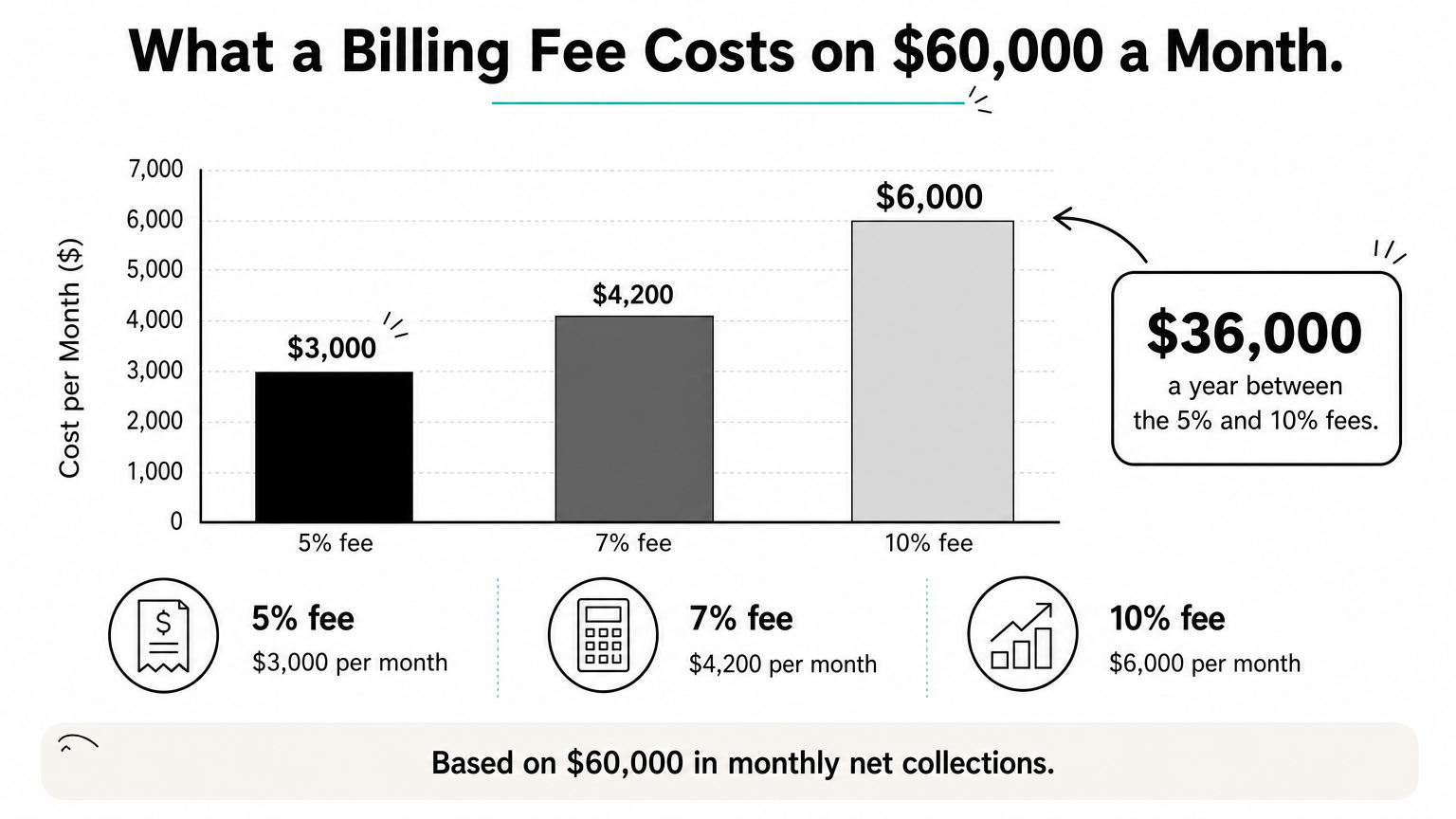
Say your practice collects $60,000 in net revenue a month. At 5%, you pay $3,000. At 7%, you pay $4,200. At 10%, you pay $6,000. The gap between 5% and 10% is $3,000 a month, or $36,000 a year.
A low percentage can still cost more if setup, credentialing and clearinghouse fees are billed separately. Ask for the all-in monthly figure at your real collection level.
What to ask before you sign
You do not need a billing company near you. Billing runs remotely, and payer knowledge for your state matters more than geography. Before you commit, get answers to these:
- What fees apply beyond the percentage or flat rate?
- How long is the contract, and what does it cost to leave?
- Will it work inside your current EHR and practice management system?
- Do you get reports by provider and payer, and how often?
- How soon after charge entry are claims submitted?
- Has the team billed your specialty, and will they sign a HIPAA business associate agreement?
The cheapest percentage is not the cheapest contract, so compare the all-in monthly cost at your own collection level.
Picking a billing partner
The right provider depends on your pain point. If you want billing, recovery, credentialing and prior authorization in one place, InfiniteRCM covers all of them. If you run a large group and want an audit first, Medical Billers and Coders fits. If your specialty is niche, look at Transcure, and if you want to start small with verification, Vision is modular.
Whichever you pick, get the all-in cost in writing and check the exit terms. If you want a quote built around your claim volume and EHR, message the InfiniteRCM team and ask how it would handle your denials and AR.