Denial rates creeping up, claims stuck in AR for 60 days or more, staff drowning in payer paperwork. If that sounds familiar, you’ve probably already searched for help and landed on the term medical billing consulting services. It’s a broad label, and most practices don’t know exactly what falls under it or whether it fits their situation.
At its core, medical billing and consulting services mean bringing in outside experts to audit your billing workflow, find where revenue is leaking, and fix the processes causing denials or slow reimbursement. That could mean a one-time audit, ongoing oversight of your billing team, or full revenue cycle management support that touches everything from eligibility checks to payment posting.
This article breaks down what these services actually include, how they differ from simply outsourcing your billing, and the specific problems they solve, from claim denials to credentialing delays. We’ll also cover what to look for in a consulting partner, based on what actually moves the needle for practices dealing with cash flow problems and compliance risk every day.
Why medical billing consulting services matter
Money gets lost in the gap between seeing a patient and getting paid for it. Industry data from the American Medical Association shows claim denial rates average between 5% and 10% across practices, and every denied claim costs staff time to rework, appeal, or write off. Medical billing consulting services exist because most practices don’t have the internal bandwidth to catch these leaks before they become chronic revenue loss.

Outside eyes catch what internal teams miss. A biller who’s worked the same claims queue for years stops noticing patterns, like a specific payer rejecting modifier codes or a front-desk gap in eligibility verification. A consultant walks in without that blind spot and audits the whole revenue cycle from intake to payment posting.
A practice that doesn’t measure its denial rate has no way of knowing how much revenue it’s already lost.
Here’s what a typical consulting engagement uncovers, based on patterns we see across specialties:
| Problem Area | Typical Impact Before Consulting | Result After Fixes |
|---|---|---|
| Claim denials | 10-15% denial rate | Under 5% denial rate |
| Days in AR | 50-70 days | Under 35 days |
| Clean claim rate | 80-85% | 99% |
| Collections speed | Baseline | Up to 40% faster |
These aren’t abstract benchmarks. They’re the difference between a practice that reinvests in staff and equipment and one that’s constantly chasing payers for money it already earned. Small independent practices and multi-provider groups both hit the same wall: billing complexity grows faster than internal expertise can keep up, and that’s exactly the gap consulting is built to close.
How to implement medical billing consulting in your practice
Starting the process doesn’t mean handing over your entire billing department on day one. Most medical billing consulting services begin with a diagnostic phase: a consultant pulls your last 90 days of claims data, reviews denial codes, and checks your credentialing status against payer requirements. This step alone usually surfaces the biggest revenue leaks before any changes get made.
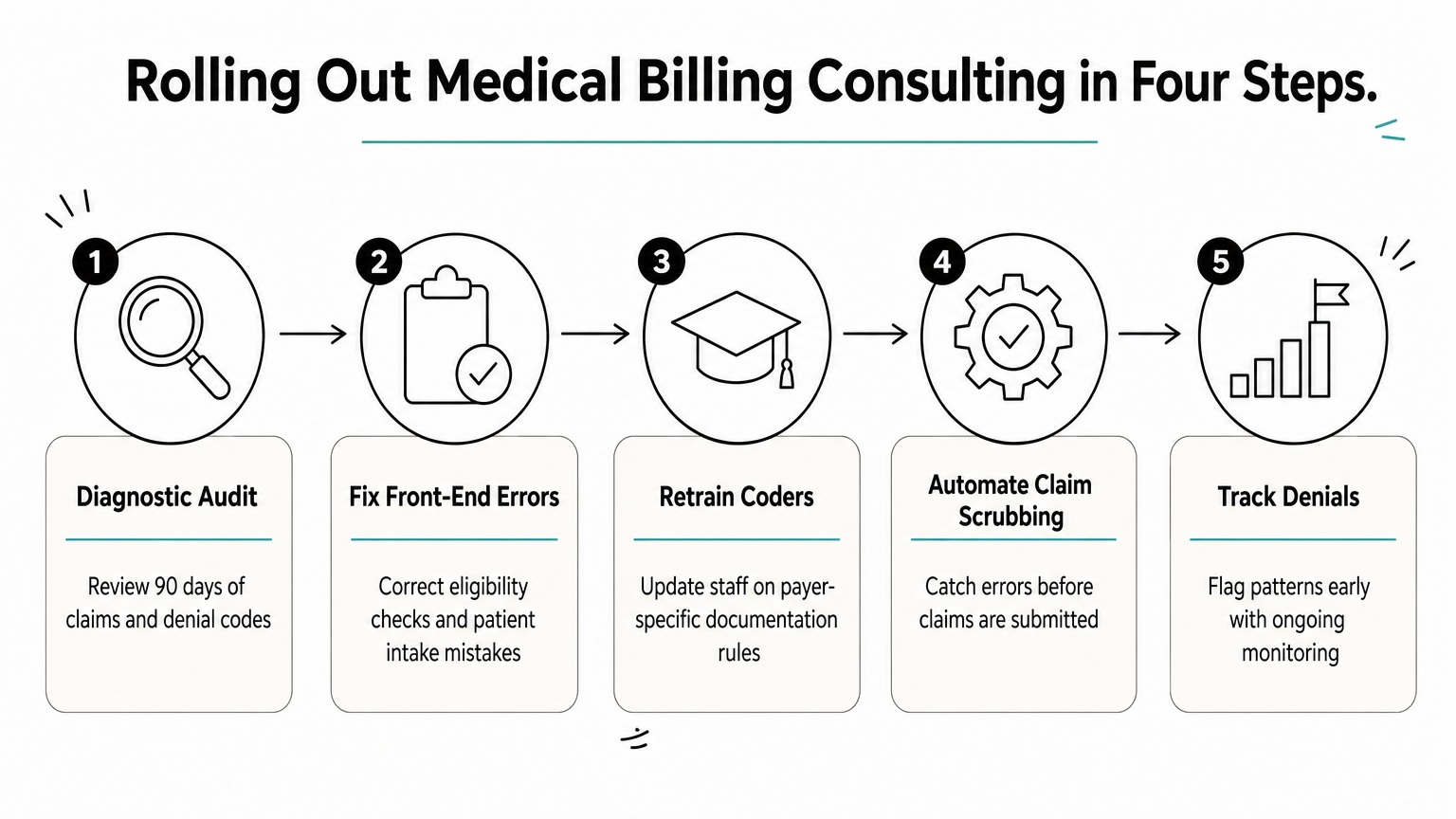
Once the audit is done, the consultant builds a corrective action plan. Typically this looks like:
- Fixing front-end errors in eligibility verification and patient intake
- Retraining coders on payer-specific documentation rules
- Automating claim scrubbing to catch errors before submission
- Setting up denial tracking so patterns get flagged early
Implementation works best in phases, not all at once. A practice that tries to overhaul coding, staffing, and software simultaneously usually creates more confusion than it solves.
The practices that see the fastest turnaround treat consulting as an ongoing partnership, not a one-time fix.
Teams that build in monthly performance reviews with their consultant catch new problems before they turn into six-figure losses.
What to look for in a medical billing consulting partner
Not every firm selling medical billing consulting services actually delivers results. Some hand you a slide deck of recommendations and walk away, leaving your staff to figure out execution. Others stick around, test fixes against real claims data, and adjust when something isn’t working. The difference shows up fast once you ask the right questions during vetting.
Before signing anything, check for these specifics:
- Specialty experience: have they worked with your specialty’s payer mix and coding rules?
- Transparent reporting: do they show denial rates, AR days, and clean claim percentage in real time?
- Credentialing support: can they handle payer enrollment and CAQH management alongside billing fixes?
- No long-term lock-in: can you exit if results don’t materialize within 90 days?
A consulting partner who won’t show you their own performance numbers shouldn’t be trusted with yours.
Ask for references from practices similar in size to yours, not just their biggest client. A group with 40 providers doesn’t tell you how a firm handles a five-physician family practice, and the workflows are rarely interchangeable.
Common billing problems these services solve
Denials tied to coding and documentation

Most denials trace back to a handful of repeat offenders: mismatched modifiers, missing prior authorizations, or documentation that doesn’t support the code billed. Medical billing consulting services dig into denial codes claim by claim, not just at the summary level, to find which payer is rejecting what and why. That precision is what separates a real fix from a guess.
Chasing denials without knowing their root cause just recycles the same losses month after month.
Credentialing delays that stall revenue
Providers sometimes wait 90 to 120 days for payer enrollment, during which every claim they submit gets denied or held. Consultants catch these gaps early and push credentialing and enrollment through before it stalls cash flow.
Staff burnout and inconsistent follow-up
Billing teams stretched across scheduling, coding, and appeals often let claims sit past the appeal window. Common problems consulting typically resolves include:
- Underpayments that go unflagged
- Aged AR with no follow-up plan
- Inconsistent payment posting that hides real cash position
- Appeals filed too late to count
Fixing these often takes less time than practices expect once someone’s actually watching the queue.
How much medical billing consulting costs
Pricing varies more than most practices expect, and it depends on whether you need a one-time audit or ongoing management. Firms offering medical billing consulting services typically charge in one of three ways: a flat project fee for an audit, a monthly retainer for continuous oversight, or a percentage of collections if the engagement includes full revenue cycle management.
| Pricing Model | Typical Range | Best Fit |
|---|---|---|
| One-time audit | $2,000 – $8,000 | Practices needing a diagnostic before committing further |
| Monthly retainer | $1,500 – $5,000/month | Practices wanting ongoing oversight without full outsourcing |
| Percentage of collections | 3% – 8% | Practices outsourcing full billing and consulting together |
The cheapest option upfront is often the most expensive one once denials keep piling up.
Question every flat monthly fee that doesn’t scale with claim volume. A five-provider practice and a twenty-provider group shouldn’t pay the same rate, and a partner charging identically for both usually isn’t customizing the work. Transparent pricing with no hidden fees is a reasonable baseline to demand, not a bonus feature.
Getting your revenue cycle back on track
Denials, slow AR, and credentialing delays don’t fix themselves. They compound until a practice is writing off revenue it should have collected months ago. Medical billing consulting services work because they bring the outside perspective and the data discipline that internal teams rarely have time to build on their own. Whether you need a single audit or full revenue cycle management, the goal stays the same: catch the leaks, fix the root cause, and put a system in place that keeps denials from creeping back up.
Practices that treat this as an ongoing partnership, not a one-time cleanup, see the results stick. A 99% clean claim rate and 40% faster collections aren’t outliers when someone’s actually watching the queue every week.
If your claims are piling up and your staff is stretched thin, talk to InfiniteRCM about what a real fix looks like for your practice.