
The best medical billing services CA practices can hire share three traits: a documented HIPAA program backed by a signed business associate agreement, proven experience with your specialty and payers, and reporting that shows collections improving. Of the five companies below, InfiniteRCM suits practices of any size that want fully remote billing without new software. Allzone suits large groups that want a big offshore team. DMSCO suits practices that want to choose how billing data reaches the biller. Synergy Billing suits FQHCs and behavioral health clinics. Atlantis RCM suits small and mid-sized physician practices.
California makes billing harder than it looks. Medi-Cal rules, a long list of commercial payers and high patient volumes produce denials and aging accounts receivable, while your front desk re-keys charges instead of helping patients. Outsourcing can fix this, but only if the partner fits your size, specialty and systems. This article gives you the same set of facts for each company so you can compare them quickly.
InfiniteRCM is our company, so it comes first. The descriptions of the other four reflect how each presents itself publicly. Confirm current services, fees and contract terms with each one before you decide.
1. InfiniteRCM: remote billing for any size of practice
What you get
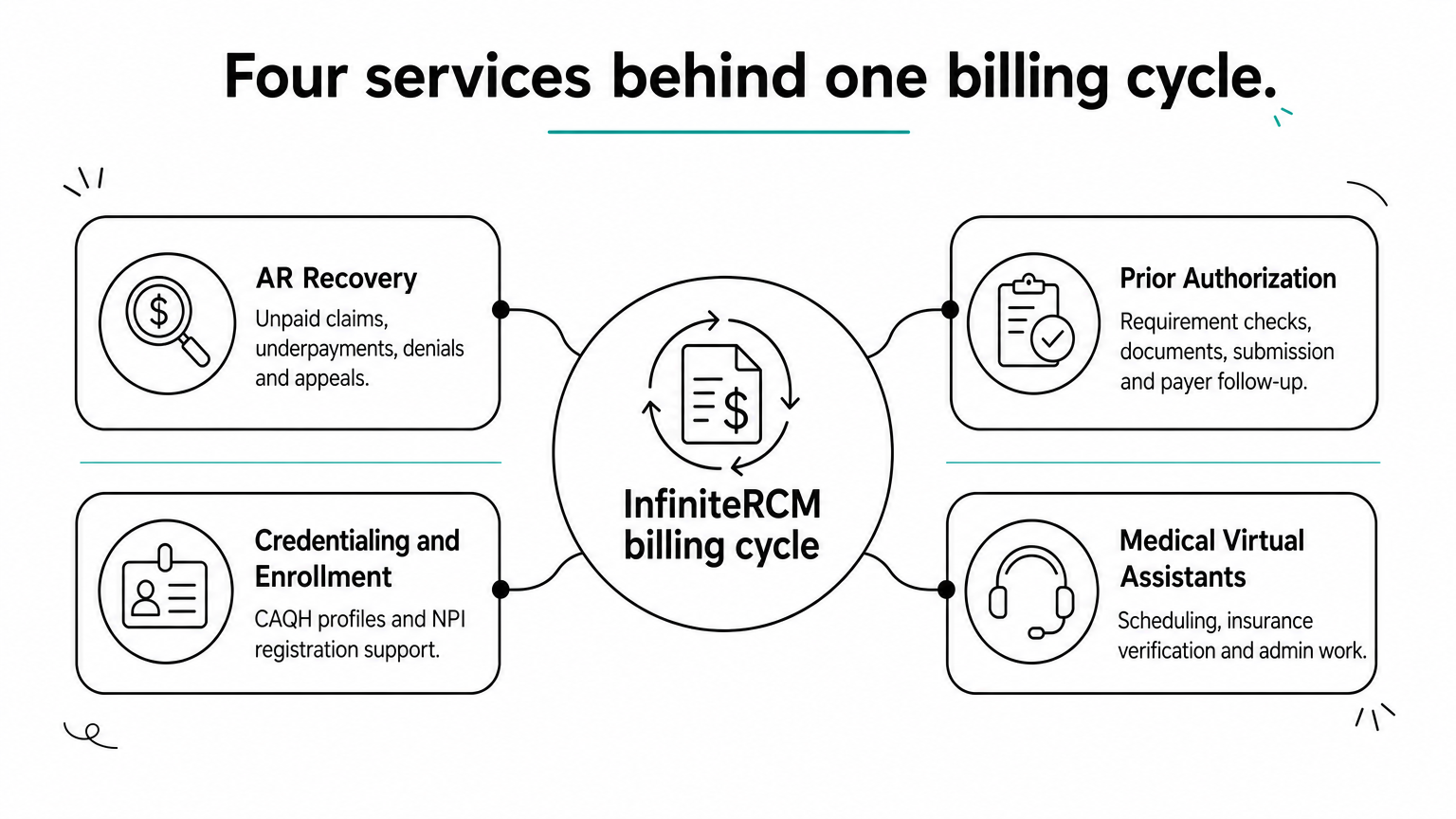
InfiniteRCM runs the whole billing cycle for you: eligibility verification, clean claim submission, payment posting, denial management and financial performance reporting. Most claims go out electronically through secure clearinghouses within 24 to 48 hours after charge entry. The service is fully remote and cloud-based, so the team works inside your existing EHR or practice management system and you buy no software.
- AR recovery: unpaid claims, underpayments, denied claims and insurance appeals
- Prior authorization: requirement checks, document collection, submission and payer follow-up
- Credentialing and enrollment: CAQH profile management and NPI registration support
- Medical virtual assistants: scheduling, insurance verification and admin work
- Company-reported results: 99% clean claim rate, 40% faster collections and 60% fewer denials across 500+ providers, with over $50M recovered
Who it suits and what to verify
InfiniteRCM works with solo providers, small clinics, urgent care centers, laboratories and larger multi-provider groups. You get a dedicated account manager, and support replies within 24 business hours. Onboarding takes a few days to a few weeks, depending on how complex your setup is. The team is HIPAA certified.
The billing service is fully remote and cloud-based. Ask how it handles California payers, including Medi-Cal and the commercial plans in your mix. Ask for a sample monthly report too. Cancelling a monthly contract takes 30 days written notice.
Remote billing works best when it plugs into the EHR you already own.
2. Allzone Management Solutions: large offshore team
What you get
Allzone Management Solutions is an offshore medical billing company headquartered in Los Angeles, with delivery centers in India. It was established in 2005 and serves clients nationwide.
- Services: medical billing, coding and revenue cycle management
- Scale: more than 500 employees
- Model: presents itself as an extended office of the practice
Who it suits and what to verify
A deep bench suits high-volume groups that need capacity for billing and coding at the same time. If your claim volume swings with seasons or provider hires, a large team absorbs that more easily than a small shop.
Offshore delivery raises one question you must settle in writing. HIPAA does not ban offshore work, but you remain responsible for having a business associate agreement and real safeguards. Ask where patient data is stored and accessed, who your day-to-day contact is, and how time-zone coverage works for payer calls.
Offshore capacity pays off only when data safeguards and contact lines are in the contract.
3. DMSCO Billing Services: flexible data intake
What you get

DMSCO Billing Services has operated since 1987, offering medical billing and accounts receivable management. Its distinguishing feature is choice in how billing data reaches the biller. It lists an EMR interface, real-time cloud scanning and secure email as options.
- Data intake: EMR interface, cloud scanning or secure email
- Data entry: can enter demographics and charges manually and post receipts
- Approach: evaluates each practice individually before recommending a setup
Who it suits and what to verify
This fits practices with older systems, paper superbills or limited IT support, where a rigid software integration would stall onboarding. A biller who can adapt to your workflow saves you a system migration.
Flexible intake can change turnaround, so ask how quickly charges become claims under each method and how often you receive reports. With nearly four decades in business, DMSCO should be able to give references from practices of your size and specialty. Ask for them.
If your workflow is unusual, choose the biller who adapts to it instead of the one who demands a new system.
4. Synergy Billing: FQHC and behavioral health
What you get
Synergy Billing specializes in federally qualified health centers (FQHCs) and behavioral health organizations. It describes a hands-on approach and strong denial management, and says it helps clinics maximize reimbursements while staying compliant with local and federal rules.
- Focus: FQHCs and behavioral health organizations
- Strength: denial management with hands-on follow-up
- Goal: maximize reimbursement within compliance rules
Who it suits and what to verify
FQHC billing follows different payment rules from a standard fee-for-service practice, and a generalist biller often gets it wrong. If you run a community health center or a behavioral health clinic, a specialist like this is worth a close look. A private cardiology or orthopedic group probably is not the target client.
Ask how Synergy handles encounter-based billing, Medi-Cal managed care plans and behavioral health authorizations. Request denial and days-in-AR figures from a client similar to you, since specialist claims are only useful if they come with numbers.
Specialty billing matters most where payment rules differ from the standard model.
5. Atlantis RCM: physician-focused billing
What you get

Atlantis RCM describes itself as a physician-focused medical billing company that markets to California practices. It says its certified coders handle multiple specialties and check that claims meet payer and CMS requirements.
- Reporting: real-time dashboards
- Support: dedicated account managers
- Compliance: HIPAA-compliant billing solutions
- Clients: personalized support for small and mid-sized practices
Who it suits and what to verify
This is a sensible shortlist candidate for a small or mid-sized physician practice that wants coding support and visible reporting. The dashboards matter because you can track claims, denials and payments without waiting for a monthly email.
Ask for a live dashboard demo and for the definition behind any clean claim rate it quotes, since companies count it differently. Also ask whether fees are a percentage of collections or a flat rate, and what the exit terms are.
A dashboard you can open yourself beats a promise that results are improving.
Picking the right partner for your practice
Match the company to your practice, not the other way around. A large offshore team, a flexible intake specialist, an FQHC specialist and a remote, software-free service each solve a different problem. Shortlist two or three, then ask each the same questions: will you sign a business associate agreement, how do you handle my specialty and California payers, what reports will I see each month, how are fees calculated, and how do I exit if results fall short.
If you want a remote team that works inside your current EHR and reports on denials and collections, talk to InfiniteRCM about your billing. We will walk through your claims process and tell you plainly whether we fit.