
The best medical billing audit services pair certified reviewers with a defined scope and a report that ends in fixes, not just findings. Of the four options below, InfiniteRCM suits small and mid-size practices that want errors corrected inside the billing workflow. Healthicity suits practices that need a certified coding and documentation review. Hayes Management Consulting suits large health systems, and Aspirion suits providers chasing complex underpaid claims.
If you run a practice, you probably suspect money is leaking. Denials repeat, accounts receivable ages, and nobody has checked whether the codes match the clinical notes. A medical billing audit company gives you an outside review of claims, coding, documentation, and compliance. The hard part is that the label covers very different businesses. Some firms are pure auditors, some are full billing companies, and some only recover underpayments.
This article compares four providers on what they cover, who they fit, and what to watch for. A final section shows how to choose a medical billing auditing company, which questions to ask before you sign, and how to read your first audit report.
1. InfiniteRCM
InfiniteRCM fits practices that want billing problems found and fixed by the same team, rather than receiving a report they must act on alone.
What you get
InfiniteRCM is a revenue cycle management company, so its review work sits inside the billing process. Its Revenue Cycle Management service covers eligibility verification, clean claim submission, payment posting, denial management, and financial performance reporting. Its AR Recovery service targets unpaid claims, underpayments, denied claims, and insurance appeals.
Most claims go out within 24 to 48 hours after charge entry, through secure clearinghouses. The work is remote and cloud-based, and it runs on your existing systems, so you buy no software.
- Denial management and appeal handling
- Underpayment identification and recovery
- Financial performance reporting
- Dedicated account manager and a HIPAA certified team
An audit only pays off when someone fixes what it finds.
Who it suits and what to watch
This option works for solo providers, small clinics, and multi-provider groups in specialties such as family medicine, cardiology, and orthopedics. It suits you best if you want ongoing improvement in denials and cash flow instead of a one-time snapshot. InfiniteRCM reports a 99% clean claim rate, 60% fewer denials, and more than $50M recovered for clients across 500+ providers.
Know the limit. The review is built around the revenue cycle, so it is not a standalone certified compliance audit for a payer investigation or legal matter. If you need that, say so on the first call and ask what scope fits. Onboarding takes a few days to a few weeks, and a monthly contract needs 30 days written notice to cancel.
2. Healthicity
Healthicity fits practices that need an independent, certified review of coding and documentation, separate from whoever bills their claims.

What you get
Its auditing page advertises AAPC-certified auditing specialists and a free consultation. AAPC is the body behind the CPC credential, so you are hiring reviewers trained in the same code sets your coders use. A certified coding audit compares a sample of your charts against what you billed.
- CPT, ICD-10, and modifier validation
- Documentation checked against medical necessity
- An error rate by provider and by code
- Education points for coders and clinicians
A certified coding audit tells you how accurate you are, not how to collect faster.
Who it suits and what to watch
Pick this route if you are answering a payer inquiry, validating a new coder, or building a formal compliance plan. An independent auditor also removes the conflict of interest that comes from your own staff checking their own work.
The trade-off is follow-through. A pure auditor reports findings, and your team or billing company must fix them. Before you hire, confirm the sample size, the turnaround time, and whether the report includes corrected claims or only error counts.
3. Hayes Management Consulting
Hayes Management Consulting fits large organizations that want analytics-heavy audits and performance benchmarking across many providers.
What you get
Hayes is a healthcare consulting firm known for a data-driven audit methodology. Its work spans billing and coding audits, charge capture, revenue integrity, compliance and risk assessments, and denial workflow review. The pitch is that analytics reveal patterns a manual chart sample would miss.
- Billing and coding audits
- Charge capture and revenue integrity analysis
- Compliance and risk assessments
- Benchmarking against comparable organizations
Analytics find patterns across thousands of claims that a 40-chart sample cannot.
Who it suits and what to watch
Hospitals, multi-location groups, and health systems get the most from this model. With many sites and providers, benchmarking and trend analysis justify a consulting engagement.
A five-provider clinic will likely find it more than it needs. The approach is consulting-heavy and enterprise-focused, which usually means longer engagements and more internal time to support them. Ask for a scoped quote for your size before you assume it fits.
4. Aspirion
Aspirion fits providers whose main pain is large, complex, or underpaid claims rather than everyday coding accuracy.

What you get
Aspirion focuses on auditing and recovering high-value claims. It is associated with hard categories such as workers’ compensation and motor vehicle accident claims, where payers underpay or delay often. The work includes coding validation, documentation review, and payer audit support.
- Review of complex and underpaid claims
- Denial and underpayment recovery
- Coding validation and documentation review
- Support during payer audits
Underpayments hide in complex claims, so that is where a recovery specialist earns its fee.
Who it suits and what to watch
Hospitals and facilities with a steady flow of difficult claims benefit most. You can improve revenue without replacing your whole billing operation.
That narrow focus is also the limit. It is not a full revenue cycle service, and it covers broad compliance audits across every specialty less deeply. If your denials come from front-end problems such as eligibility or prior authorization, a recovery specialist will not stop them at the source.
How to choose a medical billing audit company
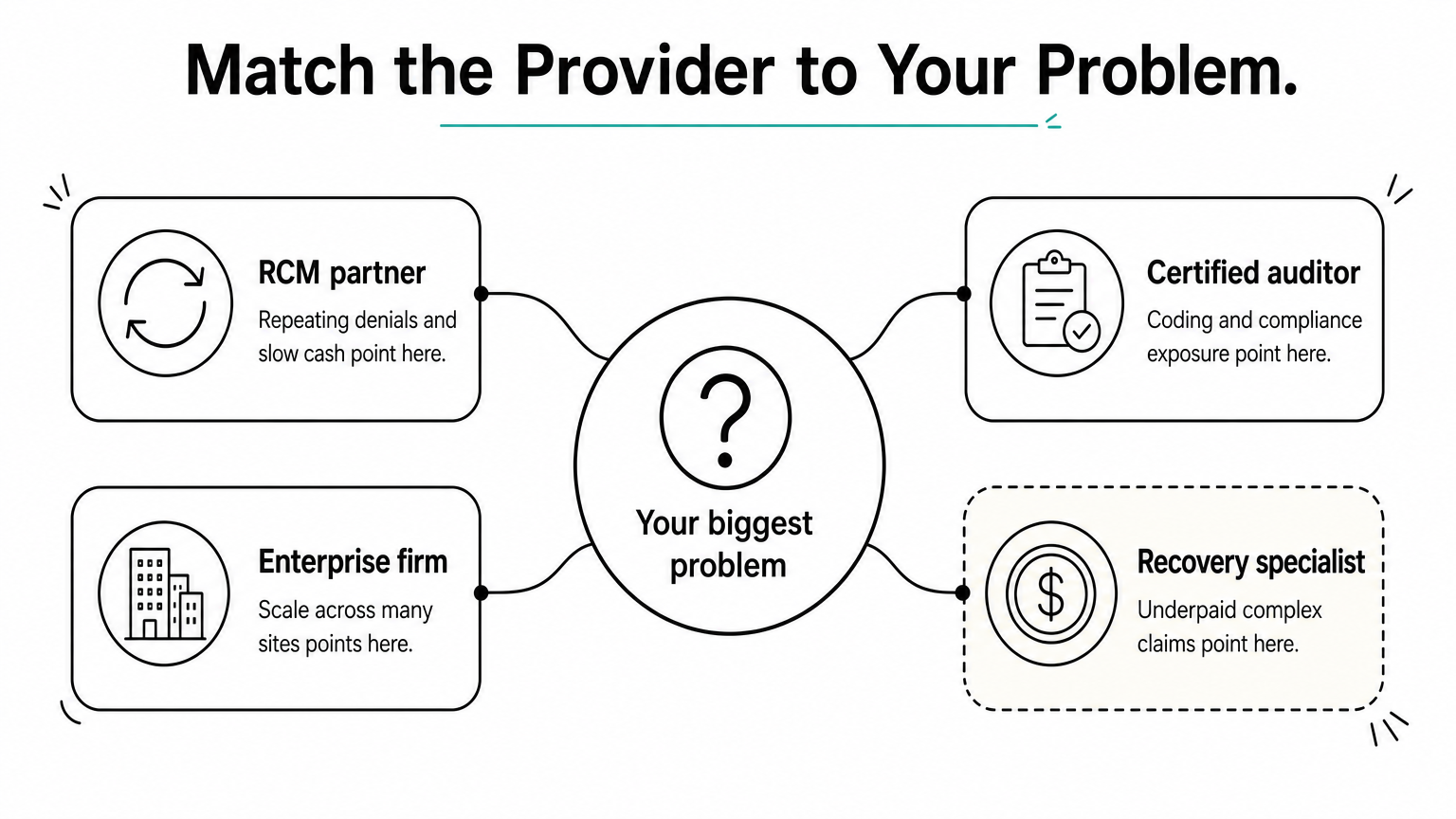
Choose by matching the provider type to your biggest problem. Repeating denials and slow cash point to an RCM partner. Coding and compliance exposure point to a certified auditor. Scale points to an enterprise firm, and underpaid complex claims point to a recovery specialist.
Match the service to your problem
| Provider | Best for | Main strength | Main limit |
|---|---|---|---|
| InfiniteRCM | Small to mid-size practices | Findings fixed in the billing workflow | Not a standalone compliance audit |
| Healthicity | Coding and compliance reviews | Certified auditors | Report only, you fix the claims |
| Hayes Management Consulting | Large systems | Analytics and benchmarking | Heavy for small clinics |
| Aspirion | Complex, underpaid claims | Recovery focus | Narrow scope |
Questions to ask before you sign
Good answers to these separate real audit firms from sales pitches:
- Which credentials do the auditors hold, such as CPC or CCS?
- How many charts will you sample, and how do you select them?
- Will you sign a HIPAA business associate agreement?
- What does the report contain, and who acts on it?
- How is the audit priced: flat fee, per chart, hourly, or a share of recovered money?
- Can I speak to a practice of my size and specialty?
Reading your first report
Take a practice with 4 providers and 10 sampled charts each, 40 charts in total. The auditor finds errors in 3 of them. That is 37 correct out of 40, or 92.5% accuracy. Many practices aim for 95% or higher, so this result flags a gap worth fixing.
Do not stop at the percentage. Look at which codes and which providers produced the errors, because a pattern means a training fix, while scattered errors suggest a process problem. Plan to repeat the audit at least once a year, and sooner if denials rise.
Pick the audit that fixes your biggest leak
The right medical billing audit service depends on what hurts most. Choose an RCM partner when denials and slow payments drive your losses, a certified auditor when coding accuracy and compliance are the worry, an enterprise firm when you manage many sites, and a recovery specialist when complex claims are underpaid. Whichever you pick, insist on a clear sample, a written report, and a named person who owns the fixes.
If you want billing errors found and corrected in one place, contact InfiniteRCM to talk through your denials, AR, and what review scope fits your practice.