The best medical billing services pair a high clean claim rate with fast denial follow-up and a team that knows your specialty and your EHR. Small and mid-size practices usually do best with a dedicated outsourced biller such as InfiniteRCM, Transcure, MZ Medical Billing, or OneMed Billing. Large hospitals need the scale of R1 RCM or GeBBS. Groups that want billing inside one system should look at athenahealth, AdvancedMD, or Tebra. CareCloud suits practices that want to keep their current EHR.
Choosing is harder than it should be. Every vendor publishes its own best-case numbers, few publish prices, and no single best medical billing company in the USA fits every practice. Meanwhile, denials, slow accounts receivable, and staff stuck on hold with payers drain revenue every month. This guide compares ten providers on the same points, shows what billing costs with a worked example, and ends with the questions to ask before you sign.
InfiniteRCM is a revenue cycle management company, so it leads the list and you should read its entry with that in mind. The other nine entries rest on figures the vendors publish themselves, and the guide shows you how to check them.
What makes a medical billing service worth hiring
A good medical billing service gets claims paid correctly the first time, works denials until they resolve, and shows you the numbers every month. Four metrics tell you most of what you need to know.

The numbers that separate good from average
Start with clean claim rate, first-pass denial rate, days in accounts receivable (AR), and net collection rate. Industry benchmark surveys put typical practices and strong performers in these ranges:
| Metric | Typical practice | Strong performer |
|---|---|---|
| Clean claim rate | 85% to 90% | 95% or higher |
| First-pass denial rate | 10% to 12% | Under 5% |
| Days in AR | 40 to 50 | Under 30 |
| Net collection rate | 83% to 89% | 93% or higher |
Treat every vendor figure as a best case. A "98% clean claim rate" usually describes the vendor’s best clients, not a practice with your specialty and payer mix. Ask for results from a practice like yours, and ask how the vendor defines each metric, because "first-pass" and "clean claim" are not always counted the same way.
Ask for results from a practice that looks like yours, not a company-wide average.
How this list is ordered
InfiniteRCM is our company, so it sits at number 1 and you should weigh that. The other nine are grouped by service model, not ranked on a score. Entries 1 to 4 are dedicated billing companies, 5 to 8 are software platforms or vendors that bundle billing, and 9 and 10 are enterprise firms. No public source ranks these vendors on the same audited numbers, so a strict ranking would be invented.
Each entry is judged on the same points: published proof, EHR flexibility, specialty depth, pricing transparency, and security credentials. The figures come from what each vendor reports, and the entries say so wherever a number is self-reported.
The 10 best medical billing services at a glance
The table below sets all ten side by side so you can build a shortlist before reading the details.
Side-by-side comparison
| # | Company | Best for | Standout fact | Pricing |
|---|---|---|---|---|
| 1 | InfiniteRCM | Small to mid-size practices that want full outsourcing | Claims out within 24 to 48 hours of charge entry | Transparent, no hidden fees |
| 2 | Transcure | Specialty-heavy and surgical groups | 1,100+ certified billers and coders | Custom quote |
| 3 | MZ Medical Billing | Independent practices and small groups | 70+ specialties, all 50 states | Proposal |
| 4 | OneMed Billing | Cardiology, DME, prior auth, RPM/CCM | 250+ active providers | Proposal |
| 5 | CareCloud | Mid-size practices keeping their EHR | Billing without its practice management software | Custom, setup fees reported |
| 6 | AdvancedMD | Multi-provider and behavioral health practices | 95% first-pass guarantee | Custom quote |
| 7 | Tebra | Solo and small practices | Per-provider pricing | About $99 to $399 per provider monthly |
| 8 | athenahealth | Multi-specialty groups wanting one system | 170,000+ clinicians on its network | Custom, rises with volume |
| 9 | R1 RCM | Large hospitals and health systems | Works with 95 of the top 100 US health systems | Custom quote |
| 10 | GeBBS | Hospitals and large groups | HITRUST CSF and SOC 2 Type 2 | Custom quote |
Which pick to start with
Match your situation to a starting point, then read those entries first.
- Solo or one to five providers: Tebra, MZ Medical Billing, or InfiniteRCM
- Keep your current EHR, outsource billing: InfiniteRCM, Transcure, CareCloud, or OneMed Billing
- Specialty-heavy work such as cardiology, DME, or surgery: OneMed Billing or Transcure
- EHR and billing in one system: athenahealth, AdvancedMD, or Tebra
- Hospital or health system volume: R1 RCM or GeBBS
1. InfiniteRCM
What it offers
InfiniteRCM is a fully remote, cloud-based revenue cycle company based in Chester, New Jersey. It covers the whole billing cycle: eligibility verification, clean claim submission, payment posting, denial management, and financial performance reporting. Most claims go out within 24 to 48 hours after charge entry, through secure clearinghouses. The company reports a 99% clean claim rate, 40% faster collections, and 60% fewer denials across 500+ providers, with more than $50M recovered for clients. Those are company figures, so ask for references.
Around the core service, you can add:
- AR recovery for unpaid claims, underpayments, denied claims, and appeals
- Prior authorization: requirement checks, clinical document collection, submission, payer follow-up, and status tracking
- Credentialing and enrollment, including CAQH profile management and NPI registration support
- Medical virtual assistants, part-time or full-time equivalent, for scheduling, insurance verification, and billing support
Best fit and trade-offs
InfiniteRCM suits solo providers, small clinics, and multi-provider groups in family medicine, cardiology, orthopedics, urgent care, and lab work that want to hand off billing without buying software. The team works inside your existing systems remotely, and onboarding takes a few days to a few weeks depending on setup. You get a dedicated account manager, support replies within 24 business hours, and the billing team is HIPAA certified.
Choose InfiniteRCM when you want billing handed off inside your current EHR, with one team also covering AR, authorizations, and credentialing.
- Pricing: transparent, with no hidden fees. Monthly contracts end with 30 days of written notice.
- Limit: it is a service, not an EHR. If you want one platform for charting and billing, look at entries 6 to 8.
2. Transcure
What it offers
Transcure is a dedicated billing company, not a software vendor with a billing add-on. It reports more than 1,100 certified billers and coders working across 40+ specialties, including cardiology, OB/GYN, orthopedics, and surgery centers, from offices in Dallas, Texas and Woodbridge, New Jersey. It runs on top of EHRs such as Epic, athenahealth, and Kareo, so you do not have to switch systems.
- AI agents: ELIXA handles real-time eligibility verification and DEXA handles denial detection and resolution
- Reported results: a first-pass clean claim rate above 98%, taken from the company’s own materials
- Model: an overlay service, so you keep your EHR
Best fit and trade-offs
Transcure fits groups in less common or surgical specialties that generalist vendors handle poorly. Dedicated billers are often paid as a share of collections, so their incentive points at your revenue, not at keeping you on a platform. That is a reason to ask any dedicated biller how its fee is structured.
Transcure’s strength is specialty depth on top of the EHR you already use.
- Pricing: custom quote.
- Limit: its headline numbers are self-reported and independent reviews are mixed, so ask for recent references.
- Watch for: the hand-off between your EHR vendor and its team, which you should test during onboarding.
3. MZ Medical Billing
What it offers
MZ Medical Billing is a newer company, started in 2022 and based in St. Petersburg, Florida. It runs the full billing cycle: insurance eligibility checks, coding review, claim submission, payment posting, denial follow-up, and patient statements. It reports work across 70+ specialties in all 50 states, from chiropractic and ophthalmology to anesthesia, oncology, and mental health.
- Reported results: a 95.8% claim acceptance rate, taken from its published client reviews
- Reputation: a 4.6 out of 5 score on Trustpilot
- Scope: HIPAA-compliant processes from eligibility to payment posting
Best fit and trade-offs
This is a pick for solo doctors, small groups, and mid-size specialty practices that want a team that knows the account by name. Reviewers repeatedly mention cleaner claims and fewer denial chases after switching from another biller. Onboarding is built to start in weeks, not after an enterprise contract cycle.
MZ Medical Billing trades scale for attention, which is the right trade for a small practice.
- Pricing: a proposal based on specialty and claim volume.
- Limit: it is built for independent practices, not hospital-scale claim volume.
- Watch for: a short track record since 2022. Ask for references from practices in your specialty that have stayed more than a year.
4. OneMed Billing
What it offers

OneMed Billing is an independent company founded in 2020. It reports more than 500 certified RCM experts supporting over 250 active providers. Its team handles eligibility, prior authorization, coding, claims, payment posting, denials, and A/R follow-up. You can outsource the full cycle or pick only the functions where your team needs help.
- Named focus areas: cardiology, DME, prior authorization, and RPM/CCM billing
- Cardiology: procedure coding, diagnostic testing, and medical-necessity documentation
- DME: coverage rules, equipment codes, and supporting records such as orders and proof of delivery
Best fit and trade-offs
OneMed suits small to mid-size practices where a missing authorization or order turns into a denial. A cardiology practice that needs approval before a test, or a DME supplier chasing proof of delivery, gets more from a team that watches those details than from a generic claims processor. Practices can also get outside billing help without migrating their EHR.
OneMed fits when your denials come from authorizations and documentation, not from simple claim errors.
- Pricing: public pricing does not show the cost of a specific service mix, so ask for a proposal that itemizes tasks, reporting, and fees.
- Limit: published performance numbers are not broken down by specialty or practice size.
- Watch for: who will be assigned to your account and what direct experience that team has with your claim types.
5. CareCloud
What it offers
CareCloud sells billing without forcing you onto its practice management software, which is rare among platform vendors. Its CollectiveIQ engine scrubs claims against a large rules library, and the company reports work in all 50 states across 50+ specialties. It is a public company (Nasdaq: CCLD) that grew partly through acquisition, after MTBC bought the CareCloud brand in 2020.
- First-pass rate: reported from about 94% to 98% depending on the source, which is why you should ask for your own specialty’s number
- Volume: one 2026 review cites more than 50,000 claims a day sent to payers
- Scope: partial or full outsourcing, which can grow with the practice
Best fit and trade-offs
CareCloud fits mid-size practices that want to keep their current EHR and may outsource more over time. Public financials mean you can read how the company performs before you commit, which smaller vendors cannot offer.
CareCloud is the platform vendor that lets you buy billing without changing your EHR.
- Pricing: custom. One review cited EDI setup of $5,000 per provider for the first three and $2,750 for each additional provider, so confirm every setup fee.
- Limit: a three-year contract is typical, the longest on this list.
- Watch for: some users describe the interface as complex, and its mobile tool is iOS only.
6. AdvancedMD
What it offers
AdvancedMD, founded in 1999, combines an EHR, practice management, and billing in one cloud system. Its Claim Inspector checks claims for CCI, HIPAA, and LCD errors before submission, and the company guarantees at least a 95% first-pass clean claim acceptance rate. A written guarantee is more useful than a marketing average, because you can hold the vendor to it.
- Managed billing: AdvancedMD staff can handle appeals and follow-up instead of your team
- Patient payments: tools that push self-pay collection at the point of care
- Specialty strength: behavioral health coding in particular
Best fit and trade-offs
AdvancedMD suits independent and multi-provider practices that want one connected system, and behavioral health practices that need accurate time-based codes. A single system cuts the double entry that causes many coding mistakes.
AdvancedMD stands out because its clean claim rate is guaranteed in writing.
- Pricing: custom quote.
- Limit: it lacks the network-scale data of athenahealth, and less common specialties may need more setup time.
- Watch for: third-party billing companies sometimes work on top of AdvancedMD, which adds a coordination point. Confirm who owns denial resolution before you sign.
7. Tebra
What it offers
Tebra came from the 2021 merger of Kareo and PatientPop and is built for small, independent practices. Its EHR+ system bundles charting, scheduling, billing, and patient engagement. You can run billing in-house with its tools, or Tebra can match you with a partner billing company for outsourced RCM. Marketing and reputation tools sit in the same platform.
- Reported pricing: roughly $99 to $399 per provider per month depending on tier
- Onboarding: reviews cite a typical fee of about $500 per provider
- Billing basis: you pay per prescribing provider, so front desk and billing staff use it free
Best fit and trade-offs
Tebra fits solo providers and newly independent practices that want a fast, unified setup and visible prices. Tebra does not publish a first-pass claim rate, so its pitch rests on ease of use, not on billing accuracy figures.
Tebra is the easiest platform to start with, but check its claim reliability before you grow on it.
- Pricing: published tiers, with the final quote depending on modules and volume. Confirm current figures with Tebra.
- Limit: claim processing reliability is the complaint that appears most often in reviews.
- Watch for: the platform can feel limiting past 10 to 15 providers.
8. athenahealth
What it offers
athenahealth sells athenaOne, a cloud system that bundles EHR, practice management, and billing. Its pitch is the network. As of late 2025, more than 170,000 clinicians used it, and it submits over 315 million claims a year. The company reports a 1.6% front-end claims rejection rate, and says practices that switch have seen collections rise by as much as 6%. These are athenahealth’s own figures.
- Specialty templates: reduce the friction of a generic system
- User community: more than 44,000 active members share coding and workflow fixes
- Ownership: private equity backed, which suggests stability but also growth pressure
Best fit and trade-offs
athenahealth suits multi-specialty groups and clinics that would rather run one connected system than stitch vendors together. Rules improve as the network sees more payer behavior.
Choosing athenahealth is a platform decision, not just a billing decision.
- Pricing: custom, and it climbs for high-volume practices. It is not the budget option.
- Limit: you commit to the full athenaOne system, not a billing-only add-on.
- Watch for: switching your EHR and billing at once is a bigger project than switching your biller, so plan for 60 to 90 days.
9. R1 RCM
What it offers
R1 RCM is the largest enterprise name here. It started in 2003 as Accretive Health and is based in Murray, Utah. It reports working with more than 1,000 provider organizations, including 95 of the top 100 US health systems, and processes over 270 million payer transactions a year. It went private in a deal reported at $8.9 billion in late 2024. In October 2025 it launched Phare, a system of AI agents paired with human reviewers.
- Scope: you can start with one function, such as denials, and expand
- Reported results: 5% to 7% revenue gains for large health system clients
- Compliance: HIPAA safeguards built in
Best fit and trade-offs
R1 suits large hospitals and health systems with hundreds of millions in revenue and complex multi-payer environments. Its payer relationships and transaction volume are hard for smaller vendors to match.
R1 RCM is built for hospital-scale revenue, and a small practice will not get its money’s worth.
- Pricing: custom, built for hospital-scale operations.
- Limit: not designed for small or independent practices, and onboarding is heavy.
- Watch for: the full-service model leaves less room to keep some tasks in-house.
10. GeBBS Healthcare Solutions
What it offers
GeBBS Healthcare Solutions is a revenue cycle and risk adjustment company founded in 2005. It reports a workforce of more than 14,000 across the US, India, the Dominican Republic, and the Philippines, and it is backed by the private equity firm EQT. Services span coding, billing, health information management, clinical documentation improvement, eligibility verification, denial management, and risk adjustment.
- Credentials: KLAS-rated, with HITRUST CSF certification and SOC 2 Type 2 compliance
- Checkable security: HITRUST and SOC 2 reports are easier to verify than a general "HIPAA compliant" claim
- Reference: a hospital HIM director is quoted as saying GeBBS cleared a coding backlog in two weeks
Best fit and trade-offs
GeBBS suits hospitals, health systems, and large physician groups that want an established outsourcing partner with formal accreditation and the staff to absorb big volume.
GeBBS offers the strongest checkable credentials on this list, but at a scale that overshoots small practices.
- Pricing: not published, so you need a custom quote.
- Limit: too large for a five-provider group.
- Watch for: much of its delivery is offshore. Some practices accept that and others want to avoid it, so ask directly.
What medical billing services cost
Outsourced billing usually costs a percentage of what the biller collects, with quoted ranges running from about 3% to 10% depending on specialty, volume, and scope. Flat per-claim fees and software subscriptions are the main alternatives.
Common pricing models
| Model | Typical range | Works best when | Watch for |
|---|---|---|---|
| Percentage of collections | About 3% to 10% | You want the biller paid on results | Rates rise with complexity and add-on services |
| Flat fee per claim | About $4 to $15 per claim | Claim values are low and denials are rare | No incentive to chase high-value appeals |
| Per-provider subscription | Tebra reports about $99 to $399 monthly | You run billing in-house with software | Onboarding fees and your own staff time |
| Hybrid | Base percentage plus add-ons | You need credentialing, AR recovery, or appeals | Add-ons that quietly double the headline rate |
Ask every vendor for setup, onboarding, and statement fees in writing. The headline rate is rarely the total.
A worked example
The cheapest rate is not the cheapest result. Say your practice has $100,000 a month in collectible charges. Vendor A charges 4% and collects 85% of that, or $85,000. Its fee is $3,400, so you keep $81,600. Vendor B charges 6% and collects 95%, or $95,000. Its fee is $5,700, so you keep $89,300.
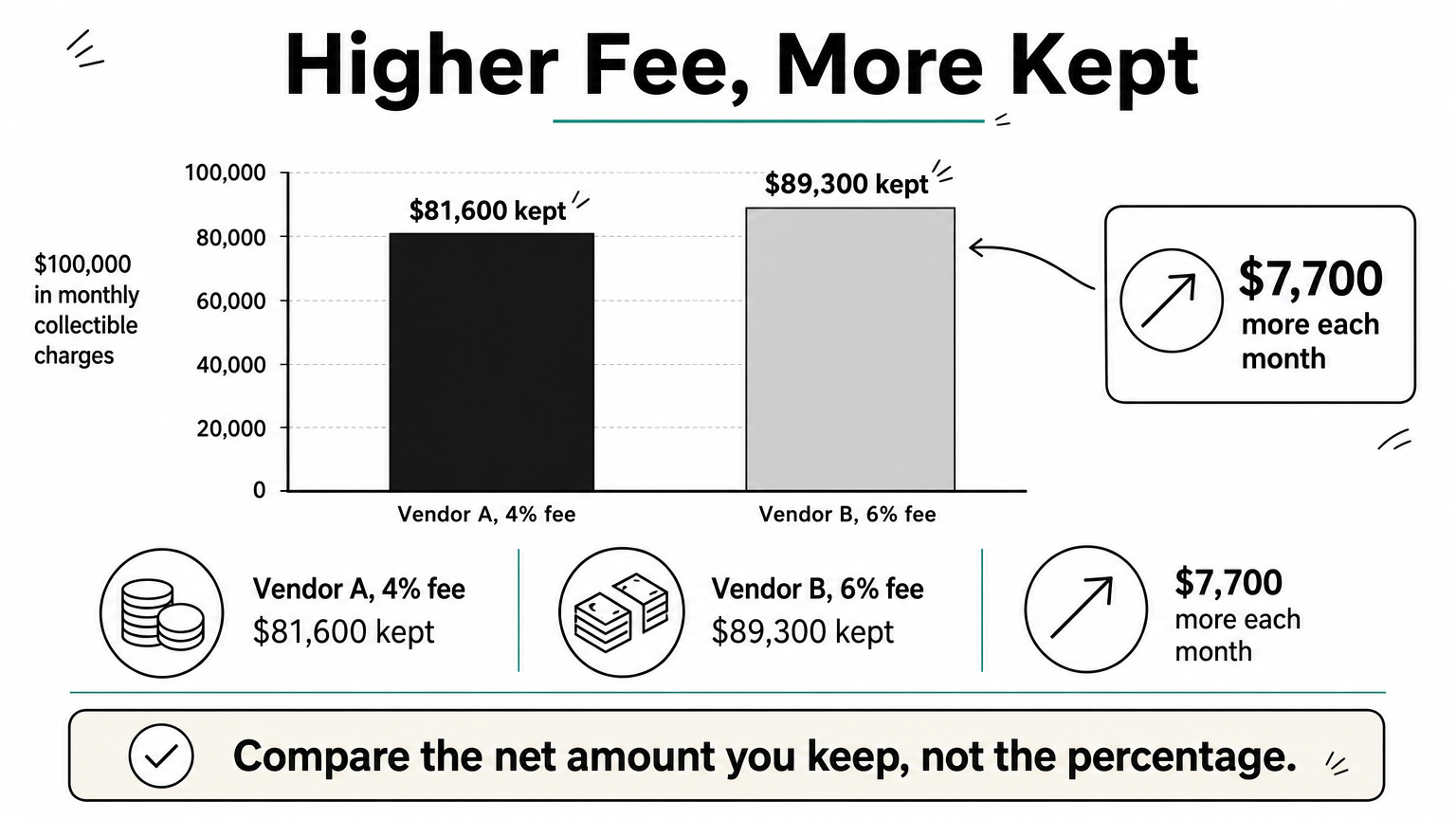
Vendor B costs $2,300 more in fees and still leaves you $7,700 better off each month, or $92,400 over a year. Always compare the net amount you keep, not the percentage.
A higher fee with a higher collection rate beats a low fee with leakage.
How to choose the right provider for your practice
Choose by fit first, then verify the proof. Write down your own denial rate, AR days, monthly claim volume, and EHR version, pick three or four vendors whose "best for" matches you, and book demos where you bring those numbers.
Questions to ask before you sign
Put these to every shortlisted vendor and get the answers in writing:
- What are your clean claim, denial, and AR day results for practices like mine?
- Who owns denial resolution and appeals?
- Which versions of my EHR have you integrated with, not just which brands?
- Who will work my account, and where are they located?
- What does the fee cover, including setup, statements, credentialing, and appeals?
- What are the contract length and exit terms?
- Can I speak to a client who has stayed two or more years?
- How often will I get reports, and can I see claim-level data?
Security and contract terms
Any biller that touches patient data must sign a Business Associate Agreement under HIPAA. For stronger assurance, look for HITRUST CSF certification or a SOC 2 Type 2 report, and ask for current documentation, not a verbal claim. Also read the exit terms. Some vendors lock you in for three years, while others, like InfiniteRCM, work on monthly contracts with 30 days of written notice.
What AI changes and what to expect after switching
AI is not replacing medical billers. It handles repetitive work such as eligibility checks, claim scrubbing, and denial prediction, but appeals, payer calls, and coding judgment still need people. Ask each vendor which tasks are automated and which are handled by a named person.
Expect a few days to a few weeks of onboarding for a billing-only overlay, and 60 to 90 days for a full platform switch. Real improvement in denial rates and AR days typically shows within 60 to 90 days, assuming your data migrates cleanly.
Choosing your billing partner
The best medical billing service is the one that matches your size, specialty, and EHR, and proves its numbers on practices like yours. Dedicated billers suit small and mid-size practices that want to keep their systems. Platforms suit groups ready to run everything in one place. Enterprise firms suit hospitals. Compare the net amount you keep, not the headline rate, and get every promise in writing.
If you want billing, AR recovery, prior authorization, credentialing, or virtual assistant support from one team that works inside your current systems, talk to InfiniteRCM about your billing setup. Bring your denial rate and AR days, and the conversation will start from your real numbers.