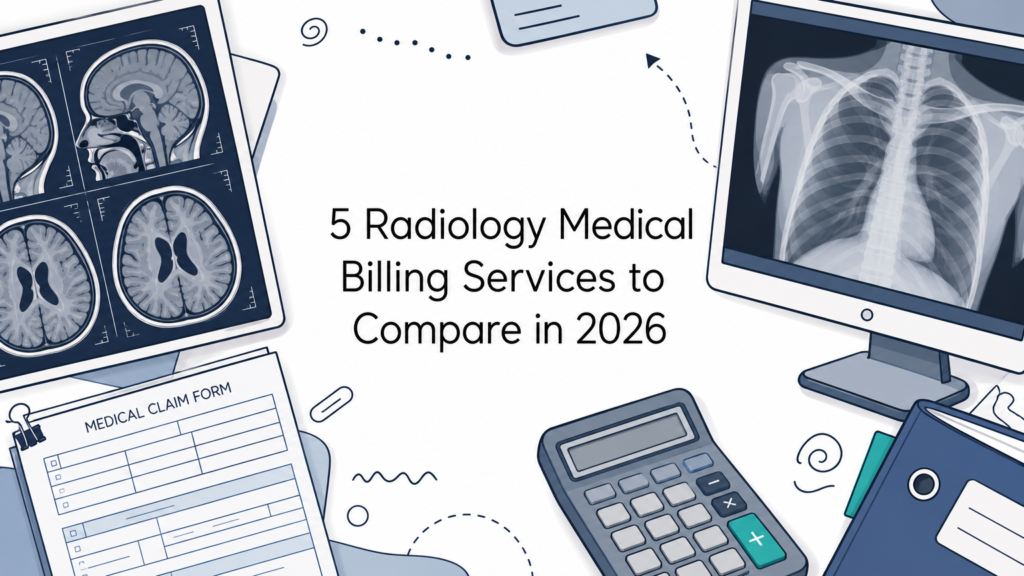
The best radiology medical billing services combine radiology-specific coding skill with clear reporting and fair pricing. That means correct handling of professional and technical component splits, modifiers 26 and TC, and authorizations for advanced imaging. InfiniteRCM suits independent and mid-sized imaging practices that want a remote team and transparent fees. Zotec Partners and R1 RCM suit large radiology groups and hospital departments. athenahealth fits multi-location practices, and CollaborateMD suits groups that want billing software to keep the work in-house.
Imaging billing punishes small mistakes. One missing modifier turns a paid claim into a denial, and a split between the radiologist and the facility can leave revenue unbilled for months. Hiring the wrong company makes this worse, because you often see the damage only when AR days start to climb.
This article compares five options one by one, using the same two questions: what each company offers, and who it suits and what to check before you sign. It then gives you a side-by-side table, the radiology details to screen for, and a fee example. We list our own company first. We describe the others from their public materials, so confirm details directly with each vendor.
1. InfiniteRCM
What it offers
InfiniteRCM is a remote, cloud-based revenue cycle management company that covers billing from eligibility verification to payment posting. Claims go out electronically through secure clearinghouses, and most are submitted within 24 to 48 hours after charge entry. The company reports a 99% clean claim rate, 40% faster collections, 60% fewer denials and a 100% compliance rate.

- Revenue cycle management: eligibility checks, clean claims, payment posting, denial management and performance reporting
- AR recovery: unpaid claims, underpayments, denied claims and insurance appeals
- Prior authorization: requirement checks, clinical documents, submission, payer follow-up and status tracking
- Credentialing and enrollment, plus medical virtual assistants for scheduling and insurance verification
Who it suits and what to check
Independent practices and mid-sized groups fit best. InfiniteRCM has served 500+ healthcare providers over more than 10 years and says it has recovered over $50M in revenue for clients. It works inside your existing EHR or practice management system, so you buy no software, and a dedicated account manager is your day-to-day contact. Onboarding takes a few days to a few weeks, depending on setup complexity.
Put the denial claim into your own numbers. Suppose your group sends 2,000 claims a month and 10% are denied, which is 200 denials. A 60% reduction leaves 80, so your staff rework and appeal 120 fewer claims each month. Ask any vendor, this one included, to measure your baseline first.
InfiniteRCM supports specialty practices, so test the fit for radiology on a call. Ask who will code your studies, how they handle 26 and TC splits, and how they run authorizations for MRI and CT. Pricing is transparent with no hidden fees, and a monthly contract needs 30 days written notice to cancel, which keeps a trial low-risk.
Pick a partner that works inside your current systems and shows you a measurable denial baseline before you commit.
2. Zotec Partners
What it offers
Zotec Partners is a well-established radiology billing and revenue cycle company that serves radiology groups across the United States. Its public materials point to a radiology-first approach rather than a general medical billing offer.
- Radiology-focused billing expertise
- Advanced analytics tools
- Automated billing workflows
- Revenue optimization support
Who it suits and what to check
Large radiology organizations are the natural match. A group with many radiologists and high study volume gets the most from specialized analytics and dedicated radiology workflows. If you run a small practice, ask whether you get the same attention and how pricing works at lower volumes.
Before you sign, request sample reports so you can judge the analytics yourself. Also ask who your day-to-day contact will be and how often you will review performance with them. Radiology depth is the strength here, so ask for radiology-specific denial and collection figures instead of company-wide averages.
Choose Zotec when your group is big enough to use radiology-only expertise and analytics every month.
3. R1 RCM
What it offers
R1 RCM provides enterprise-level billing and revenue cycle services for hospitals and large radiology groups. It stresses integration with hospital and health system operations and a scalable service model.
- Enterprise billing infrastructure
- Automation and analytics tools
- Hospital and health system integration
- Scalable billing services
Who it suits and what to check
Hospital-based radiology departments are the best fit. If your imaging billing has to connect with a health system’s wider revenue cycle, an enterprise vendor reduces handoffs between departments. A freestanding imaging center or a small group may find the model larger than it needs.
Ask how your radiology data would sit inside the wider billing operation, and whether your group gets its own reporting. Ask how denials on professional claims are tracked separately from facility claims. Scale cuts both ways, so confirm that a mid-sized account still gets named staff who know your payers.
Choose R1 RCM when radiology is one department inside a larger health system, not a standalone practice.
4. athenahealth
What it offers
athenahealth is a major healthcare revenue cycle provider in the United States. Its materials describe automated claims processing, denial management tools and revenue performance benchmarking, backed by wide payer network connectivity.
- Extensive payer network connectivity
- Automated claims processing
- Denial management tools
- Performance benchmarking
Who it suits and what to check
Multi-location radiology practices benefit most. When several sites bill under one organization, consistent workflows and benchmarking help you see which location underperforms. Connectivity to many payers also helps with claim submission and status checks.
Ask whether the service requires you to move onto athenahealth’s own platform, and what that migration involves. Then press on radiology: how are professional and technical components billed, and who reviews modifier use? A general platform needs proof of radiology skill, so ask for references from imaging practices.
Choose athenahealth when you run several locations and want benchmarking across them.
5. CollaborateMD
What it offers
CollaborateMD is medical billing software from a company with more than 20 years in business, not a fully outsourced service. Its radiology material lists automated coding tools, built-in claim scrubbing and real-time claims tracking, plus electronic submission, automated payment posting and real-time eligibility verification.
- Automated coding assistance
- Built-in claim scrubbing
- Real-time claims tracking
- EHR integration and reporting tools
Who it suits and what to check
Practices with their own billers fit best. If you want control over daily claim work and only need better tools for your team, software can cost less than a full outsourced service. Scrubbing flags inconsistencies before claims reach the payer, which lowers the odds of a denial.
The tradeoff is labor. Your staff still code, follow up on denials and chase underpayments, so price the software against the salaries and the revenue you may miss. Ask how the scrubber handles 26 and TC modifiers. Software cannot fix a coding gap on your team, so check your own radiology skills first.
Choose CollaborateMD when you want to keep billing in-house and need stronger tools, not more hands.
How to choose a radiology billing company
What radiology billing demands from a partner
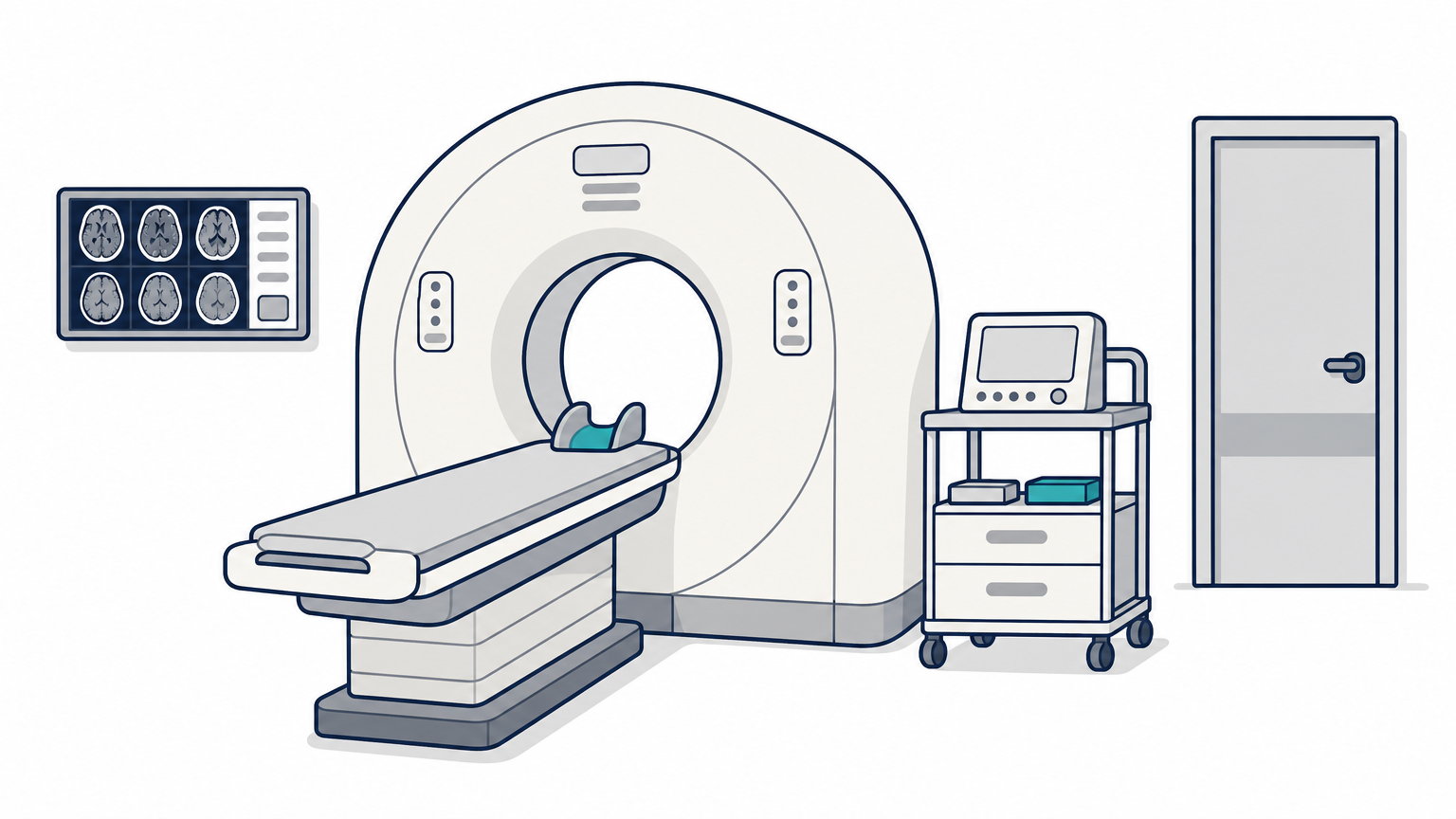
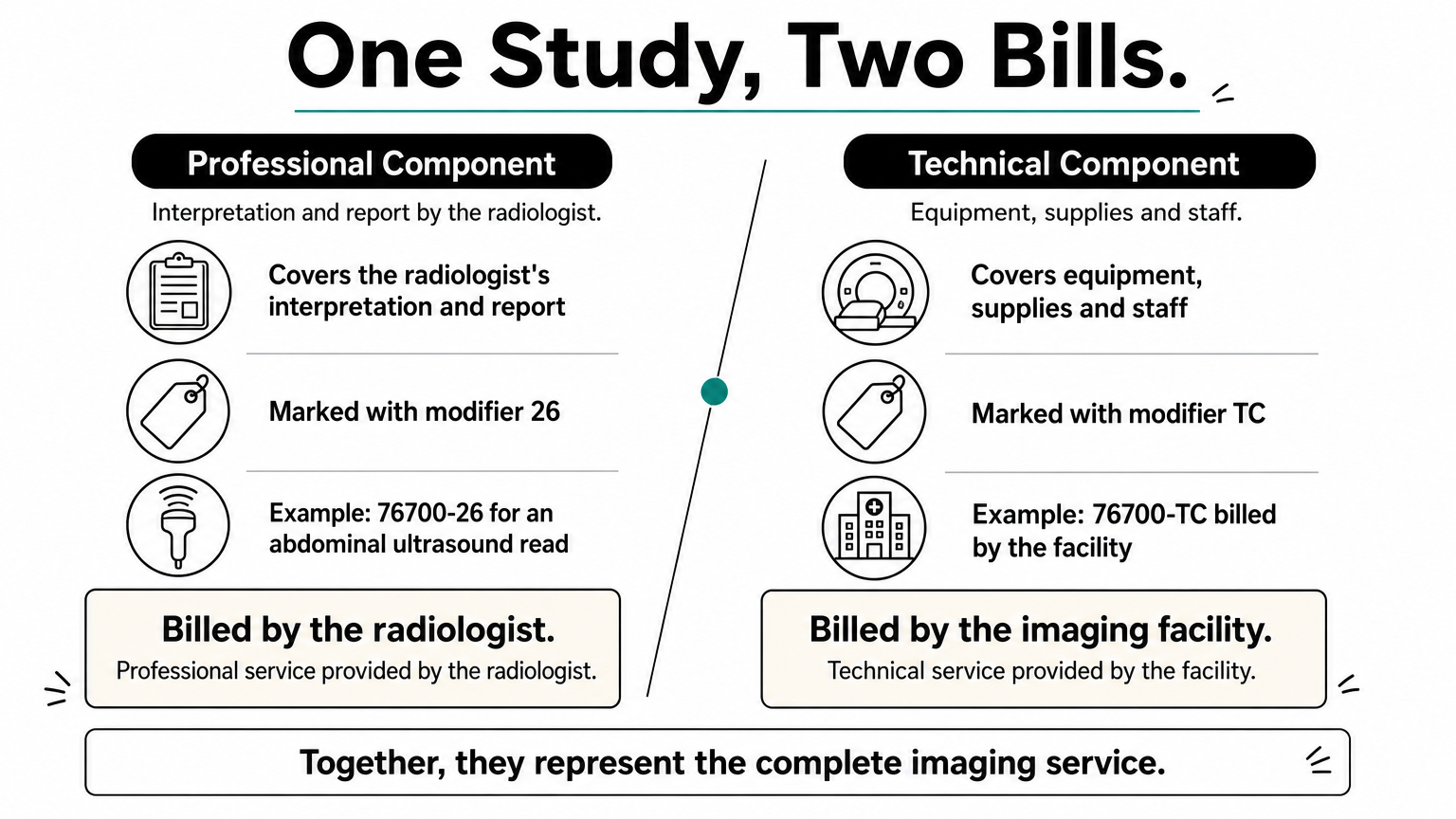
Radiology bills in two parts, and your partner must handle both. The professional component covers the radiologist’s interpretation and report. The technical component covers equipment, supplies and staff. Modifier 26 marks the professional part and TC the technical part. For example, an abdominal ultrasound (CPT 76700) billed by a radiologist reading the study is 76700-26, while the facility bills 76700-TC. This split is also why patients often get separate bills from the radiologist and the imaging facility. Diagnostic radiology codes sit in the 70000 to 79999 CPT range.
Three more checks separate radiology specialists from generalists. First, advanced imaging such as MRI, CT and PET often needs prior authorization, so ask who verifies requirements and tracks status. Second, each study needs an ICD-10 diagnosis that supports medical necessity. Third, timely filing deadlines matter: Medicare allows one calendar year from the date of service, and commercial payers often allow less. A partner that cannot explain these without notes is not ready for your volume.
Side-by-side comparison
The table puts the five options in one view. Features come from each company’s public descriptions, so verify them before you decide.
| Company | Model | Best fit | Features named |
|---|---|---|---|
| InfiniteRCM | Outsourced, remote RCM | Solo to large practices keeping their own EHR | 24 to 48 hour claim submission, AR recovery, prior authorization |
| Zotec Partners | Radiology-focused RCM | Large radiology groups | Radiology expertise, analytics, automation |
| R1 RCM | Enterprise RCM | Hospital departments, large groups | Health system integration, scalability |
| athenahealth | RCM provider and platform | Multi-location practices | Payer connectivity, denial tools, benchmarking |
| CollaborateMD | Billing software | Practices with in-house billers | Claim scrubbing, claim tracking, eligibility checks |
Fees and questions to ask
Fee models vary. Many billing companies charge a percentage of collections, and others charge a flat monthly fee or a per-claim rate. Compare them on total cost, not headline rate. At a hypothetical 5% rate, a practice collecting $200,000 a month pays $10,000. At 6% it pays $12,000, a $2,000 monthly gap and $24,000 a year. Ask what each rate includes, such as AR follow-up, appeals, authorizations and reporting.
Bring these questions to every call:
- How do you bill 26 and TC components, and who audits modifiers?
- What is your clean claim rate for radiology, and how do you measure it?
- Who handles authorizations for MRI, CT and PET?
- How often do I get reports, and can I export my data if I leave?
- What are the contract length, cancellation terms and any extra fees?
Judge every vendor on radiology-specific answers and total cost, not on general claims about clean claim rates.
Picking the right radiology billing partner
Every option here can work, but the fit differs. Large radiology groups and hospital departments lean toward Zotec Partners or R1 RCM. Multi-location practices should look at athenahealth, and teams that keep billing in-house can use CollaborateMD’s tools. Independent and mid-sized practices that want a remote team inside their existing systems should consider InfiniteRCM.
Whichever way you lean, test the same things. Ask how 26 and TC claims are billed, who handles imaging authorizations, and what your denial rate would look like against a measured baseline. Price the full service, not just the percentage.
If you want to see how that conversation would go for your practice, contact InfiniteRCM and ask for a review of your current claims, denials and authorization workflow.