The best orthopedics medical billing services employ coders who work orthopedic claims every day. They track 90-day global periods, apply modifiers correctly, document implants, and report collections by CPT code and payer. Our five picks fit different practices. InfiniteRCM suits practices that want full-cycle billing plus prior authorization and credentialing. Medical Billers and Coders fits multi-surgeon groups. Coronis Health suits large systems. CareCloud fits mid-size practices that want dashboards. AdvancedMD RCM suits practices already on that platform.
Orthopedic billing punishes small mistakes. A missed modifier 24 on a post-operative visit, a bundled arthroscopy code, or a missing implant invoice can turn a high-value surgical claim into a denial that nobody notices for 60 days. Generalist billers often treat these details as the practice’s problem, and that is how revenue leaks.
InfiniteRCM is our own service, so it comes first, and we hold it to the same test as the others. Each pick covers what it offers, who it suits, and where you should push for answers. A final section gives you a side-by-side table, cost math, and the questions to ask before you sign. Details about other companies come from their public descriptions, so confirm them in writing.
1. InfiniteRCM
What it offers
InfiniteRCM runs full-cycle billing for specialty practices, orthopedics included. That covers eligibility verification, clean claim submission, payment posting, denial management, and financial reporting. The work is fully remote and cloud-based. It runs inside your existing EHR and practice management system, so you buy no software. Most claims go out within 24 to 48 hours of charge entry.
The service goes beyond billing, and several add-ons matter for a surgical practice:
- AR recovery for unpaid claims, underpayments, denials, and insurance appeals.
- Prior authorization covering requirement checks, clinical document collection, submission, payer follow-up, and status tracking.
- Credentialing and enrollment, including CAQH profiles and NPI support for new surgeons and providers.
- Medical virtual assistants for scheduling, insurance verification, and daily administrative work.
InfiniteRCM reports a 99% clean claim rate, 40% faster collections, and 60% fewer denials. It has served 500+ providers and recovered over $50M for clients. Treat these as company-reported figures. Ask to see results from orthopedic accounts specifically.
A billing partner earns its fee on orthopedic details: global periods, modifiers, implants, and authorizations.
Who it suits and what to check
This fits independent orthopedic practices and small to mid-size groups that want one vendor for billing, old AR cleanup, authorizations, and credentialing. You get a dedicated account manager, a HIPAA certified team, and support responses within 24 business hours. Onboarding takes a few days to a few weeks, and a monthly contract ends with 30 days of written notice.
InfiniteRCM serves many specialties and is not orthopedics-only. So ask which coders will touch your claims, how they track global periods, and how they handle implant invoices. Pricing is described as transparent with no hidden fees. Request a written quote that names every service included.
2. Medical Billers and Coders (MBC)
What it offers
MBC positions its orthopedic line around subspecialty-certified coders who work orthopedic claim mixes rather than rotating across specialties. It describes global period tracking as a standard service, with modifier requirements flagged at charge entry instead of after a denial.
- Modifier handling for multi-procedure cases, including 50, 51, 59, 78, and 79.
- An implant documentation check before claim submission.
- Claim scrubbing against payer-specific orthopedic rules.
- A reported net collection rate (NCR) above 97% for orthopedic groups.
The NCR figure is MBC’s own claim, so verify it. A fair test is to ask for the number against MGMA group benchmarks, not against the vendor’s internal averages.
A self-reported collection rate means little until it is measured against an independent benchmark.
Who it suits and what to check
MBC aims at multi-surgeon groups, private-equity-backed networks, and spine and joint replacement centers with high surgical volume. If your group handles complex procedures and wants detailed financial reporting, this is a serious option to price.
A solo surgeon or a two-provider clinic should ask whether the scope and fees fit a smaller volume. Also ask for orthopedic client references, and confirm in writing that global period tracking is included in the base fee rather than sold as an add-on.
3. Coronis Health
What it offers
Coronis Health is a large, multi-specialty revenue cycle company that lists orthopedics among its specialties. Its published services cover insurance eligibility verification, demographic entry, coding, timely claim submission, and reprocessing of denied claims. It also advertises financial KPI reports and a free financial checkup for new prospects.
Its public guidance on orthopedic billing focuses on common errors. Examples include unbundling knee procedure codes and using the wrong code family for prefabricated braces. That shows awareness of the specialty’s pitfalls, but it is not proof of dedicated orthopedic coders.
Breadth of services is not the same as depth in orthopedic coding.
Who it suits and what to check
Coronis suits large organizations and hospital systems that want one enterprise partner across several service lines. Orthopedic groups inside a bigger health network can benefit from that scale and its technology infrastructure.
Independent surgeon-owned groups should ask harder questions. How many of the coders assigned to you hold CPC or COC credentials with orthopedic experience? Will you have a named team or a shared pool? Some comparisons describe its model as generalist, so get the staffing answer in writing.
4. CareCloud
What it offers

CareCloud sells billing services with structured denial management workflows and live reporting dashboards. Administrators can watch claim activity in near real time instead of waiting for a monthly report. It reports a 90% collection rate and reductions in AR days, which are credible for practices with moderate procedure complexity.
- Defined denial follow-up workflows.
- Live dashboards for claims and AR.
- Financial reporting for practice administrators.
That visibility helps if your current problem is not knowing why claims stall. Dashboards do not fix coding, though, so the quality of the coding behind them is the real question.
Dashboards show you where revenue leaks, but only good coding stops the leak.
Who it suits and what to check
CareCloud fits mid-size orthopedic practices with a mostly clinic-based mix of visits, injections, and fracture care. It is a reasonable pick if your administrator wants structure and reporting more than hands-on specialty coding.
Groups doing revision arthroplasty, complex spine, or heavy trauma should test it. Ask how it codes high-acuity surgical cases and what its denial rate is on 27447, 27130, and 22551. A generalist model can struggle there, and you want numbers, not assurances.
5. AdvancedMD RCM
What it offers
AdvancedMD RCM is a billing service built as an extension of the AdvancedMD practice management platform. Scheduling, documentation, and billing sit in one system, which cuts data hand-offs and claim submission friction. For a practice already on the platform, that integration is its main selling point.
The thing to confirm is coding. Some reviews report that coding stays with the practice rather than being done by AdvancedMD staff. If so, you keep certified coders on payroll and split the revenue cycle between two owners.
A split revenue cycle makes it hard to say whether a denial was a coding error or a billing error.
Who it suits and what to check
This suits orthopedic practices already using AdvancedMD that employ strong in-house coders and mainly want help with claim submission and AR follow-up. Switching systems just to use its billing service rarely makes sense.
Before signing, ask who owns the denial when a claim fails, who applies modifiers, and who handles global period tracking. Get the division of work in the contract, so that accountability does not blur when a six-figure AR bucket ages past 90 days.
How to compare orthopedic billing services before you sign
Side-by-side summary
Use this table as a starting filter, then verify each cell with the vendor directly.
| Provider | Best for | Orthopedic focus | Ask about |
|---|---|---|---|
| InfiniteRCM | Independent and small to mid-size groups wanting billing, authorizations, and credentialing | Multi-specialty, serves orthopedics | Coder assignment, orthopedic results |
| Medical Billers and Coders | Multi-surgeon and PE-backed groups | Orthopedic-specific coders | Benchmarked NCR, fees for small practices |
| Coronis Health | Large systems | Orthopedics within multi-specialty | Coder credentials, dedicated team |
| CareCloud | Mid-size practices wanting dashboards | General multi-specialty | Complex surgical coding |
| AdvancedMD RCM | Existing AdvancedMD users | Platform-dependent | Who does the coding |
What it costs
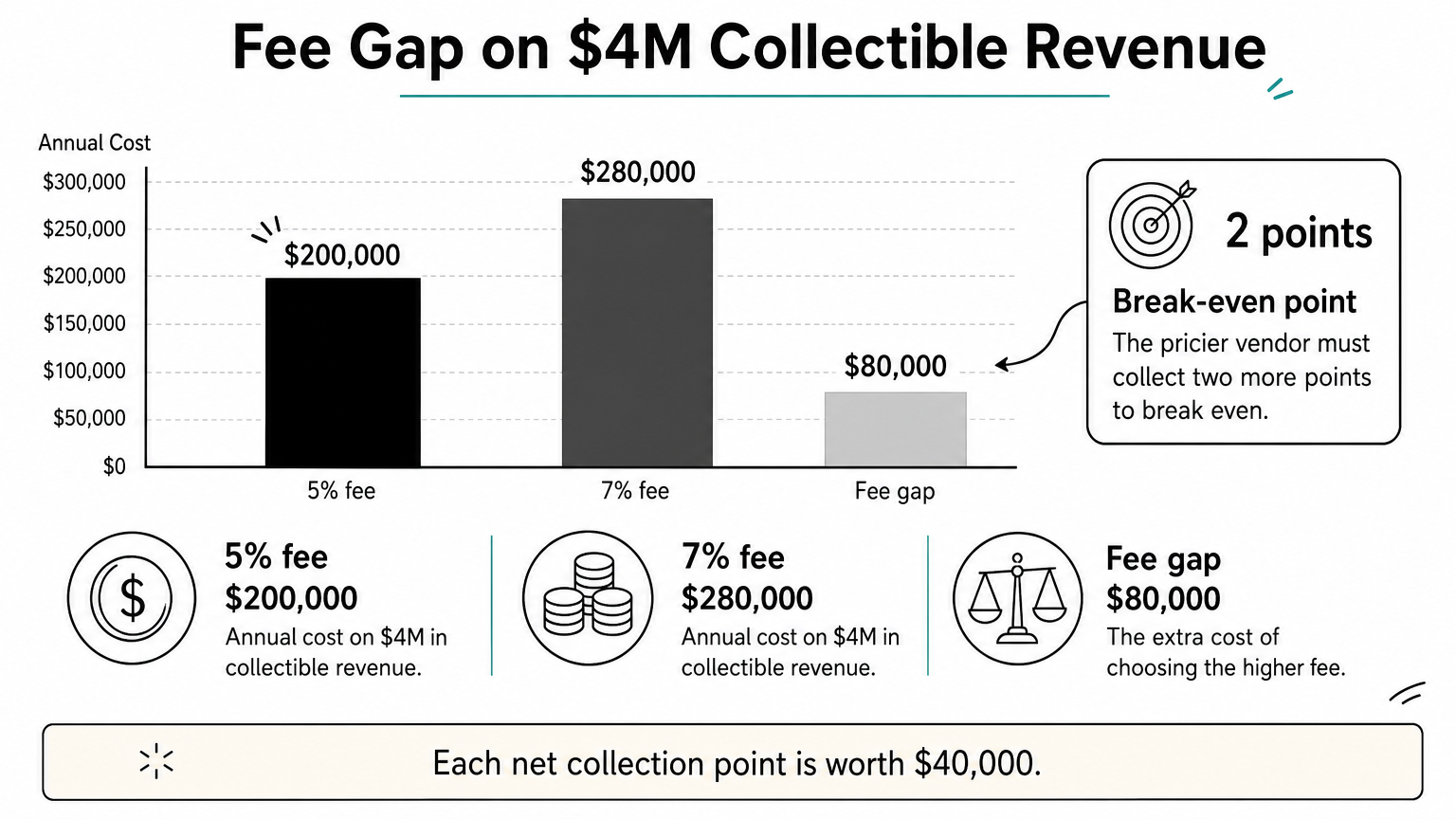
Most orthopedic medical billing services charge a percentage of collections, and commonly quoted rates run from roughly 4% to 9%, depending on volume, surgical mix, and scope. Do not pick on the fee alone. Take a practice with $4M in annual collectible revenue. A 5% fee costs $200,000 and a 7% fee costs $280,000, a gap of $80,000. Each net collection point is worth $40,000, so the pricier vendor must deliver two more points just to break even.
Questions to ask every vendor
Ask these before any contract, and expect specific answers:
- What share of your coders hold CPC or COC credentials with orthopedic experience?
- What are your denial rates on codes such as 27447 (total knee), 27130 (total hip), 22551 (cervical fusion), 29881 (knee arthroscopy), and 20610 (joint injection)?
- Do you track 90-day and 10-day global periods and flag modifiers 24, 25, 57, 58, 78, and 79 at charge entry?
- How do you verify implant invoices and manage prior authorizations?
- Which reports do I get monthly, and can I see denials by CPT code and by payer?
- What is the exit process, notice period, and who keeps working existing AR?
Specific answers on codes and global periods separate orthopedic specialists from generalists with a good brochure.
Choosing your orthopedic billing partner
The right orthopedic billing partner proves depth in the details that decide your collections: global periods, modifiers, implants, and authorizations. Large systems and multi-surgeon groups may lean toward enterprise or specialist-only vendors. Independent practices that want one team across billing, AR recovery, authorizations, and credentialing should look hard at InfiniteRCM. Whoever you shortlist, get answers in writing and test them against benchmarks, not promises.
If you want to see how that would work for your practice, contact InfiniteRCM about your orthopedic billing. Bring your current denial rate and AR aging report.